Exercise is medicine.
I really mean that. Every time we move our bodies, every time we pick up a dumbbell and work a little harder than we did last week, we are doing something genuinely powerful for our health. The more we move, the better we feel. The less we move, the faster our bodies age. So what you are doing right now, choosing to work out, choosing to build strength after 50, is exactly right.
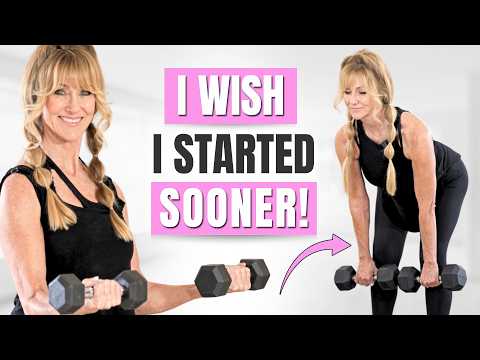
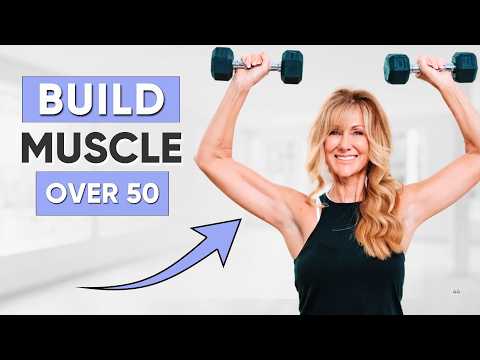
This is a 30-minute full-body workout to build muscle, created for us. It has a warmup, one circuit that we complete three times, and a cooldown, and it hits the entire body in a structured, intentional sequence. You will need dumbbells, and the goal is to lift a little bit more than you think you can.
If you can comfortably do eight reps and feel like you could easily do many more, that is the signal to add a little more weight. That is how we achieve progressive overload. That is how we build muscle. That is how we get really strong. Let’s get started.
Why Is Strength Training So Important for Women Over 50?
After 50, something happens in the body that many of us are not warned about. We begin to lose muscle mass at a rate of 1 to 2 percent per year if we are not actively working against it. This is called sarcopenia, and for women it is especially significant because the hormonal changes of menopause, particularly the drop in oestrogen, accelerate the process.
Research published in Frontiers in Public Health in 2026 found that resistance training significantly improved handgrip strength, gait speed, knee extension strength, and overall physical function in older women with sarcopenia. A 2025 study from the Journal of Clinical Medicine confirmed that sarcopenia is more common in women than in men, particularly after menopause, and that the effects compound significantly with age.
The practical reality is this: when we lose muscle, the body replaces it with fat. Weaker muscles mean slower metabolism, reduced bone density, poorer balance, and a higher risk of falls and fractures. But strength training, a consistent workout to build muscle like the one we are doing today, can stop that process and even reverse it.
UT Southwestern Medical Center puts it plainly: strength training is the only activity proven to slow the progression of sarcopenia. Resistance training, with intention, and with progressive overload over time.
READ ALSO: The Ultimate Strength Training Blueprint For Women Over 50
What Is Progressive Overload and Why Does It Matter?
Progressive overload is the idea behind this entire workout. It simply means that we gradually increase the challenge we place on our muscles over time, whether that is through heavier weights, more repetitions, or more rounds. The muscle responds to stress by rebuilding itself stronger. Without that increasing challenge, the muscle has no reason to grow.
For women over 50, this concept is not just for athletes. It is the practical mechanism behind getting stronger, building tone, and protecting the body from the effects of ageing. In today’s workout, we complete the full circuit three times. We use the first round to check our form and settle into the movements. By the third round, we want to feel that the weight is genuinely challenging. If it is not, we go heavier.
Think of this workout to build muscle as a conversation with your body. The weight is the question. The strength you build over weeks and months is the answer.
READ ALSO: How to Build Muscle and Get Stronger Over 50
The 30-Minute Full Body Dumbbell Workout: Every Exercise Explained
We have a warmup to begin, then one circuit that we move through three times, and a three-minute cooldown to close. Each round of the circuit hits a different muscle group, and together they add up to a complete, efficient strength session. Here is exactly what we are doing.
The Warmup: Prepare the Body for Strength Work
We begin with a gentle warmup that follows along with the video. The warmup is not optional, especially for women over 50. It raises the heart rate gradually, increases circulation to the muscles, and reduces injury risk. Cold muscles and sudden heavy lifting are a combination we want to avoid. Take these few minutes seriously and move with intention.
The Circuit: Complete This Three Times
The circuit below is one round. We complete it three times in total. Rest between rounds as needed, but try to keep the rest brief so the heart rate stays elevated and the muscles stay warm.
1. Bicep Curls
Stand tall with a dumbbell in each hand and curl the weights up to shoulder height, then lower back down with control. Keep the movement smooth and avoid swinging.
Bicep curls are a classic starting point in any workout to build muscle, and they earn their place here. The biceps are the visible muscles at the front of the upper arm, and building them not only creates definition but also supports functional strength for carrying, lifting, and pulling in everyday life. Keep the elbows steady at your sides and let the biceps do all the work.
2. Shoulder Punches
With light dumbbells in hand, punch the arms forward alternately in a controlled, rhythmic motion. Keep the core engaged and the movement purposeful.
Punching with dumbbells brings a cardio element into our strength circuit without interrupting the flow of the workout. The shoulder muscles, particularly the anterior deltoid, are engaged with every forward punch. This movement also activates the core, which has to stabilise the body against the rotational force of alternating arms. A simple exercise with a big cumulative effect.
3. Arm Pulses
Hold the dumbbells at shoulder height or below and pulse the arms in small, controlled movements. The range of motion is short but the effort should feel real.
Pulses are an underestimated addition to any strength session. They work the muscles in a state of constant tension, which is one of the most effective ways to build muscular endurance and improve tone. The burn we feel during a pulse sequence is the muscle under sustained load, exactly the kind of stimulus that encourages growth and strength adaptation over time. Embrace that feeling.
4. Romanian Deadlift
Take your feet hip-width apart with toes facing forward. Hinge forward from the hips with soft knees, sliding the dumbbells down your legs until you feel the hamstrings load. Then, with a flat back, drive your hips through and stand tall.
The Romanian deadlift is one of the most important exercises in any full body strength training workout for women over 50. It targets the hamstrings and glutes directly, which are two of the largest muscle groups in the body. Working large muscle groups in our strength sessions means we are burning more energy, building more metabolically active tissue, and protecting the hips and lower back that support us in everything we do. The hinge pattern also teaches the body to move safely from the hips rather than the lower back, which is a skill worth practising for life.
5. Tricep Pushbacks
Hinge at the hips with a flat back and palms facing up. Exhale as you pull the weights back toward the ribs, squeezing the shoulder blades. Then inhale as you lower. Keep the core held in tight, the spine straight, and the elbows close to the body.
The back of the arms is one of the areas many women over 50 feel most self-conscious about, and this movement addresses it directly. Tricep pushbacks in a hinged position work the triceps against gravity in their full range of motion, which is more effective than many seated variations. The simultaneous engagement of the upper back muscles also means we are improving posture with every rep. A beautiful two-for-one exercise.
6. Cross-Body Reaches
With control, reach across the body in a sweeping motion, rotating from the torso. Move with intention and keep the core switched on throughout.
Cross-body movements bring rotational strength and spinal mobility into the workout, two qualities that decline quickly without regular practice after 50. The obliques, the muscles along the sides of the abdomen, are the primary drivers of rotation, and keeping them strong supports a healthy lower back and a more defined waistline. This is also a moment in the circuit to breathe and feel the body moving as a whole.
7. Shoulder Raises
Lift the dumbbells to shoulder height. Then turn to the left, back to centre, and then to the right. Keep control on the way down and avoid swinging. The core stays held in tight throughout.
Lateral shoulder raises are one of the most effective dumbbell exercises for building the medial deltoid, the part of the shoulder that creates the rounded, toned silhouette we often want after 50. The rotational element in this variation adds a coordination challenge and ensures both the front and side of the shoulder are being worked. Keep the movement controlled and resist the urge to let gravity do the work on the way down.
8. Front Raises
With straight arms and palms facing in front of you, raise the dumbbells to shoulder height, squeezing the chest muscles at the top. Then lower back down with control. The goal is to avoid swinging.
Front raises primarily target the anterior deltoid and the upper chest, areas that contribute to a strong, open posture. Many of us carry tension and rounded shoulders from years of desk work or hunching, and strengthening the muscles through the front of the shoulder and chest directly counteracts that. Keep the movement slow and controlled: slow lifting means the muscles are working harder for longer, which increases the training effect.
9. Arm Circles
With arms extended at shoulder height, make controlled circles in both directions. Keep the movement smooth and the shoulders relaxed away from the ears.
Shoulder mobility is one of the most overlooked elements of strength training for women over 50. The shoulder joint has the greatest range of motion of any joint in the body, which also makes it the most vulnerable to stiffness and injury when not regularly moved through its full range. Arm circles keep the joint fluid, reduce the risk of impingement, and complement the heavier loaded exercises we have been doing. After several rounds of dumbbell work, this movement feels wonderful.
10. Overhead Tricep Extension
Bend the elbows to lower the dumbbell behind the head. Then press it back up, keeping the elbows steady and the arms close to the ears. The movement should be smooth.
The overhead tricep extension works the long head of the tricep muscle, which is the largest portion and the one responsible for most of the arm’s shape from behind. Because the arms are raised overhead, the long head is stretched under load, which creates a deeper and more complete training stimulus than pushdowns or kickbacks alone. Keep the core braced throughout so the lower back does not arch under the load.
11. Goblet Curl
Hold the dumbbell with both hands and curl it up to chin height. Then lower all the way back down to the legs with control. The goblet curl locks the elbows in, so the biceps are doing all of the work.
The goblet curl is a focused bicep exercise that removes the ability to cheat the movement. Because both hands hold one weight and the elbows are fixed, the biceps have no help from momentum or gravity. This isolation is exactly what we need to finish the arm work in this circuit with real intensity. We are almost at the end of the round. Give it everything.
12. Lateral Squat Walk
Lower into a half squat and in this position take two steps to the right, then two to the left. Keep the hips low, the core tight, and the movement smooth throughout.
We finish each round of the circuit with lateral squat walks, and this exercise is doing more than it looks like. The sustained half-squat position loads the quads, glutes, and inner thighs simultaneously, while the lateral movement activates the hip abductors, the muscles on the outer hip that are critical for knee stability and fall prevention. Staying low for the entire set is the challenge. The lower the hips, the more the muscles are working.
EXPLORE MORE: A 30-Minute Full Body Menopause Dumbbell Strength Workout
The Cooldown: Three Minutes to Stretch, Recover, and Celebrate
After three rounds of that circuit, we spend the final three minutes stretching out the body and cooling down together. This is not just a nice extra: the cooldown helps reduce post-workout soreness, gradually lowers the heart rate, and gives the muscles a chance to begin their recovery. Follow along with the stretches shown in the video and let the body settle.
And here is something I want you to hold onto as you stretch: today is the youngest you will ever be again. Every day from here is a fresh opportunity to be stronger, more capable, more alive in this body. So enjoy it. Embrace it. Become it.
EXPLORE MORE: 20-Minute Strength Training Workout for Women Over 50
Final Thoughts
Thirty minutes. One circuit, three rounds, a warmup and a cooldown, and every major muscle group worked.
This workout to build muscle is one of the most important things we can do for our bodies after 50. Not because of aesthetics, though feeling toned and strong in our bodies is genuinely wonderful. Because of what muscle means for the long game: bone density, metabolic health, balance, independence, and the kind of physical capability that keeps us doing the things we love well into our 60s, 70s, and beyond.
We are not getting older in the direction we fear. We are getting stronger on purpose.
Let me know in the comments below if you feel proud of yourself today. You should.