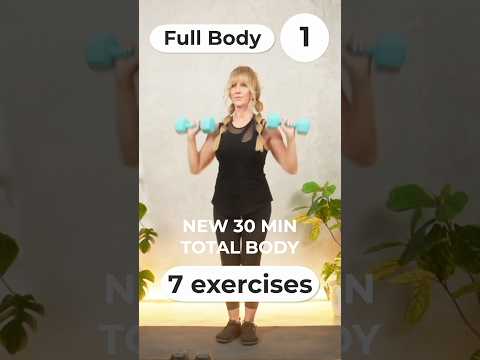
Most strength workouts ask nothing of your mind. You pick up the weights, you count the reps, and your thoughts drift somewhere else entirely. This dumbbell workout for brain and body is built a little differently.
Seven exercises, three rounds, and one move that will genuinely confuse you at first. That confusion is the point, and I will explain why shortly. Strength training over 50 starts exactly where you are, not where you wish you were.
From there we build, patiently, over months rather than weeks. Nothing here is complicated, though your legs will disagree by round three. Grab a pair of dumbbells and about thirty minutes’ worth of time.
Train along with me here: 30 Minute Full Body Dumbbell Workout for Women Over 50
Why Should a Strength Workout Involve Your Brain?
Muscle is only half of what we lose as the years pass. Coordination fades too, along with the speed at which we process what we see. Those are the skills that keep you steady on a dark staircase. They are also the ones nobody trains, because they are invisible until they fail.
Reaction time slows quietly, long before anyone notices it. Balance is governed by the brain as much as the legs. Both systems are strengthened by the same session here.
Most exercises let your body run on autopilot. Both sides do the same thing, so your brain stops paying close attention. Ask each side to do something different and everything changes. Your brain is forced to coordinate two jobs at once.
This dumbbell workout for brain and body slips exactly that demand into a normal strength session.
READ ALSO: 10 Engaging Activities to Keep Your Brain Sharp In Your 50s
What Are the Seven Exercises?
We run seven exercises three times through. Rest whenever you need to, because form matters far more than pace.
Start with the biggest movement
Come down into a squat, then press through your heels as you raise the dumbbells overhead. Your inner thighs and glutes work on the way down. Your legs, shoulders and arms take over as you press up. Keep your core engaged and your breathing steady. This one movement covers more muscle than any other in the set.
Four moves for your upper body
Start with the chest front raise, arms straight and palms facing forward. Raise the dumbbells to shoulder height, squeeze your chest, then lower with control. Avoid swinging, because momentum steals the work from your muscles. Your shoulders will feel this quickly.
Lateral raises come next. Lift your arms out to the sides until they reach shoulder height, pause, and then lower smoothly. Keep a soft bend in your elbows. Two kilos will feel heavier than you expect on this one.
For the underhand row, hinge at the hips with a flat back and palms facing up. Exhale as you pull the weights to your ribs, squeezing your shoulder blades together. Inhale as you lower, keeping your elbows close and your spine straight. Rows are the antidote to a life spent leaning forward.
Finish the block with hammer curls. Palms face inwards, elbows stay locked by your sides, and the dumbbells travel to shoulder height. Lower steadily rather than letting them drop.
One move for the backs of your arms
Hinge at the hips again with your elbows tucked in close. Straighten your arms back behind you, squeezing the tricep hard at the top. Bend the elbows to return, keeping your back flat throughout. Keep the elbows still, because they love to drift outwards.
The move that asks your brain to work
Here is the one I promised you. Rise onto the ball of one foot, letting your weight shift forward, with the other foot flat for balance. Hold a dumbbell in the opposite hand and raise it to shoulder height. Notice how your body adjusts itself to keep you stable.
Each side of your body is given a different job to do. Your brain and body are asked to work together more efficiently than usual. Strength, balance and coordination are trained in a single movement. That is the whole idea behind this dumbbell workout for brain and body.
EXPLORE MORE: 30-Minute Full Body Dumbbell Workout for Muscle Growth
How Do You Choose the Right Weight?
Choose a pair that feels challenging while still allowing good form. That last part is the bit most of us get wrong. A weight that wrecks your form is simply too heavy. Master your technique first before you even think about going heavier. Good technique is built before load, never the other way around.
Once the weight feels comfortable, add a little more. Your muscles adapt to what they already know, so they need fresh challenges. Progress is measured in months here, not days. A dumbbell workout for brain and body only works if you keep raising the bar gently.
READ ALSO: The Ultimate Strength Training Blueprint For Women Over 50
What Does the Research Say About Strength and the Brain?
The strength side of this rests on solid evidence. The evidence has been gathered mostly in adults over sixty. A 2025 meta-analysis of randomized trials found resistance training improved overall cognition in older adults. Working memory and verbal learning both improved measurably.
A separate network meta-analysis compared five exercise types across fifty-eight trials. Resistance training showed the strongest effect on overall cognitive improvement.
The balance question is more nuanced, and I want to be straight about it. One 2025 trial compared strength training with added balance demands against ordinary strength training and balance training alone.
The combined version beat balance training on attention and processing speed. It did not significantly beat ordinary strength training. So the lifting appears to be doing most of the cognitive work. The coordination challenge adds practice at staying steady, which is worth having anyway.
How Often Should We Do This?
Two or three sessions a week is plenty for most of us. Leave a day between them because muscle rebuilds during rest rather than during the workout. Recovery matters as much as the lifting itself. Add a walk on your other days if you can.
Eat well afterwards, and give your body real protein to work with. Sleep does more for your results than any extra set would. Try this dumbbell workout for brain and body twice weekly for two months. Then look honestly at how much heavier you are lifting.
EXPLORE MORE: Walking for Brain Health, Why It Is the Best Exercise For Your Brain
Final Thoughts
Today’s session was never really about the next thirty minutes. It was about the next five, ten or fifteen years of your life. Every time you choose to move this way, you are investing in something.
Your strength, your fitness and your independence all sit on the same foundation. A dumbbell workout for brain and body protects the mind alongside the muscle.
This dumbbell workout for brain and body earns its place twice over. Thank your body for the gift of movement it still gives you. Then come back and do it again in a couple of days.
Frequently Asked Questions
Which dumbbell weight should I start with?
Pick a weight you can control for every repetition. The last two reps should feel hard but clean.
How long until I feel stronger?
Most women notice everyday tasks easing within four weeks. Visible muscle changes usually take two to three months.
Do I really need three rounds?
Two rounds still builds strength if time is short. Add the third once your fitness allows it.
Why is the calf raise done with the opposite arm?
Each side of your body is handling a different task. That combination challenges balance and coordination together.
Is this safe with joint pain?
Reduce the weight and shorten your range of movement first. Check with your doctor if pain persists.
Can I do this workout every day?
No, your muscles need rest days to rebuild. Two or three sessions a week works better.