What if working your core could do more than strengthen your stomach muscles?
A fascinating 2026 study has given scientists another reason to look at the connection between movement in the body and what happens inside the brain. Researchers found that abdominal muscle contractions were closely linked with movement of the brain in awake mice. Their modelling also suggested that these movements may help drive the movement of fluid through and around the brain.
Now, before you get too excited, there is an important detail: this was a mouse study, not a study in women over 50. We can’t say that doing abdominal exercises will improve your brain health or “flush” fluid through your brain.
But it does add to our understanding of just how connected movement, muscles and the brain really are.
And that gives us a great reason to get moving.
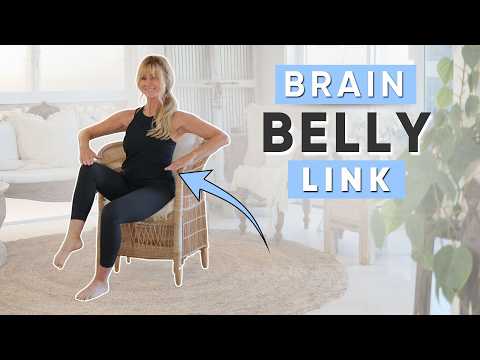
This seven-minute seated core workout for women over 50 is simple, requires very little space and can be adapted to your fitness level. You’ll work your abdominal muscles while also moving your arms and legs, challenging your coordination and practising movements that are useful in everyday life.
Start With Your Core
Before beginning the seated core workout for women over 50, let’s practise the most important part: engaging your core.
Sit tall in a sturdy chair with your feet comfortably on the floor. Gently draw your belly button in towards your spine.
You should still be able to breathe and talk.
That’s important.
Engaging your core does not mean sucking your stomach in as hard as possible or holding your breath. You want a gentle contraction that you can maintain while breathing normally.
Try holding it for a few seconds, then relax.
During the workout, you’ll return to this feeling whenever you can. If it becomes uncomfortable or tiring, simply relax your stomach and start again when you’re ready.
1. Seated Sit-to-Stands
We’re starting with a movement you probably do every day: getting out of a chair.
Sit towards the edge of your chair with your feet underneath you. Engage your core, lean forward slightly and push through your feet to stand.
Then slowly lower yourself back down.
Repeat at a comfortable pace.
This is much more than an abdominal exercise. Sit-to-stands work your legs and core while practising a movement that is important for maintaining independence as we get older.
If standing is difficult, you can make the movement smaller or use your hands for support.
2. Seated Punches
Now stay seated and bring your arms into the workout.
Sit tall with your shoulders relaxed and your core gently engaged. Punch one arm forward, then the other, keeping your movements controlled.
As you punch, resist the temptation to collapse through your torso.
Instead, keep your chest lifted and your stomach gently drawn in.
This combination of arm movement and core stability makes the exercise more challenging than it looks.
And because you’re moving your arms while keeping your trunk steady, you’re also asking your brain and body to coordinate the movement.
3. Cross-Body Knee Raises
Now we’re going to bring your arms and legs together.
Lift your left knee towards your right elbow. Lower it, then switch sides.
Move slowly at first.
The goal isn’t to get your knee as high as possible. Instead, focus on using your abdominal muscles to help lift the leg while keeping your upper body controlled.
This is a great addition to a seated core workout for women over 50 because you’re combining core strength with coordination.
If bringing your elbow and knee together feels too difficult, simply lift each knee while keeping your arms relaxed.
4. Seated Oblique Twists
Your obliques are the muscles along the sides of your abdomen, and now they’re getting their turn.
Move towards the edge of your chair and sit tall.
Gently rotate or reach towards one side, then return to the centre and repeat on the other side.
You can reach towards the floor if that feels comfortable, but don’t force the movement.
Think about moving from your torso rather than simply swinging your arms.
Breathe throughout the movement and keep your core gently engaged.
This exercise also introduces rotation, something we use when reaching for objects, looking behind us or turning during everyday activities.
5. Seated Runners
Now we’re going to increase the pace.
Lean slightly forward from your hips and extend one leg while driving your opposite arm forward. Then switch sides, creating a seated running motion.
You don’t have to move quickly.
In fact, starting slowly can make it easier to maintain good control.
This movement challenges your arms, legs and core at the same time while asking you to coordinate opposite sides of your body.
If you’re feeling energetic, gradually increase the pace. If you’re getting tired, slow it down.
There is no prize for going the fastest.
6. Power Sit-to-Stands
We’re finishing where we started, but this time we’re adding a little more power.
From your chair, stand up using your arms for momentum if needed. Then lower yourself back down with control.
The idea is to practise producing force during a familiar movement.
Power matters as we age because everyday life isn’t always slow and predictable. We need to be able to stand up, step over something, catch ourselves or react quickly.
If power sit-to-stands aren’t suitable for you, simply continue with regular sit-to-stands at your own pace.
What Does This Have to Do With Brain Health?
This is where the 2026 research becomes particularly interesting.
The researchers studying mice found that abdominal muscle activity preceded and closely correlated with brain movement during locomotion. Their models suggested that this mechanically driven brain movement could contribute to fluid movement through and out of brain tissue.
But this doesn’t mean that doing seven minutes of abdominal exercises has been proven to improve brain health.
What we can say is that the study adds another piece to our understanding of the relationship between the body and brain.
And we already know that physical activity is important for healthy ageing.
So rather than thinking of this workout as a special “brain flush”, think of it as another opportunity to move your body, strengthen your muscles and challenge your coordination.
That’s a much more useful takeaway.
A Simple Workout You Can Actually Do
One of the best things about a seated core workout for women over 50 is that you don’t need a gym or complicated equipment.
You need a sturdy chair, a few minutes and enough space to move your arms and legs safely.
You can also modify almost every movement.
Make the movements smaller. Slow down. Take a break. Use your hands for support when standing. Or skip an exercise that doesn’t feel right for your body.
The goal isn’t to push through pain.
The goal is to keep moving.
Seven Minutes Can Be a Great Start
Seven minutes may not sound like much, but it is seven minutes you could spend moving instead of sitting.
This seated core workout for women over 50 gives you a combination of core activation, functional strength, coordination and movement without requiring a long workout.
And once you’ve finished, you may find that you have more energy to keep going.
You could follow it with a walk, a strength workout, some mobility exercises or another workout from the Fabulous50s app.
Because ultimately, healthy ageing isn’t about finding one magical exercise.
It’s about building a lifestyle where movement is a regular part of your day.
So take seven minutes, sit tall, engage your core, breathe and get moving.
Your body and your brain are connected more closely than we sometimes realise.