It can feel confusing when your body suddenly starts changing and your cycle no longer behaves the way it used to. You might have hot flashes one month, then nothing the next. Your sleep might feel lighter, or your emotions may shift without warning.
And somewhere in the back of your mind you’re wondering, “Am I in perimenopause… or is this menopause?”
Knowing the difference makes everything easier. When you know exactly where you are in the menopause journey, you can support your body in a way that feels calm, confident, and compassionate.
So, let’s explore how to tell perimenopause or menopause, what symptoms belong to each stage, and the signs your body gives when it’s moving from one chapter to the next.
Key Takeaways: How to Tell Perimenopause or Menopause
Here’s how to tell perimenopause or menopause in simple steps:
- Perimenopause has irregular periods; menopause means no period for 12 months.
- Perimenopause has fluctuating hormones; menopause has steady low hormones.
- Symptoms in perimenopause come and go; after menopause they often stabilize.
- Menopause is one day on the timeline, and postmenopause comes right after.
What’s the Main Difference Between Perimenopause and Menopause?

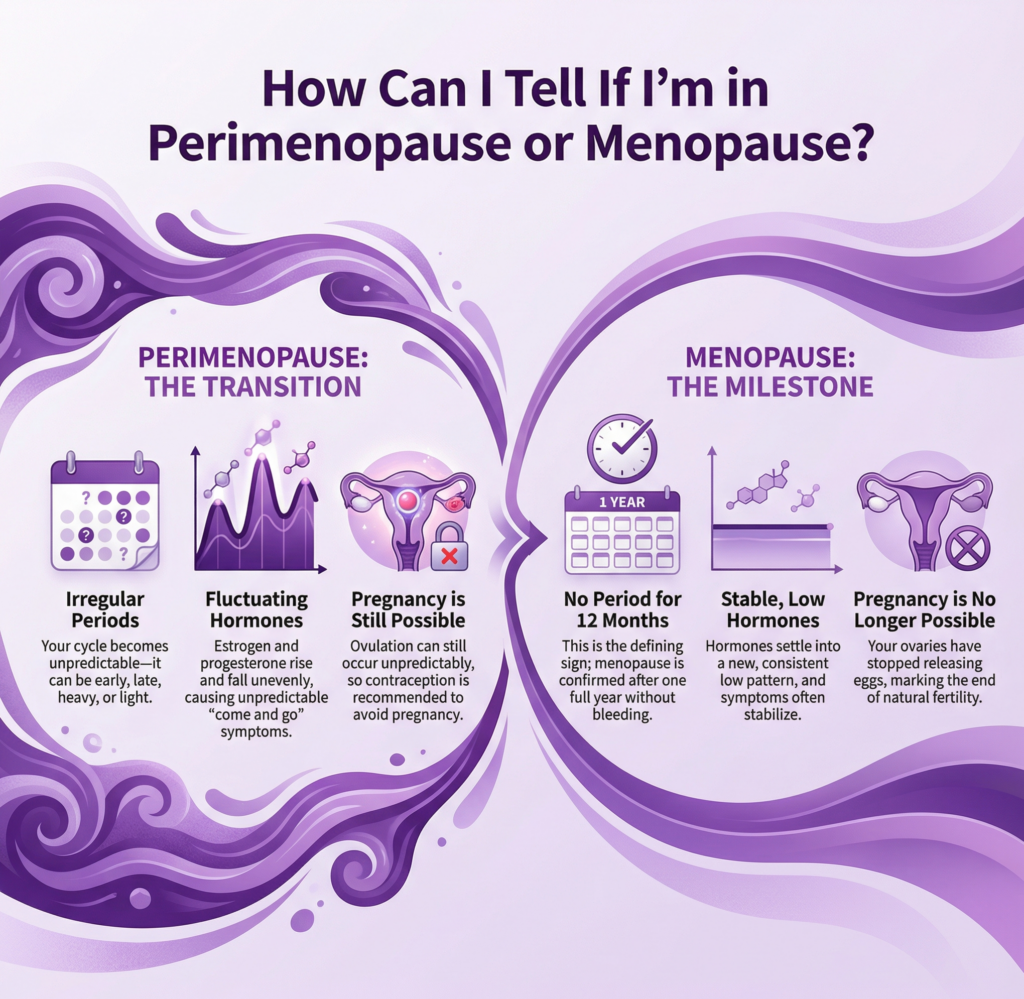
Perimenopause is the transition with irregular periods. Menopause is confirmed only after 12 months without a period.
Start with your cycle to understand the difference between perimenopause and menopause. During perimenopause, your period can come at any time and be long, short, heavy, light, early, or late. This happens because estrogen levels go up and down in an uneven way.
Menopause, on the other hand, is a single point in time: the moment you’ve reached a full year with no bleeding at all.
Even if your symptoms feel intense during perimenopause, you aren’t officially in menopause until the 12-month mark. After that, you enter postmenopause, where hormone levels stay low and steady.
What Are the Clear Signs of Perimenopause?
Irregular cycles, hot flashes, night sweats, brain fog, sleep problems, mood shifts, and vaginal dryness are classic signs of perimenopause.
During perimenopause, estrogen and progesterone move in unpredictable waves. This creates symptoms that seem to appear and disappear with no pattern. Studies show that changes in hormones, not low estrogen, are what cause symptoms in early perimenopause.
You might have breast tenderness one month and none the next. You might feel anxious one week and perfectly fine the next. This inconsistency is actually one of the easiest ways to tell you’re in perimenopause.
What Symptoms Suggest You’re Officially in Menopause?

The clearest sign is no period for 12 months. Symptoms may continue, but your cycle stops completely.
Menopause doesn’t come with a dramatic physical change, it’s simply the day your body reaches one full year without a menstrual cycle. Your ovaries stop releasing eggs and your hormones stop fluctuating wildly. Instead, they settle into a consistently low pattern.
Symptoms like hot flashes, dryness, or mood changes may still show up, but they are no longer caused by unpredictable hormone swings. Instead, they come from your body adapting to its new hormone environment.
How Do Hormone Levels Differ Between Perimenopause and Menopause?
In perimenopause, hormones rise and fall unpredictably. In menopause, they stay low and stable.
Blood tests can sometimes indicate where you are in the journey, but they’re not always reliable during perimenopause because estrogen can change dramatically from one day to the next. That’s why doctors say symptoms and cycle patterns are more accurate indicators.
Once you’re in menopause (and then postmenopause), estrogen and progesterone levels remain consistently low. This hormonal stability is why many women feel calmer and more balanced after the transition.
Can I Still Get Pregnant in Perimenopause?

Yes. Pregnancy is still possible in perimenopause, even with irregular cycles.
Because your ovaries can still release eggs unpredictably, conception remains possible. Once you reach menopause, however, pregnancy naturally becomes impossible. This is one of the clearest distinctions when learning how to tell perimenopause or menopause.
If you’re sexually active and want to avoid pregnancy, contraception is still recommended until menopause is confirmed with the full 12-month cycle gap.
How Do Hot Flashes Differ Between Perimenopause and Menopause?
They appear in both stages, but in perimenopause they are triggered by hormone swings. After menopause they happen because estrogen is consistently low.
Hot flashes often begin in perimenopause because estrogen spikes and dips confuse the brain’s temperature control center. Studies show that hot flashes affect up to 75% of women during the transition.
After menopause, hot flashes may continue, but they usually become less intense over time as the body adapts to stable hormone levels.
What About Sleep? Does It Change Differently in Each Stage?

Yes. In perimenopause, sleep changes with hormone fluctuations. After menopause, sleep issues often come from low estrogen and aging-related changes.
Progesterone, a calming hormone, drops during perimenopause, causing lighter sleep or nighttime awakenings. After menopause, sleep may improve for some women, while others experience persistent night sweats or early waking.
Knowing how to tell if you’re in perimenopause or menopause by your sleep patterns can help you change your routines, like making your bedroom cooler or practicing relaxing habits before bed.
How Can You Confirm Whether You’re in Perimenopause or Menopause?
Track your periods, monitor your symptoms, and ask your doctor for guidance if you’re unsure.
The most accurate method is still your menstrual pattern. No test is more reliable than observing your cycle over time. Hormone tests can help rule out other conditions, but they can be misleading during perimenopause due to rapid hormone shifts.
A simple symptom diary that records hot flashes, mood swings, and changes in your cycle can quickly show you patterns that tell you exactly where you are on the menopause timeline.
Final Thoughts
Learning how to tell perimenopause or menopause gives you back a sense of control. Instead of feeling confused or worried about every new symptom, you begin to understand your body’s timeline and what it’s trying to communicate.
Once you know what stage you’re in, everything becomes clearer. Your symptoms make sense, and you know what to do next.
And here’s the good news: your body isn’t working against you, no matter where you are in the journey. It’s helping you move into a new stage of life where you can feel stable, smart, and strong.
With the right help, you can get through this season with confidence and kindness towards yourself.
FAQ: How to Tell Perimenopause or Menopause
Yes. Irregular cycles are typical in perimenopause.
Yes. Early symptoms can appear before cycle changes.
Many improve over time, but some continue for a few years.
Most women begin in their 40s.
Yes, it can start earlier for some women.
Yes, especially if symptoms feel unusual or disruptive.
It helps with symptoms but does not change the stage you’re in.