Bone loss is one of the most significant health shifts that happens in a woman’s body after 50, and the frustrating part is that it happens silently. There are no obvious symptoms until a fracture occurs or a bone density scan reveals the damage that has been building for years.
After menopause, the decline in oestrogen accelerates bone loss dramatically, and women can lose up to 20 percent of their bone density in the five to seven years following their final period.
That is not a small shift. It is the kind of change that determines whether your body stays resilient and capable for decades to come, or whether everyday activities become a source of risk.
The encouraging reality is that bone is living tissue. It responds to the demands you place on it, and when those demands include impact, load, and power-based movement, your body responds by stimulating osteoblasts, which are the cells responsible for building new bone.
This is the science behind why this workout exists, and it is why 8 minutes of the right kind of exercise is worth far more than an hour of gentle walking when it comes to protecting your skeletal health.
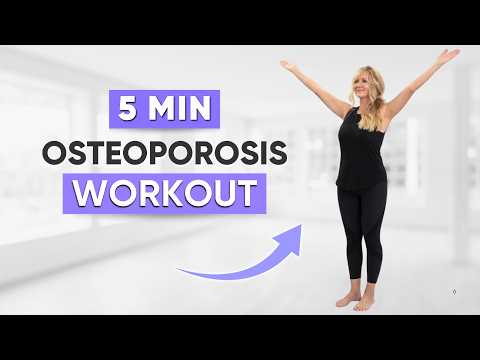
How This 8-Minute Osteoporosis Workout Builds Bone
This workout is structured in two rounds of exercises designed specifically to trigger the bone-building response your body needs. Each exercise creates mechanical stress through impact, direction change, or force, which signals to your bones that they need to become stronger to handle the load.
The workout also raises your heart rate, which supports cardiovascular health alongside bone health, and it trains power and speed, two physical qualities that women lose faster than almost anything else as they age.
Every exercise in this routine includes a modified option, so if you are new to impact training or returning to exercise after a break, you can start at a level that feels safe and work your way up progressively. The goal is consistent effort over time, not perfection on day one.
READ ALSO: Osteoporosis Exercise Videos For Women Over 50
Osteoporosis Exercises That Stimulate Bone Growth After 50
Heel Drops to Stimulate Bone Building in the Lower Body
Rise onto your toes and then gently drop back down to your heels with enough force to feel the impact travel up through your calves and legs.
This movement might look deceptively simple, but research published in the British Journal of Sports Medicine confirms that repetitive heel impact loading is one of the most effective ways to stimulate bone formation in the hip and spine, which are the two areas most vulnerable to osteoporotic fracture in women over 50.
The heel drop also activates the calf muscles and helps pump blood back toward the heart, making it a cardiovascular exercise as well as a bone-loading one.
Heel Drops With Arm Drive for Greater Bone Loading
Once you are comfortable with the basic heel drop, the next progression adds the arms. As your heels strike the ground, drive your arms downward simultaneously so that the force generated travels through your entire body rather than just your lower legs.
This added arm drive increases the impact load, which means a stronger signal is sent to the bone-building cells in your hips and spine. Keep the movement rhythmic and controlled, and focus on generating force rather than speed.
READ ALSO: Osteoporosis Workout for Strong Bones: The Jump Routine Every Woman Over 50 Should Try
Power and Speed Training to Prevent Falls and Fractures
Turn Jumps for Reactive Strength and Fall Prevention Over 50
Stand with your feet hip-width apart, then use a powerful jump to rotate your body 90 degrees before landing. This exercise combines impact, direction change, rotational movement, and speed in a single movement pattern.
The reason this matters so much for women over 50 is that fall prevention is not just about strength. It is about your nervous system’s ability to react quickly when something unexpected happens, such as a stumble, an uneven surface, or a sudden change in direction.
Training your body to move fast and land with control is one of the most practical things you can do to protect yourself from the fractures that osteoporosis makes so dangerous. If the jump feels too challenging, the modified option involves stepping through the rotation rather than jumping, which is an equally valid starting point.
Research from the National Institutes of Health highlights that power training, specifically exercises involving speed and direction change, significantly reduces fall risk in postmenopausal women when practised consistently.
Side Jumps for Fast-Twitch Muscle Fibre Activation
Bring your feet together and take small, fast jumps from side to side in a continuous rhythm. This exercise is deliberately fast-paced because the speed is what recruits the fast-twitch muscle fibres that control your ability to react and move quickly.
Fast-twitch fibres are among the first things women lose with age, and unless they are specifically trained through explosive or high-speed movement, that loss accelerates.
Side jumps also create lateral bone loading, which means the impact travels through your skeleton at a different angle than most exercises, reaching areas of the hip and femur that standard vertical impact does not address as effectively.
Use the modified option of stepping side to side if jumping is not appropriate for your current fitness level.
Round Two: Repeating the Bone-Loading Circuit
The second round of this workout repeats the same four exercises with the same structure. The repetition is intentional. Going through the circuit twice increases the total volume of mechanical stress placed on your bones during the session, which strengthens the signal sent to your osteoblasts.
It also raises your heart rate further and challenges your muscular endurance, so by the time you finish the second round you will have worked your cardiovascular system, your muscles, and your skeletal system all in under 10 minutes.
The International Osteoporosis Foundation recommends that bone health exercise programs include both impact loading and progressive resistance training performed at least two to three times per week for meaningful improvements in bone density over time.
How to Get the Most From Your Osteoporosis Workout Routine
Consistency matters far more than intensity when it comes to building bone. A moderate workout done three times a week for six months will produce significantly better results than an intense session done occasionally. Pair this workout with adequate calcium and vitamin D intake, since bone tissue cannot be built without the raw materials it needs.
The Harvard T.H. Chan School of Public Health recommends that women over 50 consume 1,200 milligrams of calcium daily through food sources and supplementation combined, alongside sufficient vitamin D to support absorption.
Track your progress by noticing how the exercises feel over time. If heel drops that once felt intense begin to feel easy, that is a sign your body has adapted and you are ready to increase the height of the drop or the speed of the repetitions.
FAQs: Osteoporosis Workout for Women Over 50
Low to moderate impact exercises like heel drops are generally considered safe for women with osteoporosis and are actively recommended by bone health specialists. High-impact jumping should be discussed with your doctor or physiotherapist first if you have a confirmed diagnosis of osteoporosis rather than osteopenia.
Studies show measurable improvements in bone density markers after six to twelve months of consistent bone-loading exercise. The effects are gradual, which is why starting early and staying consistent is so important.
Two to three times per week with rest days in between is the most effective approach. Rest days allow your bones and muscles to recover and adapt, which is where the actual strengthening happens.
Strength training with weights, Pilates for core stability, and balance exercises all complement impact-based bone loading work. A well-rounded program that includes all of these elements gives your bones, muscles, and nervous system the variety of stimulus they need to stay strong and functional.