

Feeling a little wobbly can make balance training seem daunting, especially when the first exercise you picture is standing unsupported on one leg. But building better balance does not have to begin that way. Chair balance exercises offer a safe, approachable starting point, with steady support always close by.
A sturdy chair helps you practice without feeling exposed or unsure. You can begin with both hands on the chair, progress to one hand or light fingertip support, and eventually keep it nearby only for reassurance.
As your brain, muscles and nervous system learn to work together, balance begins to feel less intimidating and much more achievable.
Key Takeaways: Chair Balance Exercises
- Chair balance exercises offer a safe, joint-friendly way for seniors and beginners to build strength without putting strain on the body.
- Practicing balance movements targeting the ankles, legs, and hips strengthens key stabilizing muscles to lower fall risk and build everyday steadiness.
- Sitting tall during exercises actively engages the core and back, which supports spine alignment and combats slumping.
- Every routine is performed entirely seated or standing using a sturdy chair for support, making it ideal for anyone with joint discomfort or mobility limits.
- Balance training stimulates sensory receptors in your muscles to sharpen coordination, allowing your body to automatically correct itself when you wobble.
- You can easily adapt the difficulty by adjusting your pace or adding resistance bands and light hand weights as your strength grows.
- Consistent daily practice helps maintain joint mobility and muscle mass, allowing you to stay active and confident in daily life as you age.
How Can Holding a Chair Make Balance Training Safer?

Holding a chair gives your nervous system a sense of safety. When your body feels supported, you can practice balance without fear taking over. This matters because fear can make us stiffen, shorten our steps, grip our muscles, and avoid movement altogether.
Research supports balance and functional training for fall prevention. A Cochrane review found that exercise reduces the rate of falls in older adults living in the community, with balance and functional training playing an important role. The World Guidelines for Falls Prevention also recommend balance-challenging and functional exercises, such as sit-to-stand and stepping, three or more times weekly, progressed over time.
Chair support simply makes those exercises more accessible. It allows you to train balance safely while still challenging your body.
Which Chair Balance Exercises Should You Start With?

Start with simple movements that train control without rushing. For all of these chair balance exercises, stand behind a sturdy chair placed on a non-slip surface. Keep your posture tall, soften your knees, and move slowly.
1. Supported Weight Shifts
Hold the chair and gently shift your weight from one foot to the other. Then shift your weight slightly forward and backward. Keep the movement small. This teaches your body how to move away from center and return with control.
2. Heel Raises
Hold the chair, rise onto the balls of your feet, pause, and then lower slowly. This strengthens the calves, ankles, and feet, which are all important for balance.
3. Toe Raises
Keep your heels on the floor and gently lift your toes. This strengthens the front of the lower legs and helps with foot control when walking.
4. Supported Single-Leg Stand
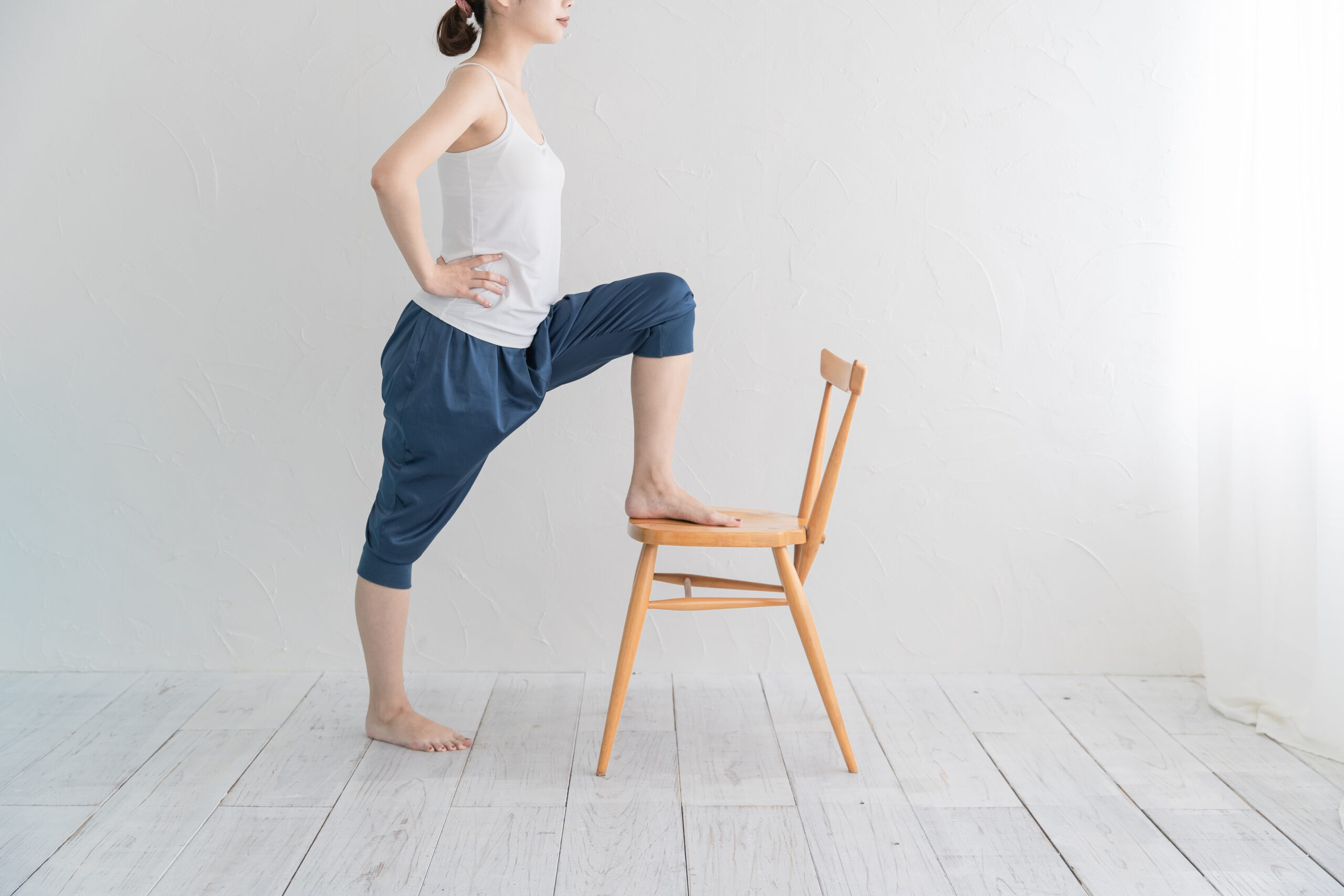
Hold the chair and lift one foot slightly off the floor. Hold for a few seconds, then switch sides. Begin with both hands on the chair if needed.
5. Side Steps
Hold the chair lightly, step one foot to the side, then bring the other foot in. Repeat both directions. Side-to-side control is important because many real-life balance challenges happen when we move laterally.
How Do Sit-to-Stands Improve Balance?
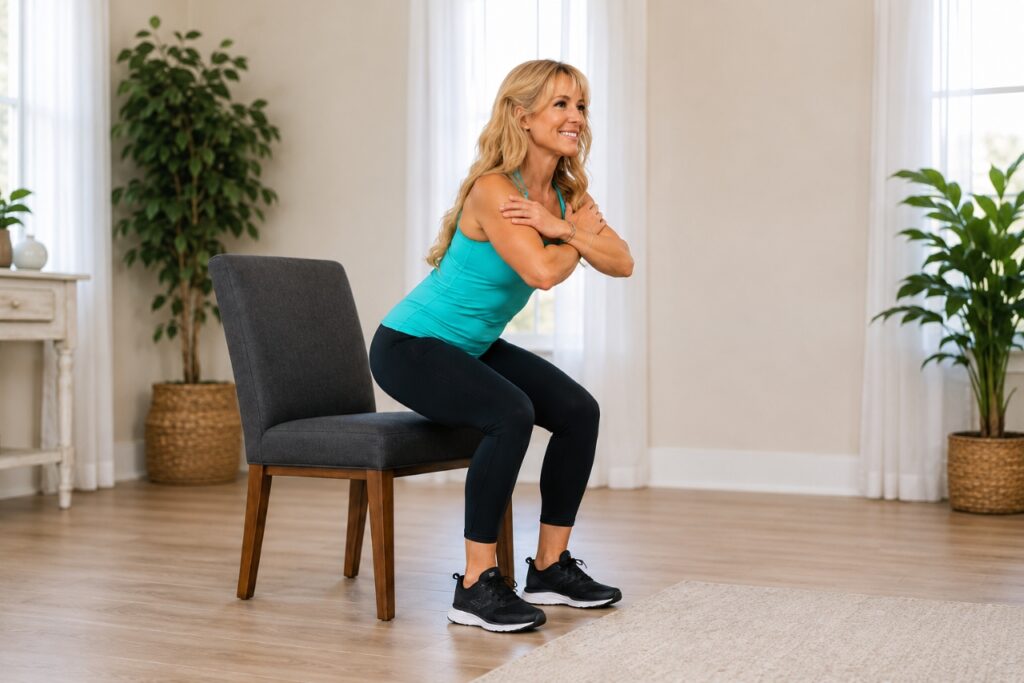
Sit-to-stands are one of the most useful chair balance exercises because they train a movement we use every day. Sit tall near the front of a sturdy chair, place your feet flat on the floor, and stand up with control. Slowly sit back down without dropping into the chair.
This movement strengthens the thighs, glutes, hips, and core. It also trains coordination between your upper body and lower body. If you need support, lightly place your hands on the chair or thighs. As you get stronger, try using less help.
The CDC lists lower body weakness and difficulties with walking and balance among fall risk factors, which is why exercises that build leg strength and control are so useful after 50.
Can You Train Balance Without Lifting One Foot?
Yes. Balance is not only single-leg standing. It is described more broadly as reaching, turning, stepping, changing direction, and moving in different ways because real life does not happen in one position.
This is important if single-leg balance feels too difficult at first. You can still improve by practicing weight shifts, heel raises, side steps, marching, and sit-to-stands while holding a chair.
The NHS also includes simple exercises such as sideways walking, heel-to-toe walking, one-leg standing, and step-ups as balance exercises for older adults, with support used where needed.
How Can You Make Chair Balance Exercises Harder Safely?

Progress should feel steady, not scary. You can make chair balance exercises more challenging by changing one thing at a time.
Hold the chair with both hands first. Then try one hand. Then fingertips. You can also hold a position a few seconds longer, slow the movement down, or add a small reach with one arm while the other hand stays near support.
Do not close your eyes unless you are very steady and have professional guidance or very secure support. Eyes-closed balance is more challenging because your body cannot rely on vision in the same way.
How Often Should You Practice?
For most women over 50, 5 to 10 minutes of chair balance exercises two to three times per week is a strong starting point. If you feel safe, you can also add one or two short balance moments into your day, such as heel raises while waiting for the kettle or a supported single-leg stand after brushing your teeth.
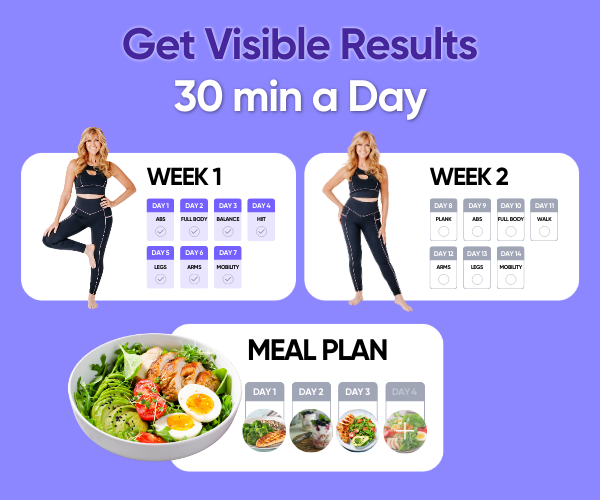
The Fabulous50s Longevity Protocol is designed around small, consistent actions that match the body you have now, and the minimum entry point is 10 minutes a day. The protocol also explains that Balance works alongside Strength, Cardio, Mobility, and Impact because no single type of exercise meets every need after 50.
When Should You Stop or Get Help?
Stop if you feel dizzy, faint, unsafe, or unusually unsteady. Speak with a healthcare professional if your balance suddenly changes, if you have had recent falls, or if you have osteoporosis, recent surgery, neurological symptoms, severe joint pain, unexplained dizziness, or vision changes.
A chair is helpful, but it is not a replacement for medical guidance when symptoms are new, severe, or worsening.
At Fabulous50s, Balance is one of the Five Pillars of the Fabulous50s Longevity Protocol™ because it supports fall prevention, coordination, steadiness, confidence, and nervous system response.
Balance training is not about never wobbling. It is about teaching your body how to recover when life moves you off-center.
Balance is a skill we can train, and progress often becomes visible as the wobble gets smaller and confidence improves.
Final Thoughts
Chair balance exercises are a safe, simple way to rebuild trust in your body. You are not trying to prove anything. You are teaching your brain, feet, ankles, legs, hips, and core how to work together again.
Start small. Hold the chair. Move slowly. Notice the improvements. Over time, the wobble may become smaller, your posture may feel taller, and daily movement may feel more secure.
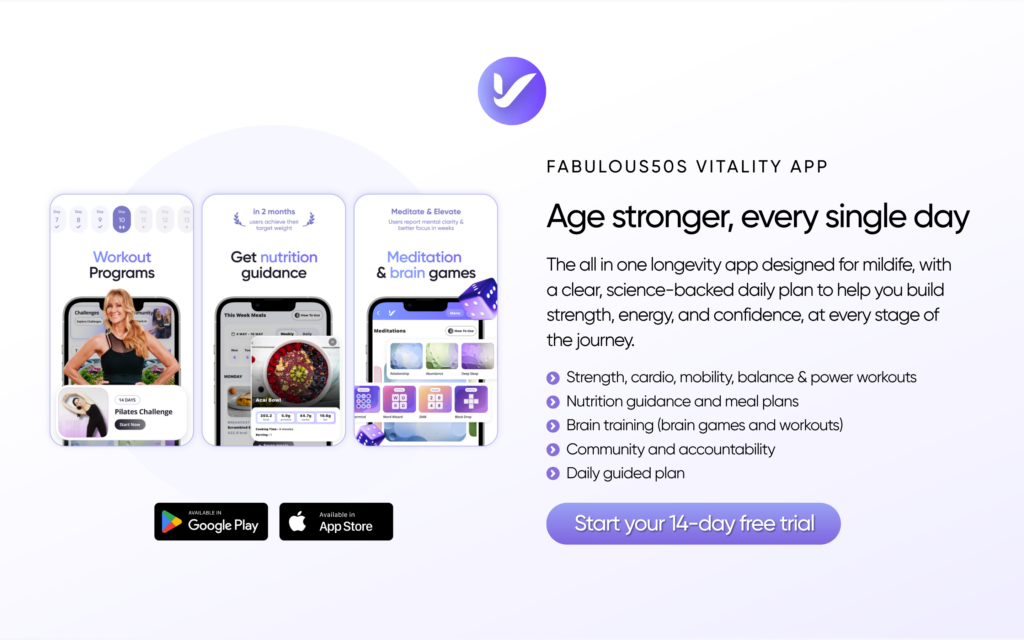
Inside the Fabulous50s Vitality App, you can follow guided workouts that train Balance alongside Strength, Cardio, Mobility, and Power as part of the Fabulous50s Longevity Protocol™. The app gives you structure, support, and safe progressions designed for women over 50.
Frequently Asked Questions
Yes. Chair balance exercises are ideal for beginners because they allow you to practice steadiness with support nearby.
Supported weight shifts are a good first exercise because both feet stay on the floor while you practise control.
They can support fall prevention by improving steadiness, leg strength, coordination, and confidence. They work best as part of a complete routine.
Start with 5 to 10 seconds. Build gradually as your control improves.
Begin with two hands if you need support. Progress to one hand or fingertips only when you feel steady.
Yes, short daily practice can be helpful if it feels safe. Keep the movements gentle and controlled.
Use a sturdy chair that does not roll or slide. Avoid soft chairs, stools, or anything unstable.
Sherrington, C., et al. “Exercise for Preventing Falls in Older People Living in the Community.” Cochrane Database of Systematic Reviews, 2019. https://pubmed.ncbi.nlm.nih.gov/31792067/
Montero-Odasso, M., et al. “World Guidelines for Falls Prevention and Management for Older Adults: A Global Initiative.” Age and Ageing, 2022. https://academic.oup.com/ageing/article/51/9/afac205/6730755
Centers for Disease Control and Prevention. “Facts About Falls.” CDC, 2024. https://www.cdc.gov/falls/data-research/facts-stats/index.html
National Health Service. “Balance Exercises.” NHS. https://www.nhs.uk/live-well/exercise/balance-exercises/
Mayo Clinic. “Balance Exercises.” Mayo Clinic, 2024. https://www.mayoclinic.org/healthy-lifestyle/fitness/in-depth/balance-exercises/art-20546836
Sherrington, C., et al. “Exercise for Preventing Falls in Older People Living in the Community.” Cochrane Database of Systematic Reviews, 2019. https://pubmed.ncbi.nlm.nih.gov/31792067/
Montero-Odasso, M., et al. “World Guidelines for Falls Prevention and Management for Older Adults: A Global Initiative.” Age and Ageing, 2022. https://academic.oup.com/ageing/article/51/9/afac205/6730755
Centers for Disease Control and Prevention. “Facts About Falls.” CDC, 2024. https://www.cdc.gov/falls/data-research/facts-stats/index.html
National Health Service. “Balance Exercises.” NHS. https://www.nhs.uk/live-well/exercise/balance-exercises/
Mayo Clinic. “Balance Exercises.” Mayo Clinic, 2024. https://www.mayoclinic.org/healthy-lifestyle/fitness/in-depth/balance-exercises/art-20546836