
There is something deeply practical about being able to get down to the floor and stand back up again.
Getting down to the floor may not seem important until everyday life calls for it. It might be to retrieve something from under the sofa, stretch on a mat, sit with grandchildren, garden, play with a pet, or kneel to organize a cupboard. More importantly, knowing how to rise safely can help you feel prepared if you ever find yourself on the floor unexpectedly.
For me, this is one of the clearest examples of why mobility matters after 50. It is not about fancy stretching or performing difficult poses. It is about life and about keeping the body capable enough to move through ordinary moments with confidence.
Getting up and down from the floor asks a lot from us. It asks for hip mobility, knee comfort, ankle movement, core strength, balance, coordination, and trust in our own body. And like so many things, it can feel harder when we stop practicing it.
The wonderful thing is that we can rebuild this skill gently. We can start with a chair, a wall, a cushion, or a sofa nearby. We can practice the pieces first, then slowly put them together.
Mobility is freedom. And every small practice is a deposit in our independence.
Key Takeaways: Mobility Exercises for Getting Up
- Getting up and down from the floor is an important functional skill after 50.
- It requires mobility, strength, balance, coordination, and confidence.
- The hips, knees, ankles, feet, spine, and core all play a role.
- Many women lose confidence with floor movement because they stop practicing it.
- Start with supported exercises before attempting full floor transfers.
- A chair, wall, cushion, or sofa can make practice safer and more comfortable.
- The goal is not speed or perfection. The goal is confidence, control, and independence.
Why Does Getting Up and Down From the Floor Matter After 50?
Getting up from the floor is one of those abilities that represents real-life independence. It tells us that the body can lower, shift weight, support itself, coordinate movement, and rise again.
Research recognizes this as an important functional skill for older adults. A 2025 study on floor-to-stand transfers describes getting up from the floor as an important skill for independence, while noting that it is not always assessed in clinical settings. Another study found that the Floor Transfer Test can be a reliable and valid measure for screening functional mobility, physical disability, frailty, and readiness for independent living.
And what that means for us is simple. This is not a small thing. Being able to get up and down from the floor is a whole-body skill that can help us feel safer, more capable, and more confident in daily life.
We do not train it because we expect to spend our lives on the floor. We train it because we want to keep the option available.
Why Does Floor Mobility Become Harder With Age?
Getting down to the floor and standing back up may feel harder after 50 for several reasons.
The hips may feel tighter. The knees may feel less comfortable. The ankles may feel stiff. Balance may feel less reliable. We may have lost some muscle strength in the legs and core. We may also feel afraid of not being able to get back up, and that fear can make the body more guarded.
Modern life also plays a role. Many of us have unintentionally designed movement out of our lives through chairs, cars, elevators, and long hours looking at screens. Over time, the body adapts to this lack of movement by becoming stiff and rigid.
Getting up and down from the floor uses movements that modern life does not always ask of us anymore: squatting, kneeling, reaching, rotating, shifting weight, and pushing through the hands and legs. If we never practice those positions, they can begin to feel unfamiliar.
But unfamiliar does not mean impossible. It simply means we begin again, gently.
What Parts of the Body Help Us Get Up From The Floor?
Floor mobility is a full-body movement. The hips help us bend, rotate, kneel, and step one foot forward. The knees help us lower and rise. The ankles and feet help us balance and push into the ground. The hands and arms may assist us as we transition from lying, sitting, or kneeling. The core helps us control the body as we shift position.
This is why the Fabulous50s Longevity Protocol includes Mobility as one of the core movement pillars. Mobility supports freedom of movement, flexibility, joint comfort, posture, and daily function. Floor mobility is exactly that: daily function.
We are not training one muscle. We are training a practical pattern that brings many parts of the body together.
What Mobility Exercises Help With Getting Up and Down From The Floor?
The best exercises are the ones that practice the building blocks before asking the body to do the full movement. Start slowly, use support, and choose the level that feels right for your body today.
1. Chair sit-to-stands
Sit near the front of a sturdy chair with both feet flat on the floor. Lean slightly forward, press through your feet, and stand up. Sit back down slowly with control.
This strengthens the legs and teaches the body the rising pattern we need for floor transfers. It is also one of the most practical movements we can train because we use it every day.
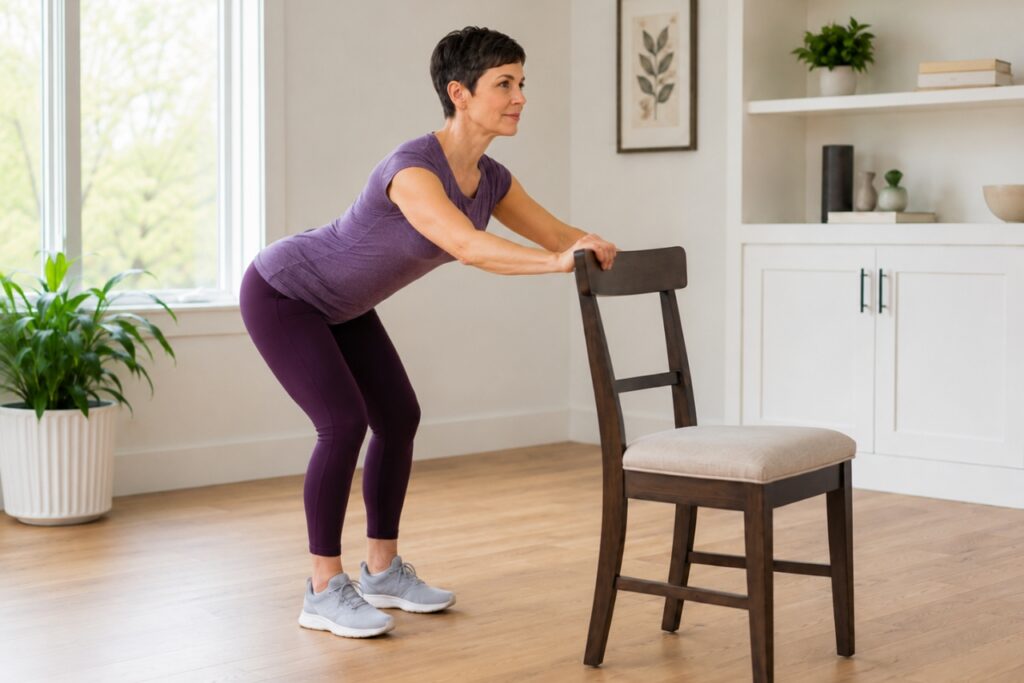
2. Supported hip hinges
Stand behind a chair and hold it lightly. Soften your knees and hinge forward from your hips, keeping your back long. Return to standing.
This helps the hips learn to fold without rounding or forcing the spine. We need this movement when reaching toward the floor, picking things up, and preparing to lower the body.
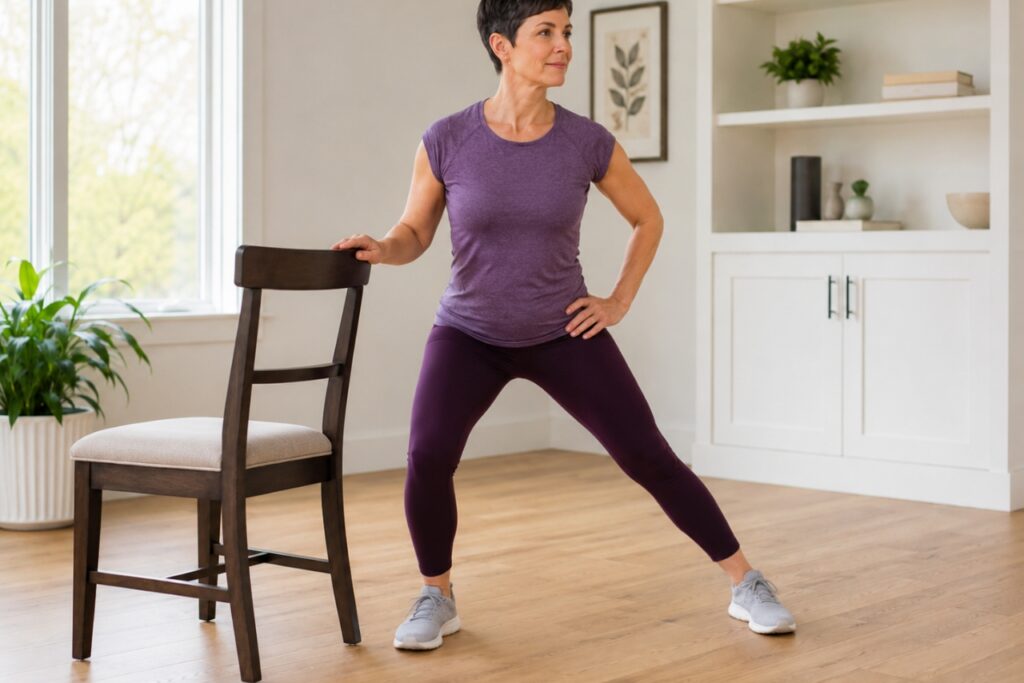
3. Side-to-side weight shifts
Stand with your feet a little wider than hip-width apart. Slowly shift your weight to one side, then the other. Hold a chair if needed.
This teaches the hips, feet, and nervous system to manage weight transfer. That matters because getting up from the floor often requires shifting weight from one knee to one foot, then standing.
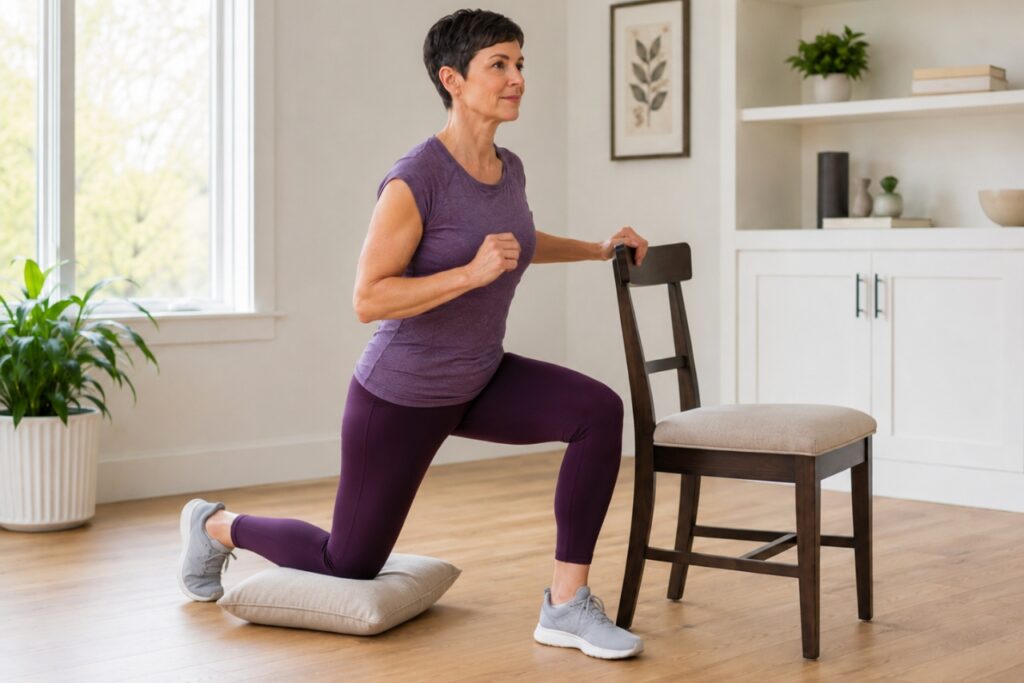
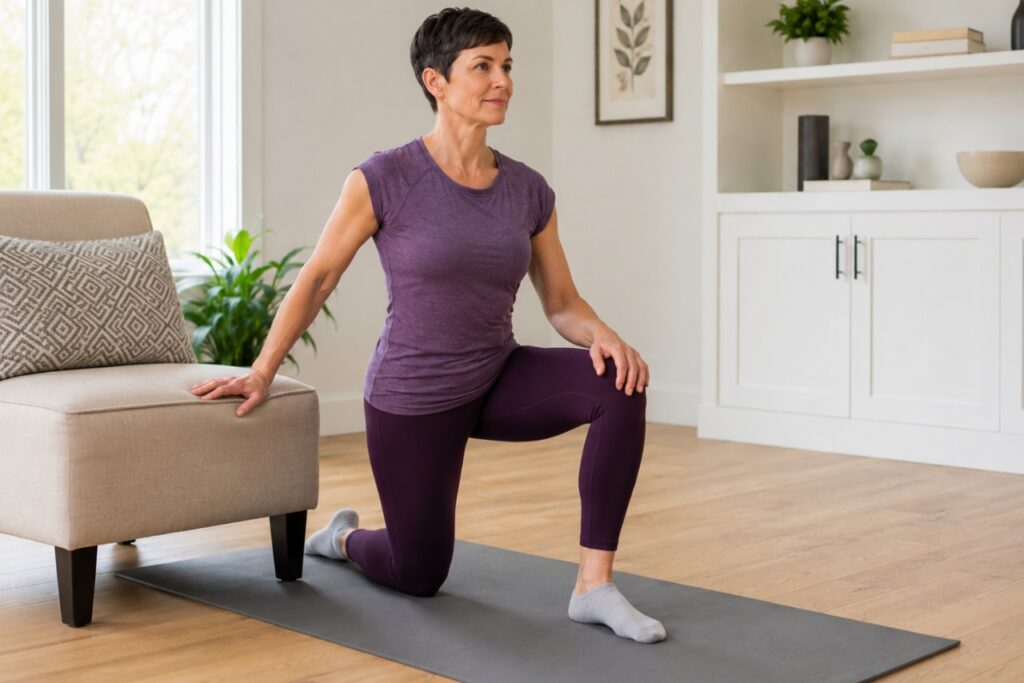
4. Supported lunges to a cushion
Place a cushion on the floor and stand beside a chair or sofa. Step one foot back and gently bend both knees as though moving toward a supported kneel. You do not need to go all the way down at first.
This helps prepare the hips, knees, and ankles for the positions used in floor transfers. Keep the movement small and supported.
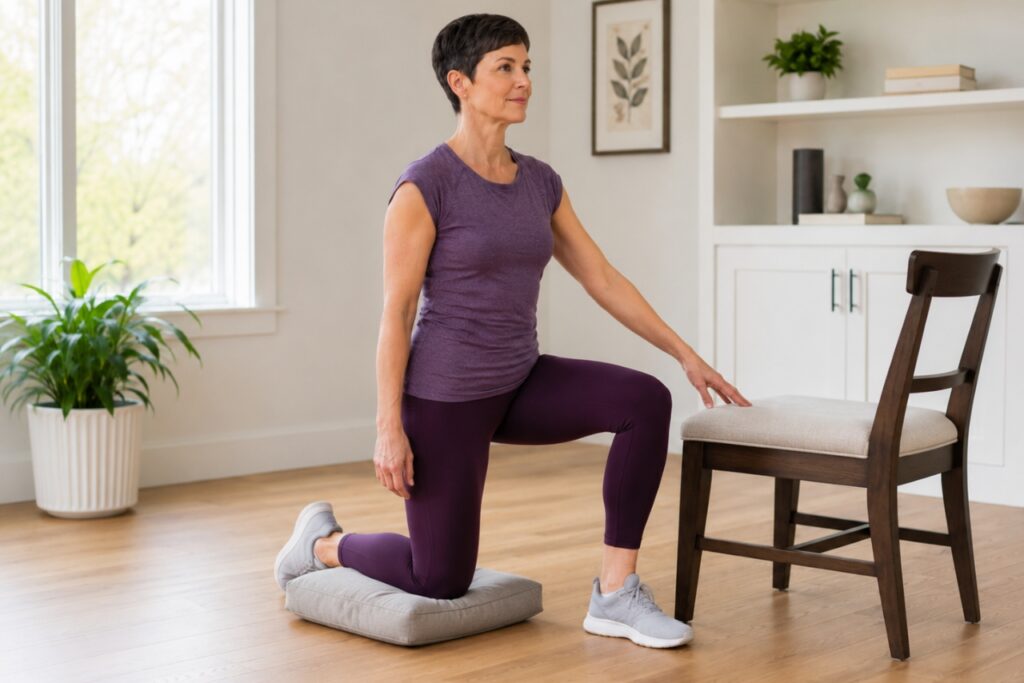
5. Half-kneeling practice
Place one knee on a cushion and the other foot forward, with a chair or sofa beside you for support. Practice holding this position, breathing, and gently shifting your weight.
Half-kneeling is a powerful bridge between the floor and standing. It teaches balance, hip mobility, and confidence.
6. Hands-and-knees rocking
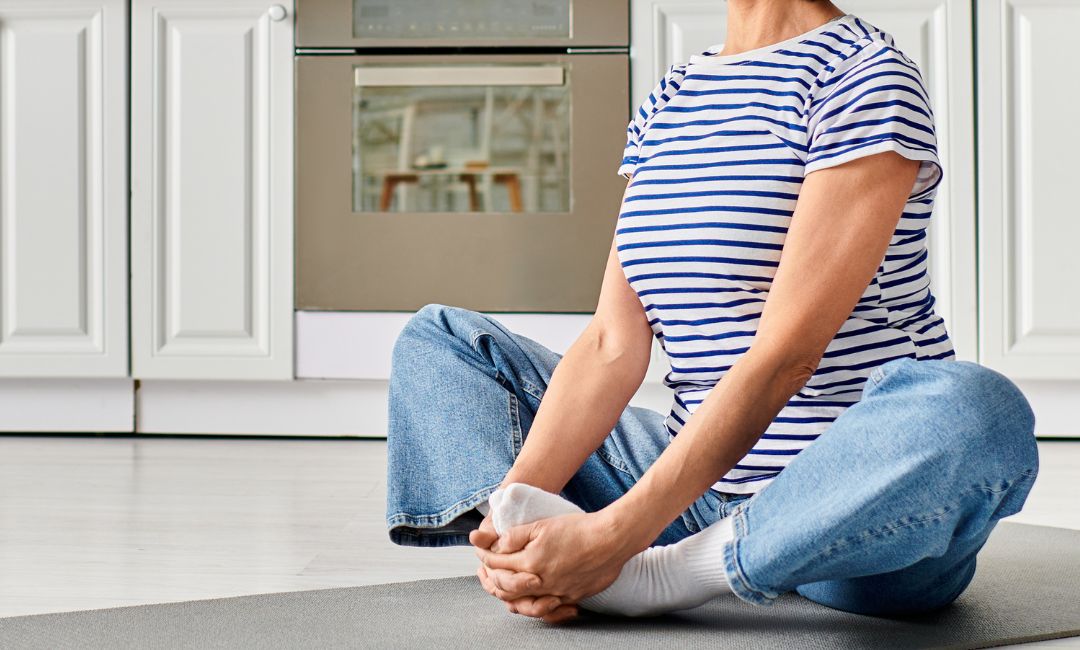
Come onto hands and knees on a soft mat, or use a bed if the floor is uncomfortable. Gently rock your hips back toward your heels, then return forward.
This helps the hips, knees, shoulders, wrists, and spine practice gentle movement in a safe, supported position.
7. Seated floor-to-chair practice
Sit on a mat beside a sturdy chair or sofa. Place one hand on the chair, bring one foot forward, and practice shifting into a kneeling or half-kneeling position with support.
This is not about rushing to stand. It is about learning the pathway. The more familiar the pathway becomes, the more confident the body feels.
What Is The Safest Way To Practice Getting Up From The Floor?
Safety comes first. Practice near something sturdy, such as a sofa, chair, wall, or bench. Use a soft mat or folded blanket under your knees. Keep your phone nearby if you are practicing alone. Move slowly, and stop before fatigue makes the movement messy.
A simple supported method is this: start seated on the floor beside a chair, roll gently to one side, come onto hands and knees, bring one foot forward into half-kneeling, press through the front foot, use the chair for support, and stand slowly.
There is no shame in using support. In fact, support is often what allows us to practice safely enough to improve.
Why Do Strength And Balance Matter Too?
Mobility is essential, but getting up from the floor also requires strength and balance.
The CDC recommends that adults 65 and older include aerobic activity, muscle-strengthening activity, and balance activities each week. The NHS also recommends daily activity, reducing long periods of sitting, and doing activities that improve strength, balance, and flexibility at least two days a week.
This is why the Fabulous50s approach layers the pillars together. Mobility helps us move into positions. Strength helps us rise. Balance helps us feel steady. Power helps us respond quickly when life asks us to move. The body works as a whole, so our training should support the whole woman.
What If I Feel Afraid to Get Down on The Floor?
Fear is understandable. Many women worry that if they get down, they will not be able to get back up. If that is how you feel, start above the floor. Practice chair sit-to-stands, supported lunges, wall push-ups, side-to-side weight shifts, and hip mobility first. Build confidence in the pieces before putting them together.
You can also practice with someone nearby or work with a physiotherapist if you feel unsteady, have a history of falls, or have medical concerns.
The goal is not to prove anything. The goal is to build trust. Confidence comes from repeated safe experiences, not from forcing yourself into fear.
When Should We Be Careful?
Please be especially careful if you have osteoporosis, recent surgery, a hip or knee replacement, severe arthritis, dizziness, unexplained pain, nerve symptoms, a history of falls, or any medical condition that affects safe movement.
If getting down to the floor feels unsafe, do not practice alone. Begin with chair-based exercises or ask a qualified healthcare professional for guidance.
Mobility is not about pushing through pain. It is about giving the body the right level of challenge with the right amount of support.
How Can We Begin This Week?
Let us make this very simple. Choose three exercises: chair sit-to-stands, side-to-side weight shifts, and supported half-kneeling practice. Practice for five to ten minutes, two or three times this week.
Before you begin, notice what feels difficult. Is it the knees? The hips? The fear of lowering? The push to stand? After you finish, notice what changed. Maybe your legs feel warmer, maybe you feel steadier, and maybe you simply feel proud that you practiced something important.
That counts.
This is exactly why the Fabulous50s Vitality App is such a beautiful next step. Inside the app, mobility becomes part of a complete longevity rhythm alongside strength, cardio, balance, power, recovery, and community support. You do not have to guess what to do next. You can choose a gentle mobility or strength session and let me guide you step by step.
Every stretch and every supported rise is a deposit in your independence. Start your 14-day free trial of the Fabulous50s Vitality App today and take your first gentle step toward moving with more freedom and confidence.
Explore More About Mobility For Women Over 50
- The 5 Ultimate Workouts Every Woman Over 50 Should Do
- Why You Feel Stiff After 50 and What to Do About It
- Effective Stretching Workouts to Improve Your Flexibility & Mobility
- Top 5 Mobility Exercises For Women Over 50
- An Easy 8-Minute Mobility and Flexibility Workout for Women Over 50
- 5 Minute Hip Mobility Workout For Women Over 50
- Chair Exercises for Seniors: Gentle Seated Workouts for Women Over 50
- Low-Impact Osteoporosis Exercises for Women Over 50
Final Thoughts
Getting up and down from the floor is not just an exercise. It is a life skill.
Getting up and down helps us feel more capable in our homes, with our families, in the garden, on holiday, and in unexpected moments. It reminds us that our body can still learn, adapt, and become more confident with practice.
Start with support. Start with a chair; also start with one small piece of the movement.
Mobility is about keeping your body open to life. Small steps, practiced consistently, create remarkable changes over time.
Frequently Asked Questions
Why is it hard to get up from the floor after 50?
It can become harder because of reduced hip mobility, knee discomfort, ankle stiffness, lower-body weakness, balance changes, fear of falling, or simply not practicing the movement often.
What exercises help with getting up from the floor?
Chair sit-to-stands, supported lunges, half-kneeling practice, side-to-side weight shifts, hip hinges, and hands-and-knees rocking can all help build the pieces of the movement.
Is getting up from the floor a sign of fitness?
It can reflect several parts of fitness, including strength, mobility, balance, coordination, and confidence. Research has linked floor transfer ability with functional mobility and independence.
Should I practice getting down to the floor every day?
Not necessarily. Start with the building blocks two or three times a week, then gradually practice full-floor transfers if it feels safe for your body.
What if my knees hurt when kneeling?
Use a thick cushion or a folded blanket, or avoid kneeling for now. Practice chair sit-to-stands, hip hinges, side steps, and supported lunges instead. Speak with a healthcare professional if knee pain is persistent or severe.
Can I learn this if I am a beginner?
Yes. Begin with support and small movements. You do not need to do a full floor transfer on day one. Practice the pieces and build gradually.
When should I avoid floor exercises?
Avoid practicing alone if you feel unsafe, dizzy, very weak, or have a high fall risk. Seek professional guidance if you have recent surgery, joint replacement, severe osteoporosis, severe pain, or neurological symptoms.
- Stutzenberger L, et al. Floor-to-Stand Transfers in Older Adults.
- CDC. Older Adult Activity: An Overview.
- NHS. Physical activity guidelines for older adults.
- PubMed. Reliability and Validity of the Floor Transfer Test as a measure of readiness for independent living among older adults.
- Ng SSM, et al. Floor transfer test for assessing people with chronic stroke.
- de Brito LBB, et al. Ability to sit and rise from the floor as a predictor of all-cause mortality.