
There was a time when I avoided lifting heavy things whenever I could. Like many women, I was more interested in being slim than in building muscle.
Today, I actively look for opportunities to lift something challenging. I want to carry my own luggage, move things around my home and remain physically capable in my seventies, eighties and nineties.
That change came from understanding what muscle really gives us. It is not simply shape or definition. It is confidence, resilience and the physical freedom to continue living life on our terms.
So, can women build muscle after 50? Absolutely. The more useful question is how much we can realistically expect and what we need to do to achieve it without comparing ourselves with people who may have been training for decades.
What Does Realistic Muscle Gain Look Like After 50?
There is no honest monthly figure that applies to every woman. Muscle growth is affected by training experience, genetics, age, health, hormonal changes, nutrition, sleep, exercise selection and how consistently the muscles are challenged.
However, research gives us a helpful starting point.
A 2024 systematic review and meta-analysis examined 14 randomized trials involving postmenopausal and older women. Lower-volume resistance programs produced average whole-body muscle-related gains of approximately 0.9 kilograms, or about 2 pounds. Higher-volume programs produced gains of approximately 1.3 kilograms, or almost 3 pounds.
These figures came from studies of different lengths and included measurements such as lean mass, fat-free mass and skeletal muscle mass. They should therefore be viewed as useful group averages rather than a promise of exactly how many pounds one woman will gain. The researchers also rated the certainty of the evidence as low, which is another reason to avoid treating the numbers as a guaranteed result.
A practical interpretation is that an untrained woman might gain roughly 1 to 3 pounds of measurable muscle-related mass over several months of well-planned resistance training. Some women will gain more, some less, and some may initially maintain their muscle rather than add a large amount.
Maintenance still matters. Preserving muscle during a period when we might otherwise be losing it is a meaningful result.
READ ALSO: How To Gain Muscle Over 50 Even If You’re A BEGINNER!
Why might you feel stronger before you look more muscular?
The first change we notice may not be larger muscles. It may be standing from a chair more easily, lifting a heavier dumbbell or carrying the shopping without needing to change hands.
Early strength improvements are partly connected to the nervous system becoming better at recruiting and coordinating the muscle we already have. Muscle tissue can then continue adapting as the training progresses. This is why strength often increases before a visible change appears in the mirror.
A woman might train consistently for eight weeks and feel significantly stronger while seeing only a small change in body measurements. That does not mean her workouts are failing. It means her body is adapting in several ways at once.
This is also why we should measure muscle gain after 50 through function as well as appearance. More controlled squats, steadier lunges, heavier shopping bags and greater confidence getting up from the floor are all signs that the training is working.
READ ALSO: The Ultimate Strength Training Blueprint For Women Over 50
Why do results vary between women?
Your training history makes a difference
A beginner often has more room for rapid improvement than someone who has trained consistently for years. When resistance exercise is new, the body receives a strong stimulus from relatively simple workouts.
A woman who already has years of strength training experience can still progress, but each additional gain may take more time and more precise programming.
This is why comparing your results with someone online tells you very little. You may be looking at a woman who has been lifting for 20 years while you are in your first 12 weeks. The only meaningful comparison is who we are today compared with who we were yesterday.
Menopause can change the starting point
Building muscle after menopause may feel different because menopause can coincide with changes in muscle mass, joint comfort, sleep, recovery and body composition. Research has found an association between the menopausal transition and reductions in muscle and lean mass, although hormones are only one part of the picture.
I noticed that gripping dumbbells and squatting felt different when my knuckles and knees became more sensitive during menopause. This did not mean strength training was no longer appropriate. It meant the starting point and progression needed to respect what her body was experiencing.
Heavy lifting does not need to be the first step. We can first rebuild movement quality, coordination, mobility and confidence. Heavier resistance can follow as the body adapts.
Your program needs to keep progressing
Muscle grows when it has a reason to adapt. Repeating the same comfortable weight for the same repetitions indefinitely may eventually stop providing enough stimulus.
Progressive overload can mean increasing the weight, completing an additional repetition, adding a set, improving control or moving through a fuller range of motion. Progress does not need to be dramatic from one week to the next.
A study following older women through 12 and 24 weeks of resistance training found considerable differences in individual muscle responses. Some women who showed little measurable growth during the first phase responded after training continued and the weekly volume increased.
That tells us something encouraging. A slower start does not automatically mean your body cannot respond.
What does it take to build muscle after 50?
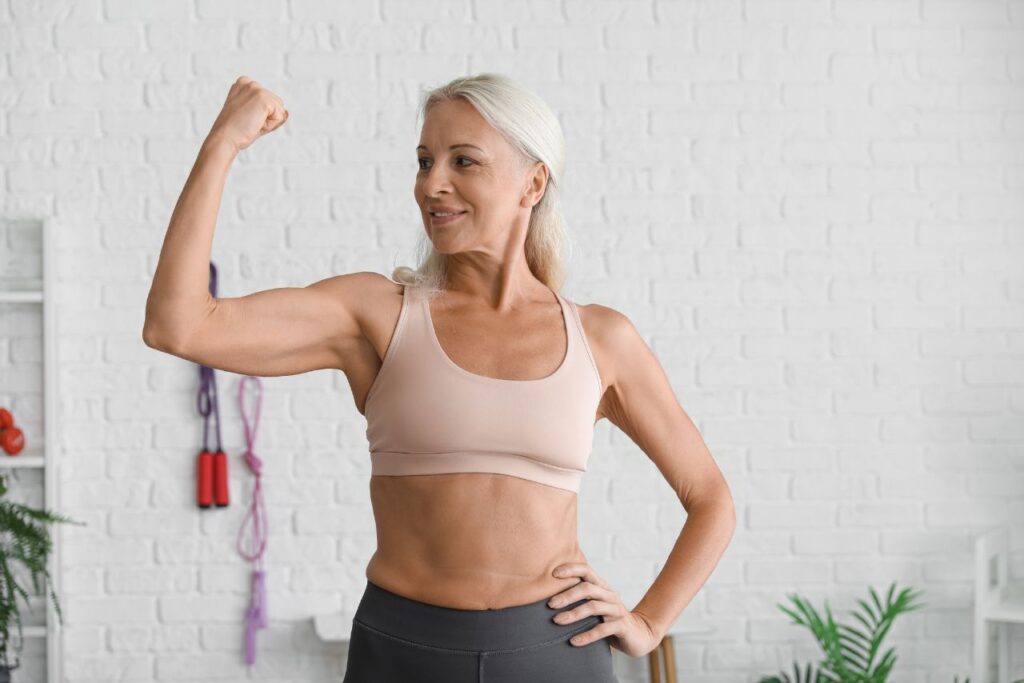
Challenge the muscles consistently
The latest American College of Sports Medicine guidance recommends training all the major muscle groups at least twice weekly and building gradually. For muscle growth, the guidance suggests that higher weekly volume can be useful, with approximately 10 sets per muscle group presented as a general target for healthy adults seeking hypertrophy.
That does not mean a beginner needs to complete 10 sets immediately. Starting with fewer exercises and sets gives the joints, muscles and nervous system time to adapt.
The best way to build muscle after 50 is to choose a routine that is challenging enough to create change but realistic enough to repeat. A perfect program that feels overwhelming will be less useful than a simple plan we can follow consistently.
Use a resistance that protects your form
I usually follow two practical strength-training rules. First, the weight should never be increased when doing so compromises technique. If we need to swing, twist, lean or use momentum to complete the movement, the weight is too heavy.
Second, the final repetitions should feel challenging. If we can easily complete 10 or 12 repetitions and continue without much effort, the resistance may no longer be providing a sufficient challenge. Choose a weight that allows about eight controlled repetitions, with the final two feeling difficult but achievable.
Bodyweight exercises, chair sit-to-stands, wall push-ups, resistance bands and light dumbbells can all help women build muscle after 50. The equipment matters less than whether the muscles are being challenged safely and progressively.
The 2026 ACSM guidance also confirms that bands, bodyweight exercise and home-based training can improve muscle size, strength and physical function.
Eat enough to support the work
Strength training provides the stimulus, while protein supplies amino acids used in muscle repair and adaptation.
A large systematic review and meta-analysis found that increasing daily protein intake produced small additional gains in lean body mass and lower-body strength among adults participating in resistance training. Protein helps, but it does not replace progressive resistance exercise.
Protein needs vary according to body size, overall diet, activity and medical history. Women with kidney disease or another condition requiring dietary restrictions should discuss significant protein changes with their healthcare professional.
Give the body time to recover
Training creates the challenge, but adaptation happens during recovery. Muscles need adequate sleep, nourishment and time between demanding sessions.
This is particularly important when joint discomfort, poor sleep or menopause symptoms are affecting how the body feels. More exercise is not always better. A program should create enough work to stimulate the muscles without leaving us too exhausted or sore to train consistently.
Strength is one of the five pillars of the Fabulous50s Longevity Protocol, but it works alongside Cardio, Balance, Mobility and Power. The supporting elements of Real Nutrition and Recovery also help the body respond to training and make the routine sustainable.
How can you tell whether you are building muscle?
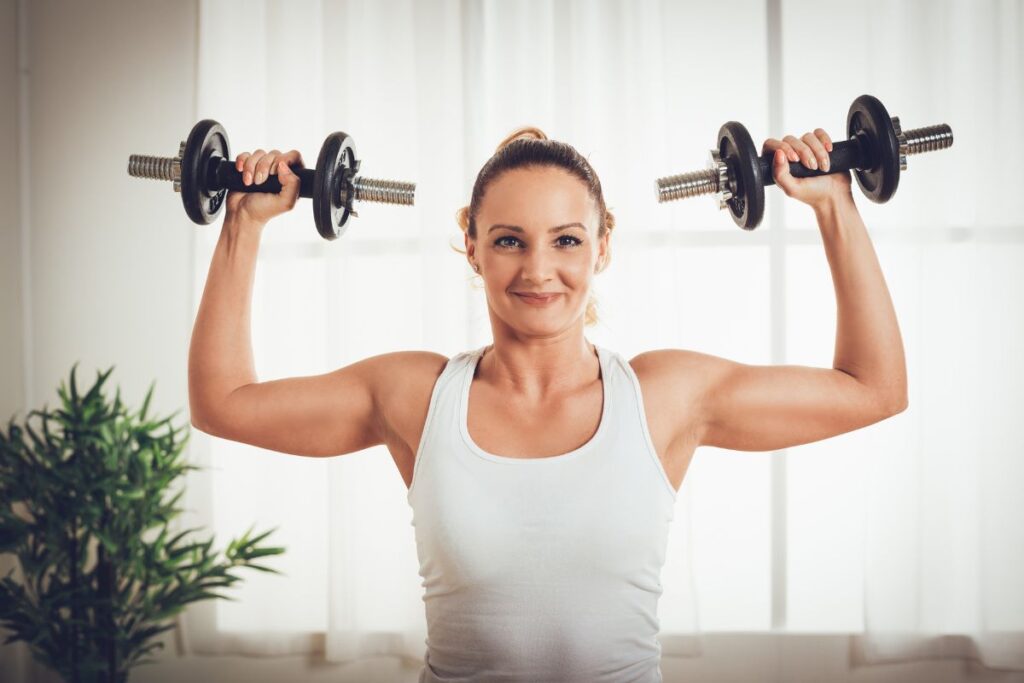
A body-composition scan can provide information, but it is not the only way to track progress. Measurements can vary according to the device and testing conditions, and muscle gain may happen alongside fat loss.
Look for changes in what your body can do:
- The dumbbells that once felt heavy now feel manageable.
- You can complete more repetitions without losing form.
- You rise from a chair with greater control.
- Stairs feel easier on your legs.
- Your posture feels stronger.
- You can carry bags, lift luggage or move household objects more confidently.
These outcomes reflect the reason we train in the first place. Schellea does not train to be skinny. She trains to stay capable. The purpose of strength training for women over 50 is not simply to add a certain number of pounds of muscle. It is to create a stronger, more capable woman.
Final thoughts
Women can build muscle after 50, but the process is more personal than the dramatic promises we often see online.
Research suggests that average gains of approximately 2 to 3 pounds of muscle-related mass may be possible across several months of consistent resistance training, particularly for women who are new to it. The exact number matters less than the direction of progress.
We are looking for stronger legs, a more secure grip, better posture and the confidence to continue lifting, carrying, climbing and travelling independently.
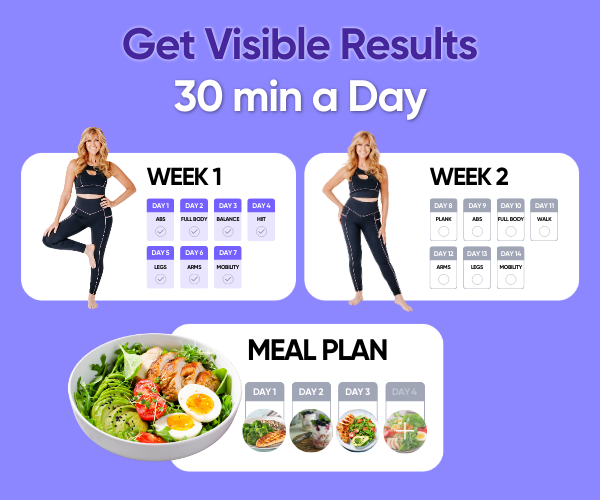
The Fabulous50s Vitality App brings the five pillars of the Fabulous50s Longevity Protocol together through guided Strength, Cardio, Balance, Mobility and Power workouts created for women over 50. You can begin with the level that suits your body, learn the movements safely and increase the challenge as your confidence grows.
Frequently Asked Questions
Yes. Research involving postmenopausal and older women shows that resistance training can increase muscle-related mass, strength and physical function. Results vary, but age does not remove the body’s ability to adapt.
Research suggests average whole-body gains of approximately 2 to 3 pounds across resistance-training studies involving postmenopausal and older women. Some beginners may gain more or less depending on their program, nutrition, health, recovery and starting muscle mass.
Strength may begin improving within the first several weeks, while measurable or visible muscle growth usually requires consistent training over several months. Changes in everyday function may appear before a dramatic visual difference.
Women need resistance that challenges the muscles, but this does not always mean starting with heavy weights. Bodyweight movements, bands and light dumbbells can be effective when the final repetitions feel demanding and the resistance gradually progresses.
Two full-body sessions each week can provide a meaningful starting point. Current ACSM guidance recommends training the major muscle groups at least twice weekly. Additional volume may support greater muscle growth when it is introduced gradually and recovery remains adequate.
Yes, particularly when you are new to resistance training. Muscle gain and fat loss can occur at the same time, which means the scale may change very little even while body composition and strength improve. Research in postmenopausal women shows resistance exercise is particularly useful for supporting muscle gain.
Yes. Building muscle after menopause may require more attention to progressive training, protein, sleep, joint comfort and recovery, but postmenopausal women remain responsive to resistance exercise.
Nunes, Paulo Ricardo Prado, et al. “Higher Volume Resistance Training Enhances Whole-Body Muscle Hypertrophy in Postmenopausal and Older Females: A Secondary Analysis of Systematic Review and Meta-Analysis of Randomized Clinical Trials.” Archives of Gerontology and Geriatrics, September 2024.
https://pubmed.ncbi.nlm.nih.gov/38744142/
American College of Sports Medicine. “ACSM Unveils Landmark 2026 Resistance Training Guidelines.” March 2026.
https://acsm.org/resistance-training-guidelines-update-2026/
Nunes, João Pedro, et al. “Responsiveness to Muscle Mass Gain Following 12 and 24 Weeks of Resistance Training in Older Women.” Aging Clinical and Experimental Research, 2021.
https://pubmed.ncbi.nlm.nih.gov/32447738/
Oliveira-Júnior, Gersiel Nascimento de, et al. “Resistance Training Volume Enhances Muscle Hypertrophy, but Not Strength in Postmenopausal Women: A Randomized Controlled Trial.” Journal of Strength and Conditioning Research, May 2022.
https://pubmed.ncbi.nlm.nih.gov/32569127/
Nunes, Everson A., et al. “Systematic Review and Meta-Analysis of Protein Intake to Support Muscle Mass and Function in Healthy Adults.” Journal of Cachexia, Sarcopenia and Muscle, April 2022.
https://pubmed.ncbi.nlm.nih.gov/35187864/
Khalafi, Milad, et al. “The Effects of Exercise Training on Body Composition in Postmenopausal Women: A Systematic Review and Meta-Analysis.” Frontiers in Endocrinology, June 2023.
https://pubmed.ncbi.nlm.nih.gov/37388207/