
There is a moment a lot of us know too well. You sit down to rest and realise your knees ache a little more than they used to. Or you try to get up quickly and feel that familiar stiffness in your hips. It is not a sign that your body is giving up. It is a sign that your body is asking for something different.
This is where chair exercises for seniors can make such a difference. They are not lesser workouts or watered-down versions of what you used to do. They are safe, intentional exercises designed to help you build strength, improve mobility, support your balance, and feel more confident in your body, all while seated or using a chair for support.
Research consistently shows that regular exercise after 50 helps preserve muscle mass, protect bone density, and reduce the risk of falls. You do not need a gym, a mat, or a long workout to begin. A sturdy chair and 20 minutes can be enough to help you move better, feel steadier, and start building strength safely.
We’re going to take this one step at a time, together.
Key Takeaways: Chair Exercises For Women Over 50
- Chair exercises for seniors build genuine strength, flexibility, and balance without stressing your joints.
- Just 20 to 30 minutes a few times a week is enough to improve your posture, circulation, and energy.
- Seated workouts are ideal for women over 50 managing arthritis, joint pain, or returning to movement after a break.
- Seven simple chair exercises can help strengthen the arms, core, legs, and upper back using only a sturdy chair.
- Consistency matters far more than intensity. Three sessions a week can produce real, visible results within weeks.
- Move at your own pace, within your own comfort range. Progress builds one session at a time.
Why Are Chair Exercises for Seniors Worth Taking Seriously?
So many women over 50 have told us the same thing: they stopped exercising because what they used to do started hurting. The high-impact classes, the floor work, the long runs. Their bodies gave them clear signals and they listened. The problem was, nothing replaced it.
Chair exercises fill that gap beautifully. When you are seated, the pressure on your knees, hips, and lower back drops significantly, but your muscles are still working. You are still building strength. You are still improving circulation and flexibility. The chair is not a limitation. It is a tool that lets you keep moving safely.
A study published in the Journal of Aging and Physical Activity found that chair-based exercise programs led to meaningful improvements in muscle strength, flexibility, and quality of life in older women. These are not from gruelling sessions but from consistent, manageable exercise done regularly over time.
Chair exercises for women over 50 also fit into real life. You can do them before the day gets away from you, while watching something you love, or during a work break. That kind of accessibility is exactly why women actually stick with them.
14 days of chair workouts. Free.
A short guided routine each day for your arms, core, legs and posture, all done sitting down.
- Safe for every fitness level, including joint pain and balance concerns
- Every move can be done fully seated, or adapted to stand
Two free bonuses when you join:
- Printable progress tracker
- Protein food sources cheat sheet
Created by Schellea Fowler, Certified Personal Trainer and Neuro Athletics Coach.
What Do You Need to Get Started?
Very little. That is part of what makes this so freeing.
- A sturdy chair without wheels. A dining chair is perfect.
- Comfortable clothing that lets you move without restriction.
- Flat shoes or bare feet for stability.
- Optional: a light resistance band or small hand weights when you are ready to progress.
Please check with your doctor before beginning any new exercise routine, especially if you are managing a health condition or recovering from surgery or injury.
7 Chair Exercises for Seniors That Build Real Strength
We’re going to move through the full body here, starting gently and building as we go. Take your time with each one and notice how your body responds. There is no rush.
1. Seated Marching (Warm-Up)

Sit tall with your feet flat on the floor and your hands resting lightly on your thighs. Lift one knee slowly toward your chest, lower it, then lift the other. It is exactly what it sounds like: marching on the spot. This warms up the hip flexors, gets the blood moving through the legs, and gives your body a gentle signal that movement is starting.
Do 20 lifts (10 per side) at a comfortable, steady pace.
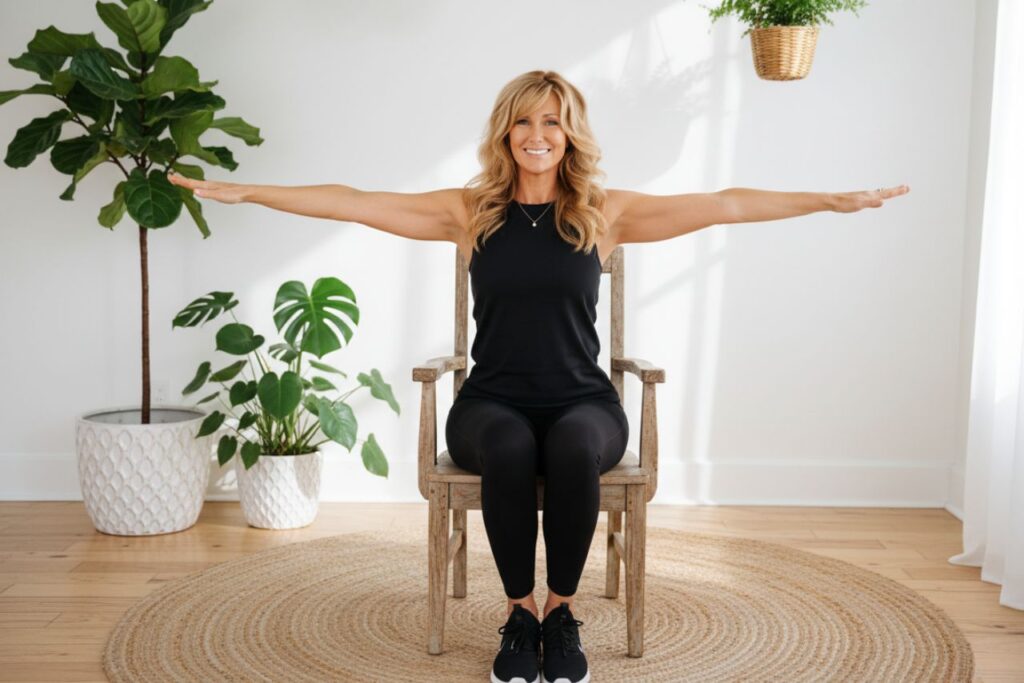
2. Seated Overhead Press
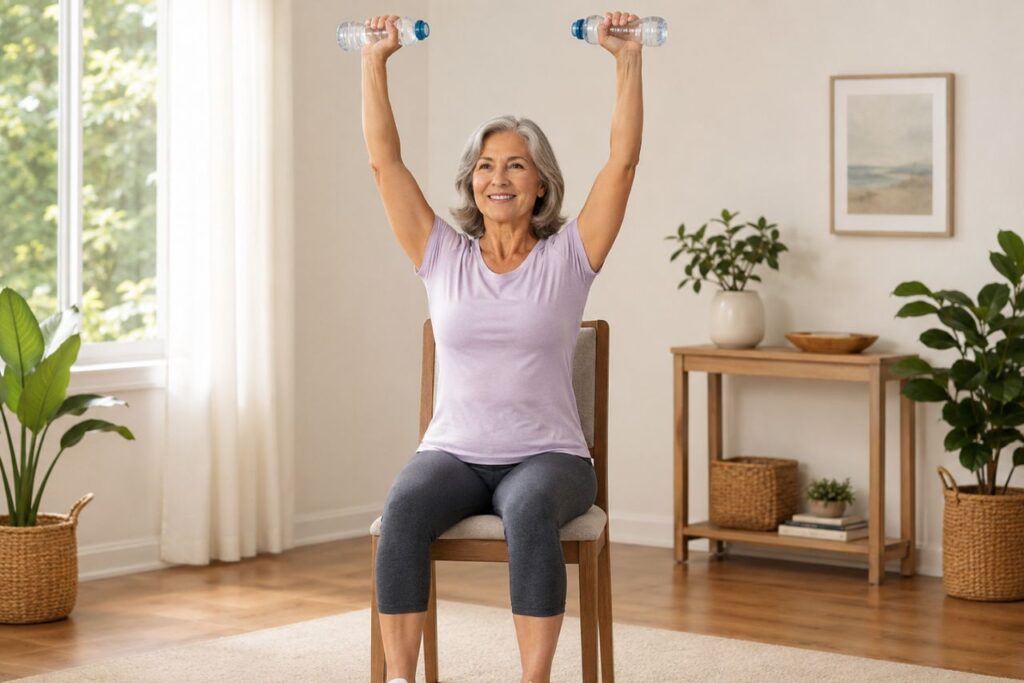
Hold a light weight or a water bottle in each hand. Bring your elbows up to shoulder height with your palms facing forward. Press both arms straight overhead, then lower slowly back to the start. Feel the work in your shoulders and upper arms. After menopause, these are the muscles that tend to lose strength fastest, and pressing movements like this are one of the most effective ways to rebuild them.
Do 3 sets of 10 to 12 repetitions.
3. Seated Leg Extensions
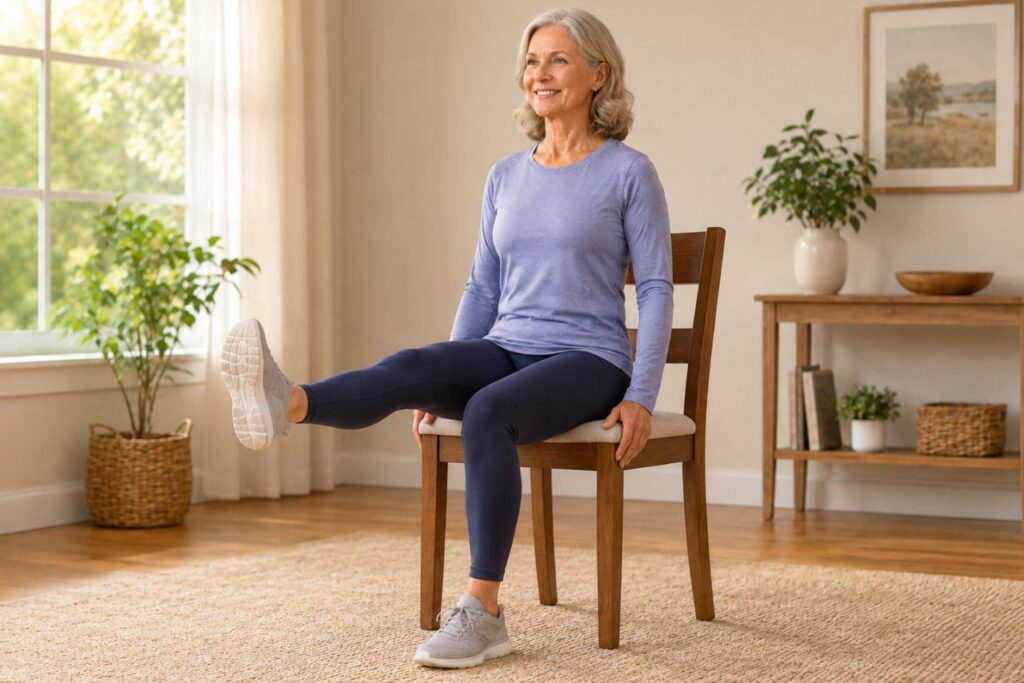
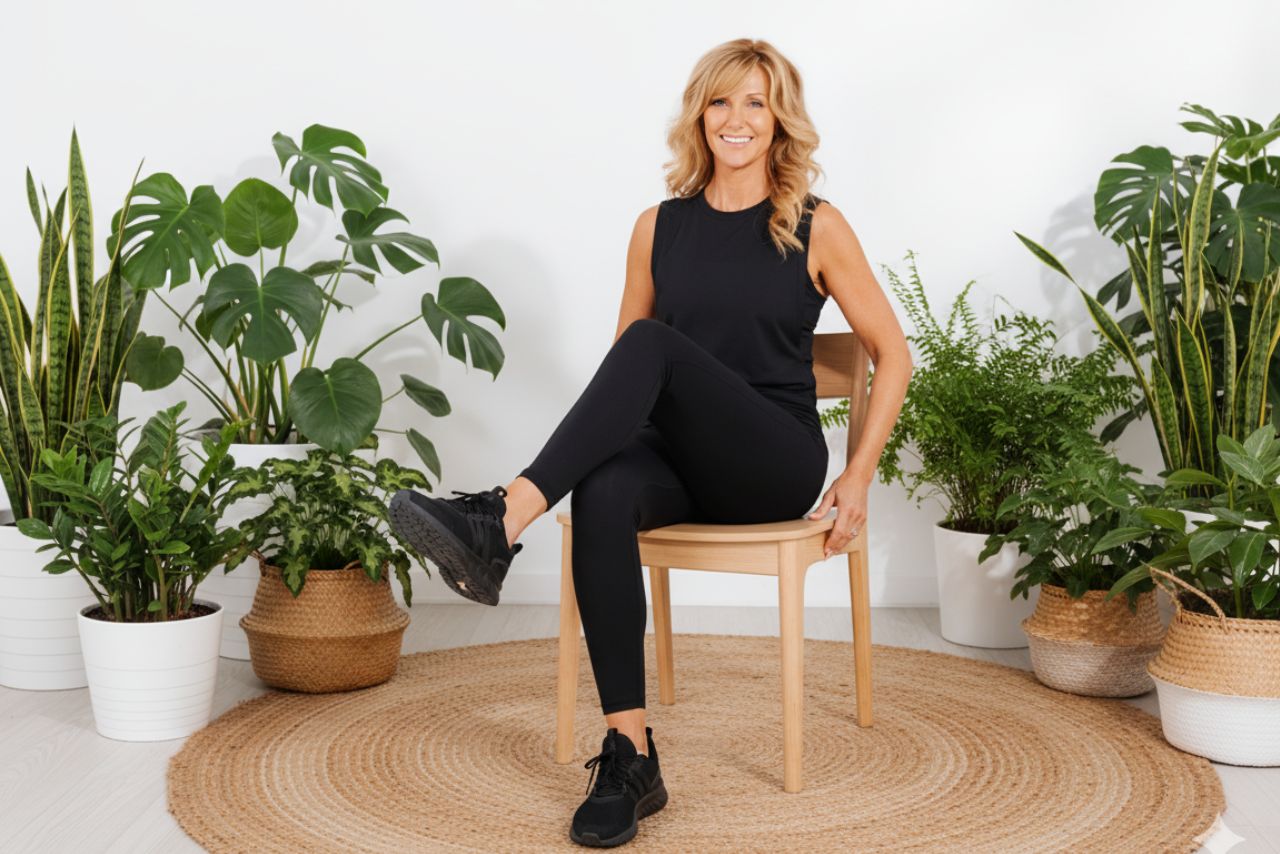
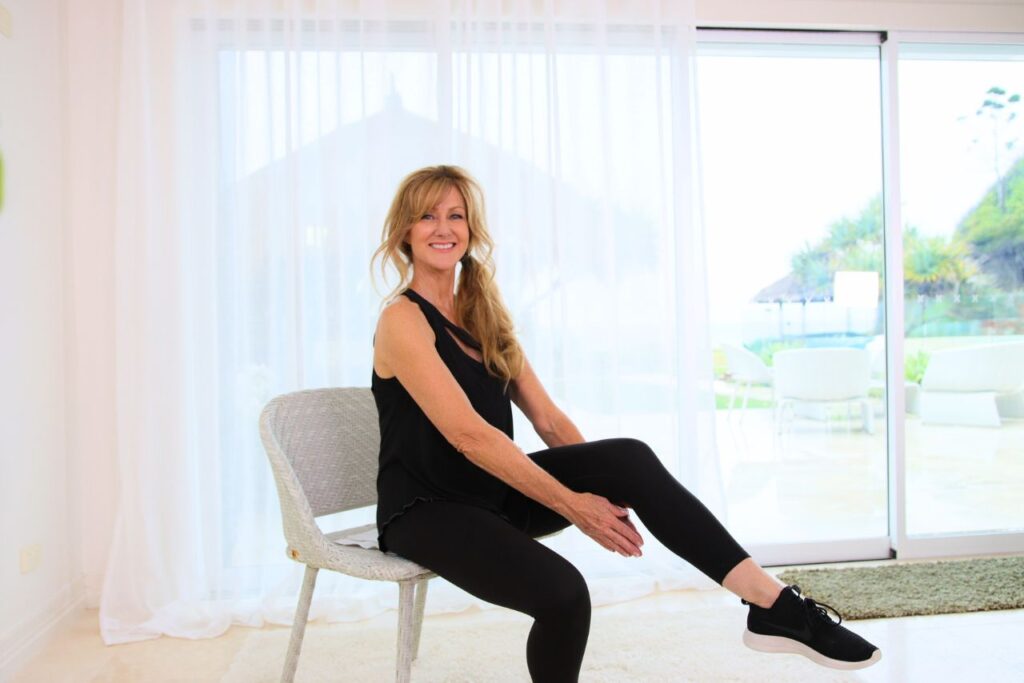
Sit near the front edge of your chair. Extend one leg straight out in front of you until it is level with your hip, hold for two seconds, then lower it slowly. Alternate legs. This targets the quadriceps, the large muscles at the front of your thighs, which play a huge role in how easily you get up from a chair, climb stairs, and stay steady on your feet. Research shows quad strength is one of the strongest predictors of functional independence as we age.
Do 3 sets of 10 per leg.
4. Seated Row
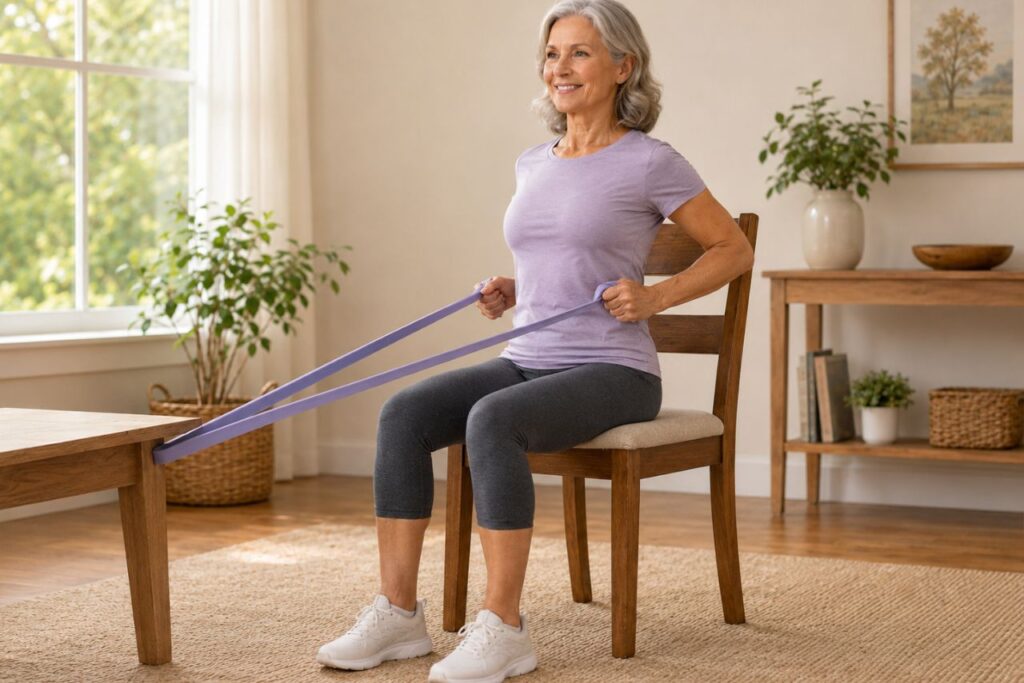
Loop a resistance band around something sturdy in front of you, or simply extend your arms forward and imagine you are holding one. Pull your elbows back in a rowing motion, squeezing your shoulder blades together as you do. This is one of the most important chair exercises for women over 50 because it directly targets the upper back, the part of the body most responsible for good posture. If you have noticed yourself rounding forward more than you used to, this is the exercise to prioritise.
Do 3 sets of 12 repetitions.
5. Seated Torso Twist
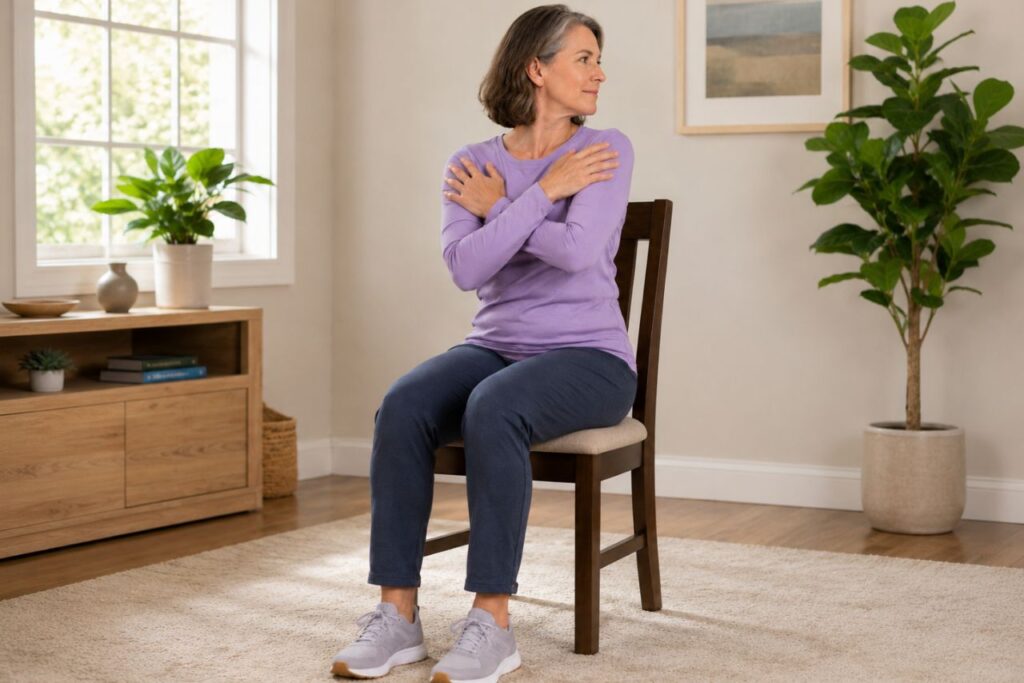
Sit tall with your feet grounded and your arms crossed over your chest. Breathe in, and as you breathe out, rotate your upper body gently to the right. Hold for a moment, return to centre, then rotate to the left. Keep your hips facing forward throughout. This movement keeps the spine mobile and works the muscles along the sides of your waist. For women dealing with back stiffness, this can feel like exactly what the body has been asking for.
Do 10 rotations per side.
6. Seated Calf Raises
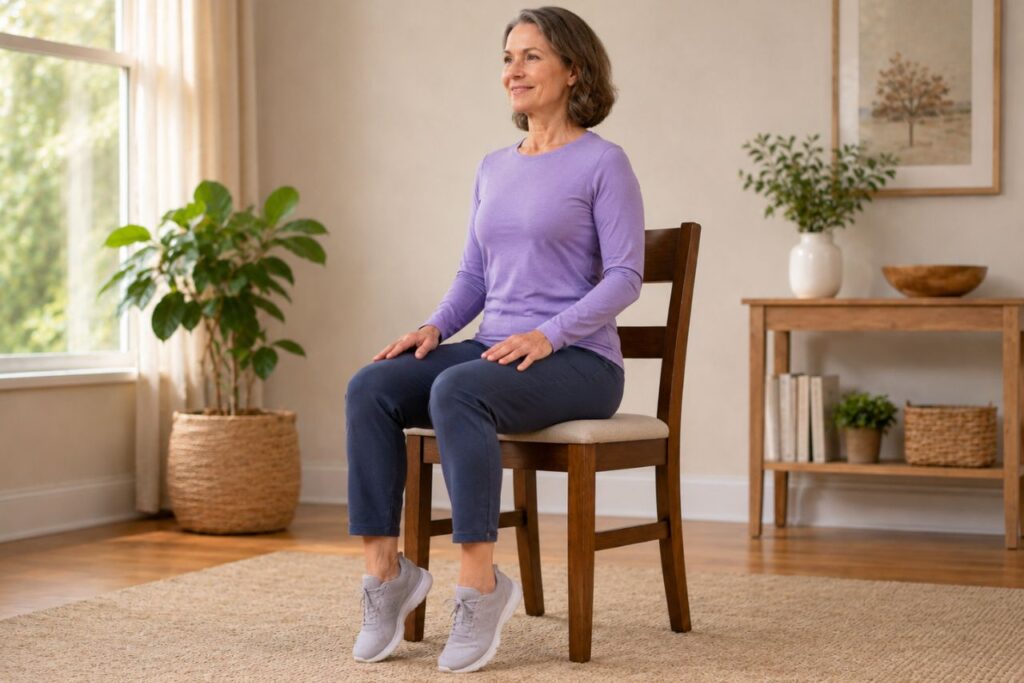
With both feet flat on the floor, press through the balls of your feet and lift your heels as high as you comfortably can. Hold for two seconds, then lower slowly. Simple as it looks, this is one of the most valuable chair exercises for seniors. It strengthens the calf muscles, supports ankle stability, and improves circulation in the lower legs, which is especially important for women who spend long periods sitting.
Do 3 sets of 15.
7. Sit-to-Stand
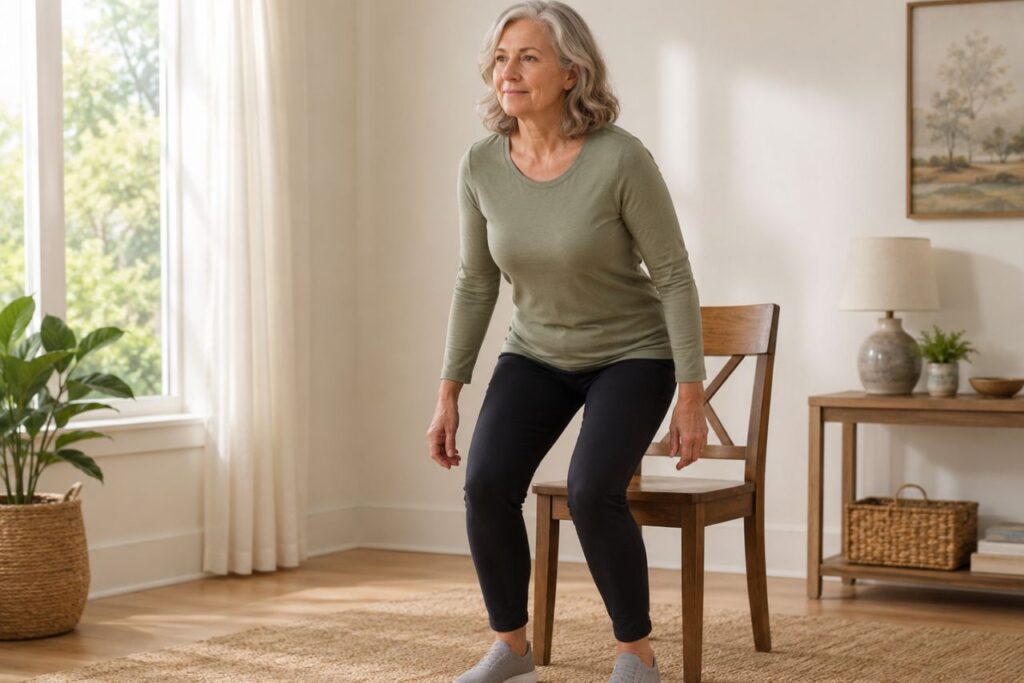
Move to the front edge of your chair. Plant your feet hip-width apart. Lean slightly forward from the hips, press through your heels, and rise to standing, without using your hands if you can manage it. Then lower yourself back down slowly and with control. This is the single most functional movement in this entire routine. It trains the exact muscles and movement pattern you use dozens of times every day, and it is one of the best indicators of overall physical strength and independence.
Do 3 sets of 8 to 10 repetitions.
READ ALSO: 30-Minute Seated Chair Workout for Women Over 50
How Often Should You Do Chair Exercises for Women Over 50?
Start with three sessions a week and let your body have a day of rest in between. Even 20 minutes is enough to create real change when you are consistent. Most women begin noticing a difference in how they feel within the first two to three weeks, such as improved energy, less stiffness in the morning, and a little more ease in everyday movement.
When the routine starts feeling comfortable, that is your cue to add a little more challenge. More repetitions, a slightly heavier weight, or a slower tempo on the way down. Small progressions like these are what keep your body adapting and improving over time.
The World Health Organization recommends that older adults aim for at least 150 minutes of moderate-intensity movement per week. Chair exercises count toward that. Three sessions of 20 to 30 minutes already gets you there.
READ ALSO: Chair Exercises WORK! Try it Now 😮 #shorts
What Will You Notice When You Start Moving Consistently?
The changes often show up quietly at first. Reaching for something feels a little easier. Getting up from the couch takes less effort. Your posture feels taller, your steps feel steadier, and someone may even notice the difference in how you carry yourself. That is the work paying off.
Women who commit to chair exercises for women over 50 regularly tend to report:
- Noticeably better posture within the first two to three weeks.
- Less joint stiffness, especially in the mornings.
- Improved balance and steadiness when walking or navigating stairs.
- More energy throughout the day.
- Stronger arms, legs, and core within six to eight weeks.
- A genuine lift in mood, backed by research on movement and mental health.
Every session adds something. Even the short ones, even the slower ones. It all counts.
Final Thoughts
We want you to know something important: starting where you are is not settling. It is wisdom. A chair is not a compromise. It is how so many women have rebuilt their strength, found their footing again, and rediscovered what their bodies are still capable of.
Whether you are coming back after months away from movement, managing pain that makes traditional exercise difficult, or simply looking for something you can do every day without dreading it, this is a genuine starting point. A real one. And you do not have to be perfect at it to benefit from it.
Try three of these exercises this week. See how your body feels on the other side of that. Then come back and do a little more. We will be right here with you, every step of the way.
Frequently Asked Questions
They can, and the science backs that up. Resistance-based seated movement stimulates muscle protein synthesis in older adults, the same process that drives muscle growth in any form of strength training.
Chair exercises are one of the most commonly recommended options for women managing arthritis or joint pain precisely because they take load off the knees and hips. The seated position supports the joints while the muscles around them get stronger, which actually helps reduce pain over time.
Most women notice a shift in how they feel, more energy and less morning stiffness, within the first one to two weeks. Strength changes tend to become visible around the four to six week mark when you are exercising consistently.
They will, and this is one of the most important benefits. Strengthening the muscles in your legs, ankles, hips, and core directly improves balance and reduces fall risk. The sit-to-stand exercise in particular is used in clinical settings specifically for this purpose. The stronger those muscles become, the steadier you will feel when you are standing and moving.
One missed session doesn’t undo what you’ve created. Life happens to all of us and the most important thing is just to get back without making yourself wrong for the gap. Progress isn’t gone overnight. Just pick up where you left off. Give yourself grace and keep going. That’s the only rule that really matters.
Sources
World Health Organization. “Physical Activity and Older Adults.” World Health Organization, www.who.int/news-room/fact-sheets/detail/physical-activity.
Human Kinetics. “Chair-Based Exercise and Physical Function in Older Women.” Journal of Aging and Physical Activity, journals.humankinetics.com/view/journals/japa/japa-overview.xml.
National Institute on Aging. “Exercise and Physical Activity for Older Adults.” National Institute on Aging, www.nia.nih.gov/health/exercise-physical-activity.
Arthritis Foundation. “Exercise Benefits for Arthritis.” Arthritis Foundation, www.arthritis.org/health-wellness/healthy-living/physical-activity.
American College of Sports Medicine. “Physical Activity Guidelines for Older Adults.” American College of Sports Medicine, www.acsm.org/education-resources/trending-topics-resources/physical-activity-guidelines.