
As we move through our 50s and beyond, balance becomes so much more than simply standing steady on one leg. It becomes the quiet reassurance that you can walk across a room, step off a curb, climb the stairs, or move through your day without that little fear of falling sitting in the back of your mind.
And if you have osteoporosis, balance is even more important. When our bones become weaker, a fall can lead to much more serious injury. That is why fall prevention is not something to think about later. It is something we can begin gently, safely, and consistently today.
The beautiful thing is that your body is always willing to learn. You can build your stability, strengthen the muscles that support your bones, and get more comfortable in your movement with the right exercises.
You don’t need to do intense workouts or complicated routines to get started. Small, simple balance exercises, done regularly, can really help. They train your feet, legs, hips, core and posture to work together so your body can respond faster when you trip, turn or step on uneven ground.
So, let’s explore the balance exercises for osteoporosis and fall prevention after 50. These movements are designed to help you feel stronger, steadier, and more confident in your body.
Why Does Balance Decline After 50 and What Does It Have to Do with Osteoporosis?
Balance is the result of several body systems functioning together. Your vision, your inner ear (the vestibular system), and your proprioceptive system (the network of sensors in your muscles, tendons and joints that tells your brain exactly where your body is in space at any given moment).
After menopause, there are several things that change all at once. They lose muscle mass and the strength and speed of the corrective responses that would prevent falling from becoming a stumble. This impairs the nerve conduction and makes the signals from the proprioceptors less efficient. Loss of estrogen affects bone density but also muscle quality and reaction time. This means that when you lose your footing, you have less margin for error.
A 2023 systematic review and meta-analysis published in the Journal of Rehabilitation Medicine confirmed that balance training significantly improves postural stability and reduces fall risk in women with osteoporosis. The review found that structured balance training produced meaningful improvements in balance scores, fear of falling, and functional mobility across multiple studies.
It’s a direct road to osteoporosis. When a woman has low bone density, the consequences of a fall are far more serious than they would be for a woman whose bones are healthy. A fracture of the wrist, hip or vertebra can alter everything from independence and mobility to quality of life and long-term health outcomes. Training balance is not an optional extra to an osteoporosis management plan. It’s one of the top priorities on the list for most women.
READ ALSO: How to Start Exercising After an Osteoporosis Diagnosis
What Is Proprioception and Why Does It Matter for Fall Prevention?
Your body’s sense of its own position is called proprioception. This is what allows you to step over an uneven surface without watching your feet, to grope around in the dark for something without knocking it over, and to catch yourself when you trip before you are consciously aware of what is happening.
Your muscles, joints and connective tissue have sensors that send your brain constant information about angles, pressures and movement. Your brain uses that information to make constant, micro-adjustments in your posture and movement.
A six-month pilot study published in the Journal of Functional Morphology and Kinesiology (2025) assessed proprioceptive training in older women with osteoporosis and found significant improvements in balance, with one-leg stance duration increasing from an average of 2.49 seconds at baseline to 7.31 seconds after the six-month intervention. Participants also reported meaningful reductions in chronic back pain alongside the balance improvements.
Just like strength and cardiovascular fitness are responsive to exercise, bones respond to practice. The more you train your balance in a controlled, safe environment the sharper and more responsive your proprioceptive system becomes, and the safer you are from the split-second stumbles that lead to falls.
What Are the Best Balance Exercises for Osteoporosis After 50?
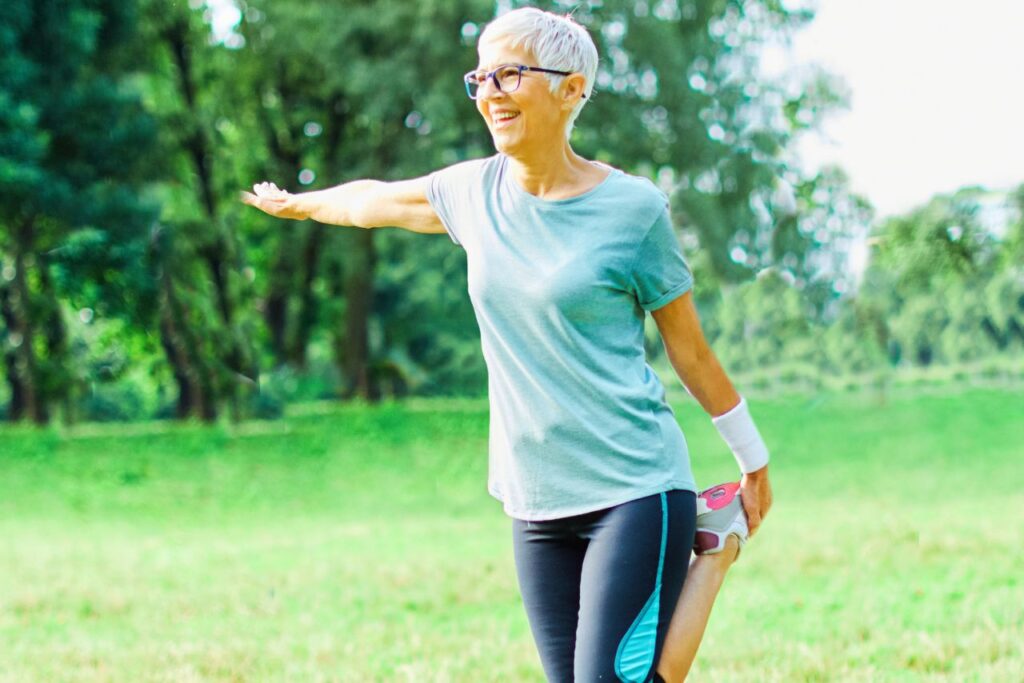
The exercises below are organized from most accessible to slightly more challenging. Start with the first two or three and add more as your confidence grows. All of them can be done near a wall or sturdy chair for safety.
1. Single-Leg Stand
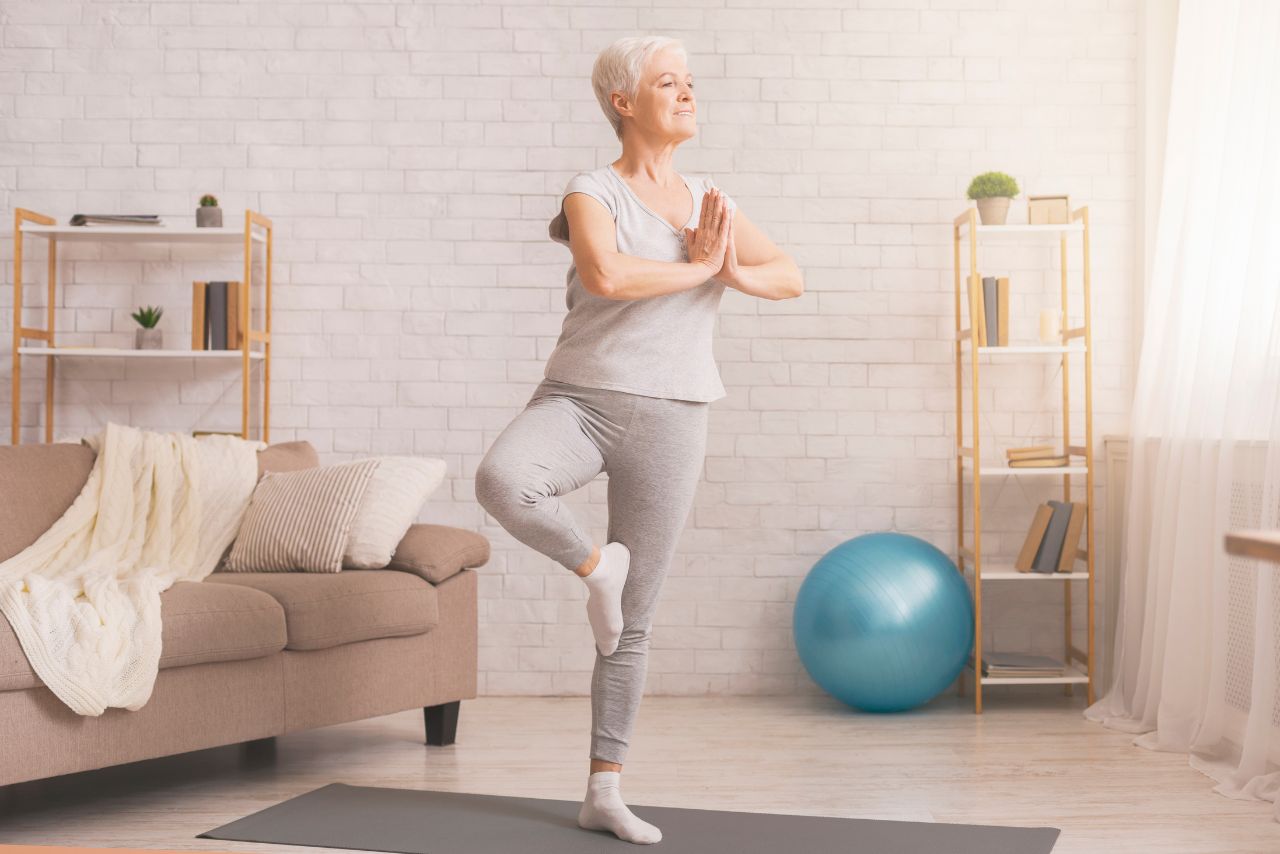
This is the foundational balance exercise and one of the most studied for fall prevention. Stand tall near a chair or wall, shift your weight onto one foot, and lift the other foot just off the floor. Hold for as long as comfortable, working toward 10 to 30 seconds per side.
The single-leg stand is a direct exercise for the stabilizing muscles around the ankle, knee and hip on the standing leg. It also activates the proprioceptive sensors in the foot and ankle, which are important in detecting and compensating for balance shifts. Open your eyes and lightly touch the chair with your finger for safety. When confidence builds, try with eyes open and no support and then eyes closed.
2. Heel-to-Toe Walk
With each step place one foot directly in front of the other so the heel of the leading foot touches the toes of the trailing foot. Walk forward 10-20 steps along a wall or corridor. Come back and turn slowly. This exercise trains the narrow base of support our bodies use when we navigate tight spaces, stairs and uneven ground.
The heel-to-toe walk improves coordination of the foot and ankle with the core and also challenges the vestibular system to maintain balance in a limited pattern. It’s simple, requires no equipment and can be done daily as part of a morning routine.
3. Side Steps
Stand with feet together and step to the side. Right foot out, left foot out, right foot out, repeat for 10 steps to the right, 10 steps back to the left. Maintain control and purpose in the movement, weight evenly distributed through each foot on landing. This works on lateral stability, the balance direction most involved in the sideways stumble pattern that causes many hip fractures.
4. Sit-to-Stand Without Using Your Hands
This is a strength and balance challenge all in one. Sit forward on a sturdy chair with your feet hip-width apart. Cross your arms over your chest and lean slightly forward at the hips, then push through your heels to straighten up without using your hands to help you. Lower back slowly into a seated position. 10 repetitions and do 2 sets.
The sit-to-stand is one of the most important functional exercises for women with osteoporosis. It trains the exact movement pattern that protects the hip in everyday life, like getting up from chairs, getting out of the car, and rising from the toilet. Research repeatedly shows that the ability reduces the risk of falls and promotes independence in the long term.
Follow along: This 10-Minute Balance Workout Could Save Your Life After 50
5. Calf Raises
Stand behind a chair with hands resting lightly on the back for support. Rise up onto your toes as high as comfortable, hold for two seconds, then lower slowly. The slow lowering is what trains the eccentric control of the calf muscles and ankle, which is what activates when you catch yourself mid-stumble. Start with two sets of 12, progressing to doing them without holding the chair as your ankle stability improves.
6. Standing Marching
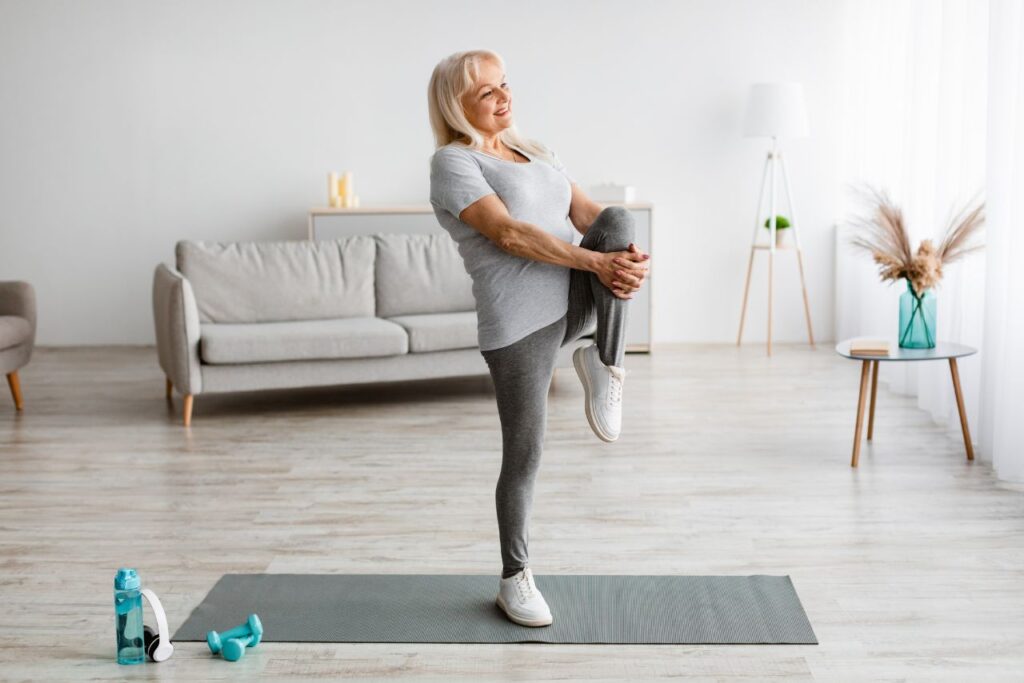
March on the spot, raising each knee to hip height if possible, swinging the opposite arm. Stand tall. This exercise works the hip flexors and core muscles used in step-over patterns that help to prevent trips, such as stepping over a curb, going around furniture, or walking on uneven ground. March for 30 to 60 seconds at a controlled, deliberate pace.
7. Tandem Stance
Stand with one foot directly in front of the other, heel touching toe, and hold the position for 10 to 30 seconds. This is a static version of the heel-to-toe walk and places a sustained challenge on the lateral balance system. It is harder than it looks and can be done facing a wall for safety. Alternate which foot is in front.
8. Tai Chi-Inspired Weight Shifting
Tai Chi is one of the most extensively studied movement practices for fall prevention in older women. A 2024 study published in Frontiers in Public Health found that 12 weeks of Taijiquan practice improved one-leg stance balance by 61% in fall-prone postmenopausal women, alongside significant improvements in strength and flexibility. Even simple Tai Chi-inspired movements, done without formal training, can be beneficial.
Stand with feet shoulder-width apart and shift your weight slowly from foot to foot, transferring fully before lifting the unloaded foot slightly. Add slow arm movements if you like. This deliberate, flowing weight shifting trains the proprioceptive system across the full range of single-leg balance in both directions.
EXPLORE MORE: Low-Impact Osteoporosis Exercises for Women Over 50
9. Standing Core Work
Balance is as much a core function as it is a function of the leg and ankle.” During every upright movement, the deep muscles of your abdomen and lower back are responsible for maintaining your centre of gravity over your base of support. Standing core exercises like standing oblique crunches, one-arm exercises on one leg and controlled torso rotations train this central stability in a functional, weight-bearing position.
Try standing on one leg and slowly lifting one arm up over your head and back down. This simple movement works the lateral core muscles on the standing side and trains the ankle proprioception at the same time. It’s a deceptively good one.
READ ALSO: Strength Training for Osteoporosis After 50: A Beginner Guide
How Do You Build Daily Balance Practice into Your Routine?
The women who get the most improvement in their balance are not the ones taking an hour-long balance class once a week. They are the ones who do five to ten minutes every day, woven into moments that already exist in their routine.
A few ideas that work well:
- While the kettle boils: single-leg stands, one minute per side. You have two minutes every time you make tea.
- During the morning news: seated-to-standing practice, heel-to-toe walking across the room, or standing marching on the spot.
- After your morning walk: two minutes of calf raises and tandem stance near a wall before you come inside.
- Before bed: one minute of slow weight shifting, which also functions as a gentle wind-down for the nervous system.
The total is never more than five to ten minutes. Practiced daily, the compound effect over weeks and months is significant. This is exactly how balance improves, through repeated, small inputs that the nervous system gradually internalizes.
Try this daily five-minute practice: 5 Minute Balance Exercises for Women Over 50
Why Does Balance Training Work Best Alongside Strength Training?
Balance training teaches your body to detect instability. Strength training gives it the power to respond. Both are essential, and neither fully substitutes for the other.
When you lose your balance, your body has a split second to react with corrective action, a corrective step or muscle contraction. The success of that correction depends on how quickly your proprioceptive system can detect the imbalance and how strongly your muscles can act on that signal. Balance training boosts detection. Corrective exercise is strength training that is mainly for legs and glutes.
Research reviewed in Current Osteoporosis Reports (2025, Springer Nature) found that multimodal exercise programs combining balance training with resistance exercise were the most effective approach for fall prevention in postmenopausal women with osteoporosis, outperforming either modality used alone.
So in practice this means your ideal weekly schedule looks like this: balance work everyday (it’s gentle enough to do everyday) and strength training two to three times per week on non-consecutive days. They work together to construct a body that is sensitive to instability and resilient enough to correct it.
EXPLORE MORE: Power Training: The New Science Behind Longevity and Fall Prevention for Women Over 50
What Home Safety Changes Support Your Balance Work?
Balance training builds the capacity to catch yourself. A safer home environment reduces the triggers that challenge that capacity unexpectedly. Both matter, and together they significantly reduce fracture risk.
A few simple home adjustments that make a meaningful difference:
- Remove rugs and runners that can slide or catch a toe, particularly near the bathroom, kitchen, and stairs.
- Ensure good lighting in all areas you move through at night, including the path from the bedroom to the bathroom.
- Install grab bars in the shower and beside the toilet if they are not already there. These are genuinely protective, not just a concession to frailty.
- Wear supportive, flat-soled shoes with good grip inside the house. Slippers with smooth soles on hard floors are a significant fall risk.
- Keep frequently used items at waist to shoulder height to reduce the need to reach up or bend down in ways that challenge balance.
- Consider a non-slip mat in the shower or bath.
None of these changes limits your independence. Every one of them protects it.
What About the Fear of Falling? How Does That Affect Balance?
Fear of falling is a very real and understandable reaction to living with osteoporosis. What many women don’t realize is that fear of falling is also a risk factor for falling. When we are scared we shrink, and we make shorter and tentative steps. We look down at our feet instead of ahead. We do not move freely and we grab surfaces. All these adaptations to protect us, in reality, degrade the quality of balance over time.
The most effective antidote to fear of falling is progressive confidence, built through exactly the kind of daily balance practice described in this article. Each time you hold a single-leg stand a little longer, each time you take a step heel-to-toe a little more steadily, you’re proving to your nervous system that you’re capable. It builds up the evidence, the fear diminishes, and the movement becomes more natural.
If fear of falling is significantly limiting your movement or quality of life, it is worth mentioning to your doctor. In some cases, a referral to a physiotherapist with experience in balance rehabilitation can make a transformative difference, both physically and psychologically.
READ ALSO: Best Exercises to Improve Balance and Prevent Falls After 50
Explore More Osteoporosis Exercise Guides for Women Over 50
Osteoporosis can feel worrying at first, but the right kind of movement can help you feel stronger, steadier, and more confident in your body again. These guides will help you understand which exercises are safest, how to begin, and how to build a simple routine that supports bone strength, balance, posture, and fall prevention.
Start with the beginner-friendly guides, then explore strength training, low-impact movement, balance exercises, and bone-supporting routines you can add to your week.
Osteoporosis Exercise Guides
Best Osteoporosis Exercises for Beginners Over 50
A gentle starting point for women who are new to osteoporosis exercise or returning to movement after a break. This guide covers walking, resistance training, balance work, and posture exercises.
How to Start Exercising After an Osteoporosis Diagnosis
A reassuring guide for women who have recently been diagnosed and want to know what is safe, what to avoid, and how to begin without fear.
Low-Impact Osteoporosis Exercises for Women Over 50
Perfect for women who want bone-supporting exercises without jumping, jarring movement, or pressure on the joints. It includes walking, Tai Chi, chair-based strength, resistance bands, and water exercise.
Strength Training for Osteoporosis After 50: A Beginner Guide
A simple guide to starting strength training safely at home, using bodyweight, light dumbbells, or resistance bands to support bone density, muscle strength, and confidence.
Balance Exercises for Osteoporosis and Fall Prevention After 50
A practical guide to improving balance, stability, and fall prevention with simple exercises you can do near a chair or wall for support.
Osteoporosis Workout for Strong Bones: The Jump Routine Every Woman Over 50 Should Try
A focused guide on how gentle impact and jumping-style routines may help stimulate bone strength, especially around the hips and spine. This is best for women who have medical clearance and feel confident with higher-impact movement.
Related Bone Health and Fall Prevention Guides
Bone Health and Menopause: Preventing Bone Loss After 50
A helpful background guide on why bone loss accelerates after menopause and what women over 50 can do to protect their bone health.
Why Strength Training Is Essential During Menopause and After 50
A supporting guide that explains how strength training helps protect muscle, metabolism, bone density, and long-term independence after 50.
Best Exercises to Improve Balance and Prevent Falls After 50
A broader fall-prevention guide that supports the osteoporosis cluster by helping women improve stability, confidence, and everyday movement.
Calcium Rich Foods for Women Over 50
A nutrition-focused support article for women who want to strengthen their bones from the inside out with calcium-rich foods.
Final Thoughts
Balance is one of the quiet superpowers of healthy aging. It is what lets us walk confidently on an uneven footpath, step off a kerb without hesitation, and move through our homes and lives without a constant low-level anxiety about falling. For women with osteoporosis, it is also one of the most powerful things we can actively cultivate.
Five minutes a day near a kitchen bench. A single-leg stand while the kettle boils. Heel-to-toe walking to the bathroom each morning. Over weeks and months, though, they build something real, a more responsive nervous system, stronger stabilizing muscles, and a sense of trust in your own body that is genuinely life-changing.
We are not trying to make you fearless. We are trying to give your body the tools to handle the unexpected moments so that when they come, as they inevitably do for all of us, you are ready.
Follow along with guided workouts on the Fabulous50s YouTube channel, where every session is designed for women over 50, and most need no equipment at all.
Frequently Asked Questions
Daily is the goal, but even five days a week will produce meaningful results. Balance, unlike strength training, does not require recovery days between sessions because the demand on the muscles is much lower. Short, frequent sessions, five to ten minutes every day, are more effective than one long session each week.
In most cases, yes, though the starting point may need to be more conservative and supervised. If you have had a recent fracture, get clearance from your doctor before beginning any new exercise.
Occasional dizziness on changing position (called postural hypotension) is common in women over 50 and can increase fall risk. If you experience dizziness, always move slowly from sitting to standing, and start all balance exercises near a wall with both hands available for support. If dizziness is frequent or severe, speak with your doctor before starting a balance program, as it may have a treatable underlying cause.
Not at all. Every exercise in this guide can be done with only a wall or sturdy chair for safety. Some women find a non-slip yoga mat helpful for floor-based movements.
Most women notice improvements in their steadiness and confidence within four to six weeks of consistent daily practice. Measurable improvements in formal balance tests, such as the one-leg stance, typically show up within six to twelve weeks.
Sources