
Let’s get real…How many times have you changed your diet for your belly fat? How many things have you cut out, reduced, tracked, or eliminated? And how many times has the belly fat remained exactly where it was?
If your answer is more times than you can count, join the club, me too! What I am about to share reframes the entire conversation. And once you understand it, a lot of what you have been told about belly fat is going to start making a different kind of sense.
The science is now pointing to something that most of us were never told. Belly fat, particularly the kind that accumulates after menopause, is often not a food problem at all. It is a biological problem. And food restriction is not the solution, because it was never the cause.
Key Takeaways: The Science Behind Losing Belly Fat
- Postmenopausal belly fat is primarily driven by estrogen withdrawal and fascial stagnation, not by overeating.
- When estrogen drops, the body shifts fat storage from the hips and thighs to the abdomen as a hormonal response.
- Stagnant fascia signals the body to surround abdominal organs with protective visceral fat, a biological protective mechanism.
- The lymphatic system, which clears metabolic waste from the fascia, has no pump and relies entirely on rhythmic exercise to function.
- A 2025 Mahidol University meta-analysis found that 12 weeks of arm swing exercise reduced waist circumference by an average of 4.76 cm without any dietary changes.
Your Body Is Not Storing Fat Because You Eat Too Much
This is the part that stops most women in their tracks. We have been told for so long that belly fat equals excess calories that it can feel almost impossible to consider an alternative explanation.
But here is what the research is increasingly showing. After menopause, the body’s relationship with fat storage changes fundamentally. It is not that your appetite suddenly became uncontrollable or your willpower disappeared. It is that the biological environment inside your body shifted. And that shift has very little to do with what is on your plate.
Two changes happen in the postmenopausal body that directly drive belly fat accumulation, and neither of them is caused by eating.
READ ALSO: Why You’re Gaining Weight Even When You Eat Less
Change 1: Estrogen withdrawal
Estrogen plays a significant role in where the body stores fat. When you are premenopausal, estrogen encourages the body to store fat in the hips and thighs.
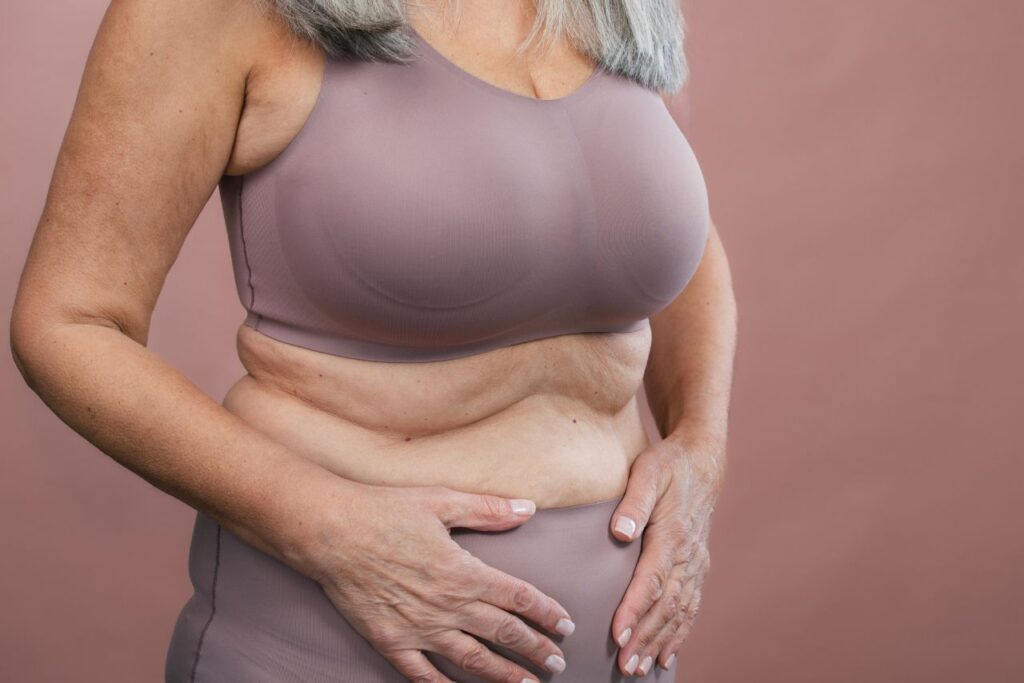
When estrogen drops, that preference shifts. The body begins storing fat preferentially in the abdomen, specifically as visceral fat or belly fat, which sits deep inside the abdominal cavity, wrapped around the organs.
This is not a lifestyle choice your body is making. It is a hormonal instruction. Eating less does not change the instruction. It only changes how much total fat is available, not where the body chooses to put it.
Change 2: The fascia becomes sticky
This is the one that surprised me most when I first came across it. Fascia is the connective tissue that wraps around your muscles, organs, and internal structures. It is a web-like system that runs through the entire body.
When we are active and well-hydrated, fascia stays supple and fluid. When we are sedentary, dehydrated, or hormonally disrupted, it can become sticky and stiff.
In Traditional Chinese Medicine, this has been described for centuries as stagnant fascia. And now modern research is giving us the clinical language to back it up.
When fascia becomes stagnant around the abdominal organs, the body interprets this as a threat. Its response is to surround those organs with a layer of visceral fat as protection.
A biological airbag, if you like. You can read about this mechanism in the 2025 Mahidol University meta-analysis on arm swing exercise, which identified fascia stagnation as a primary driver of postmenopausal belly fat.
Notice what neither of these changes has to do with. What you are eating.
So What Does Actually Shift It?
If the problem is hormonal redistribution and fascial stagnation, then the solution needs to address both of those things. And here is where the science gets genuinely interesting.
The body has a system specifically designed to clear stagnant tissue and metabolic waste. It is called the lymphatic system. And unlike your cardiovascular system, which has the heart pumping blood around the body continuously, the lymphatic system has no pump of its own.
It relies entirely on exercise to function.
When we are sedentary, which most of us are for large portions of the day, the lymphatic system essentially stalls. Metabolic waste accumulates in the tissues. The fascia becomes stickier. The body continues storing fat as protection around the stagnation. And no amount of calorie restriction addresses any part of that cycle.
What does address it is specific, rhythmic exercise that manually pumps the lymphatic system, clears the stagnation from the fascia, and signals to the body that the protective visceral fat is no longer necessary.
READ ALSO: Arm Swing Exercise for Belly Fat: What a 2025 Clinical Study Discovered About Women Over 50
The Three Biological Shifts That Happen Without Diet Change

The 2025 Mahidol University meta-analysis identified three interconnected mechanisms that explain how belly fat can be reduced without changing food intake. Understanding these three shifts changes the way you think about your body.
Shift 1: Lymphatic clearance
When the lymphatic system is activated through consistent rhythmic exercise, it begins clearing the metabolic waste, what researchers sometimes call visceral sludge, that has accumulated in the fascia. As that waste clears, the fascial tissue becomes more supple. The body no longer reads it as a threat zone. The signal to store protective visceral fat around it begins to diminish.
This is a mechanical process. It has nothing to do with how many carbohydrates you consumed. It responds to movement, specifically the kind of continuous rhythmic exercise that keeps the lymphatic system circulating consistently.
Shift 2: Inflammation reduction
The study measured a marker called high-sensitivity C-reactive protein, known as hsCRP. This is one of the most reliable indicators of systemic inflammation in the body. Across all participant groups, hsCRP levels decreased meaningfully after the 12-week exercise protocol.
This matters enormously for women over 50. Chronic low-grade inflammation is now understood to be one of the primary drivers of metabolic dysfunction after menopause. It reduces insulin sensitivity, disrupts cholesterol regulation, and suppresses the body’s ability to access and burn stored fat. When inflammation comes down, the metabolic environment changes. The body begins functioning more efficiently, including its ability to release and burn visceral fat.
No dietary change produced this result. Exercise did.
Shift 3: Energy source redistribution
The third mechanism is about what fuel the body chooses to burn. Under sustained low-intensity rhythmic exercise, the body shifts away from burning quick-access glucose and toward drawing on stored fat as its primary energy source. Exercise scientists call this the fat-burning zone.
What is distinctive about this particular type of exercise is that the continuous, whole-body engagement sustains this fat-burning shift more consistently than many other forms of low-intensity exercise. The body stays in the fat-drawing state for the duration of the session rather than cycling in and out of it.
Why Dieting Can Actually Make This Worse
Here is something that does not get said enough. For women over 50, aggressive calorie restriction can actively work against belly fat loss rather than supporting it.
When you significantly reduce calories, the body registers this as a scarcity signal. In response, it does several things that are counterproductive for the postmenopausal body. It slows the metabolism to conserve energy. It increases cortisol, the stress hormone, which directly promotes abdominal fat storage. And it can break down muscle tissue for energy, which further reduces metabolic rate over time.
For women who are already managing the metabolic changes of menopause, adding the physiological stress of calorie restriction on top of that is often what creates the plateau. You are eating less and exercising more and your belly is not moving because your body is in protective mode. It is holding onto everything it can.
The research from the Mahidol University study is significant partly because of what it confirms about this. The participants who lost an average of 4.76 centimetres of waist circumference were not in a caloric deficit. Their bodies released the fat not because they were starving, but because the biological conditions that were causing the fat storage were addressed directly.
What This Means for You Practically

None of this means diet is irrelevant to health. Nourishing your body well matters deeply. But it does mean that if your primary goal is shifting postmenopausal belly fat, removing food groups or aggressively cutting calories is very unlikely to be the answer. And it has not been the answer for most of the women who have tried it.
What is more likely to shift it is consistent exercise that addresses the lymphatic stagnation, reduces systemic inflammation, and creates the conditions for the body to release the protective fat it no longer needs.
The practical application from the 2025 research is specific. Twenty minutes of rhythmic arm swinging, four days a week, for twelve weeks, using the traditional Ping Shuai Gong 4+1 technique. It is gentle, low-impact, and requires nothing except space to stand and move your arms.
And if twenty minutes in one block does not fit your day, the research supports breaking it into four five-minute sessions. One upon waking, one after breakfast, one after lunch, one after dinner. Each short session activates the lymphatic pump, clears a little more stagnation, and nudges the blood sugar down after a meal.
Four small doses of exercise through the day. Consistent over twelve weeks. No meal plan required.
A Different Conversation About Belly Fat
The most important thing I want you to take from this is permission. Permission to stop blaming your food choices for something that was never entirely a food problem. Permission to stop the cycle of restriction and guilt that has not been working, because it was never designed to address the actual cause.
Your body is responding intelligently to a biological environment that shifted at menopause. The visceral fat you are carrying is not evidence of failure. It is your body doing exactly what it was designed to do under those conditions.
The good news is that the conditions can change. Not through deprivation, but through exercise that works with your biology rather than against it.
Our 12-week VitaliT Arm Swing Challenge is built around exactly this approach. Gentle, guided, and grounded in clinical research that confirms what we have always suspected. Your body already knows how to let go of this fat. It just needs the right conditions to do it.
Start Your 14-Day Free Trial Today!
Study reference: “Effectiveness of Arm Swing Exercise on Comprehensive Health Outcomes: A Systematic Review and Meta-Analysis”, Mahidol University, 2025.
PubMed Central: PMC11246977
Frequently Asked Questions
When estrogen levels drop at menopause, the body shifts where it stores fat, favouring the abdomen over the hips and thighs, a hormonal change that has nothing to do with calorie intake.
Fascia is the connective tissue surrounding your organs and muscles, and when it becomes stiff and sticky from inactivity or hormonal disruption, the body stores visceral fat around it as a protective response.
Research suggests aggressive calorie restriction can actually worsen belly fat in postmenopausal women by raising cortisol and triggering the body’s protective fat-storage mode.
The lymphatic system clears metabolic waste from the fascia, but it has no pump of its own and stalls without regular movement, allowing stagnation and visceral fat to build up.
The 2025 Mahidol University meta-analysis found that 20 minutes of rhythmic arm swing exercise (Ping Shuai Gong) four days a week for 12 weeks reduced waist circumference by an average of 4.76 cm with no dietary changes required.
Yes, the research supports splitting sessions into four five-minute blocks throughout the day, such as after each meal and upon waking, with the same lymphatic and metabolic benefits.