
Posture and balance are closely connected. When your body is well aligned, your head, ribs, pelvis, hips, knees, ankles, and feet work together more efficiently. When posture changes, your center of gravity can shift, and your body has to work harder to keep you steady.
This is one reason many women over 50 notice that balance feels different as they age. It may not begin with a dramatic fall or obvious weakness. It may begin with smaller signs: rounded shoulders, a forward head position, a shorter stride, less arm swing, or feeling less steady when turning, reaching, or walking on uneven ground.
At Fabulous50s, Balance is one of the Five Pillars of the Fabulous50s Longevity Protocol™ because balance supports fall prevention, coordination, steadiness, confidence, and nervous system response. It works best alongside Strength, Cardio, Mobility, and Power, rather than being trained in isolation.
Key Takeaways: How Posture Affects Balance
- Posture affects balance because it changes how your body weight is organized over your feet.
- Forward head posture, rounded shoulders, and increased upper-back rounding can make balance harder.
- Improving posture is not about standing perfectly straight. It is about helping your body move with better alignment, strength, and control.
- Posture work should be combined with balance training, strength, mobility, and core exercises.
- Balance is one of the core pillars of the Fabulous50s Longevity Protocol™.
Why Does Posture Matter for Balance?
Posture matters because balance depends on your body’s ability to keep its center of mass over its base of support. In simple terms, your body needs to keep your weight organized over your feet. When your head moves forward, your upper back rounds, or your hips shift out of alignment, your muscles and nervous system must work harder to keep you upright.
Research on age-related hyperkyphosis, which is excessive rounding of the upper back, suggests that increased spinal curvature can affect posture, physical function, balance, and fall risk in older adults. A 2025 review found that hyperkyphosis is linked with reduced postural stability and higher fall risk.
This does not mean posture has to be perfect. It means posture and balance should be trained together so the body can stay upright, responsive, and confident.
READ ALSO: Balance Exercises for Women With Osteoporosis
How Does Rounded Posture Affect Stability?
Rounded posture can bring the head and shoulders forward. This may shift weight toward the front of the body and make it harder to react quickly if you trip, turn, or step onto uneven ground.
When the upper back rounds, the chest may feel more closed, the neck may carry more tension, and the arms may swing less naturally when walking. These changes can affect gait, confidence, and movement efficiency.
A prospective study on older adults found that hyperkyphosis is common in adults aged 65 and older and may be associated with falls. The relationship is complex, but the study supports the idea that spinal posture can be part of the wider fall-risk picture.
Can Poor Posture Make Balance Worse?
Poor posture can make balance feel harder because it changes how the body receives and responds to information. Balance depends on the eyes, inner ear, feet, joints, muscles, and brain working together. If posture changes how the head, spine, pelvis, and feet relate to each other, the body may need more effort to stay steady.
Posture and balance also affect confidence. When we feel hunched, stiff, or cautious, we may take shorter steps and move less freely. Over time, moving less can reduce strength, mobility, and reaction speed, which are all important for balance.
This is why balance training should include more than standing on one leg. Keep in mind that real life includes reaching, turning, stepping, changing direction, and recovering when we lose balance.
READ ALSO: Best Balance Exercises to Improve Your Stability and Coordination
What Postural Changes Are Common After 50?
Common changes after 50 can include forward head posture, rounded shoulders, increased upper-back rounding, reduced spinal mobility, tight chest muscles, weaker upper-back muscles, weaker core muscles, and reduced hip mobility.
These changes can happen gradually. Sitting for long periods, looking down at screens, reduced strength training, osteoporosis-related spinal changes, and loss of mobility can all contribute. Posture is not just about how we sit or stand. It reflects strength, mobility, habits, bone health, and how often we move through a full range of motion.
Can Improving Posture Improve Balance?
Improving posture may support better balance, especially when posture training is combined with strength and mobility work. A randomized controlled trial found that targeted spine-strengthening exercise and posture training reduced kyphosis in older adults with hyperkyphosis over six months.
This matters because better spinal strength and alignment can help the body stand taller, move more efficiently, and respond more easily to balance challenges. Still, posture work should not replace balance exercises. It should support them.
A complete routine for posture and balance may include upper-back strengthening, gentle chest opening, core work, hip mobility, ankle strength, weight shifts, heel-to-toe walking, and supported single-leg balance.
What Exercises Help Posture and Balance?
The best exercises are simple, controlled, and safe. Try these as part of a short routine:
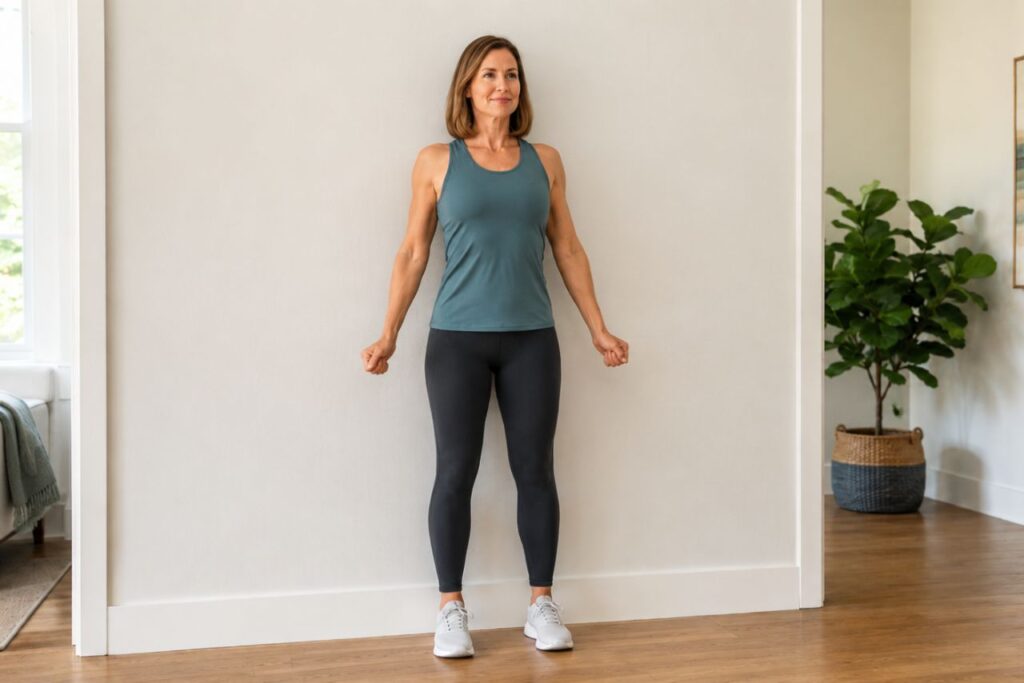
Wall Angels: Stand with your back near a wall and gently move your arms up and down to improve upper-back awareness and shoulder mobility.
Shoulder Blade Squeezes: Sit or stand tall; gently draw your shoulder blades back and down, hold for a few seconds, then release.
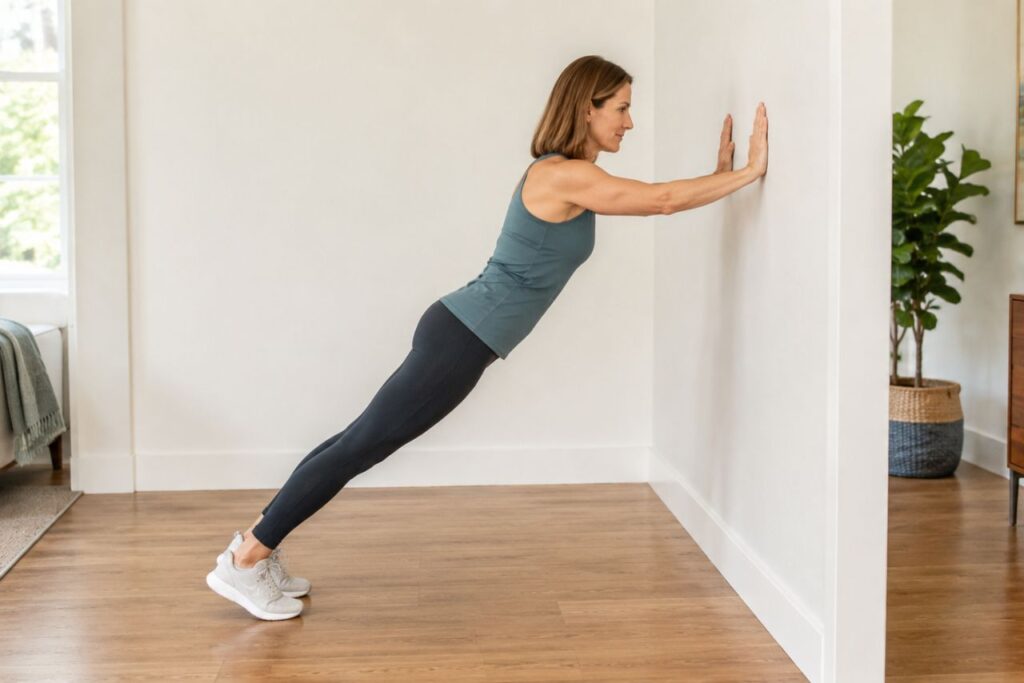
Wall Plank: Place your hands on a wall and hold a long, aligned position to train your core, shoulders, and posture.
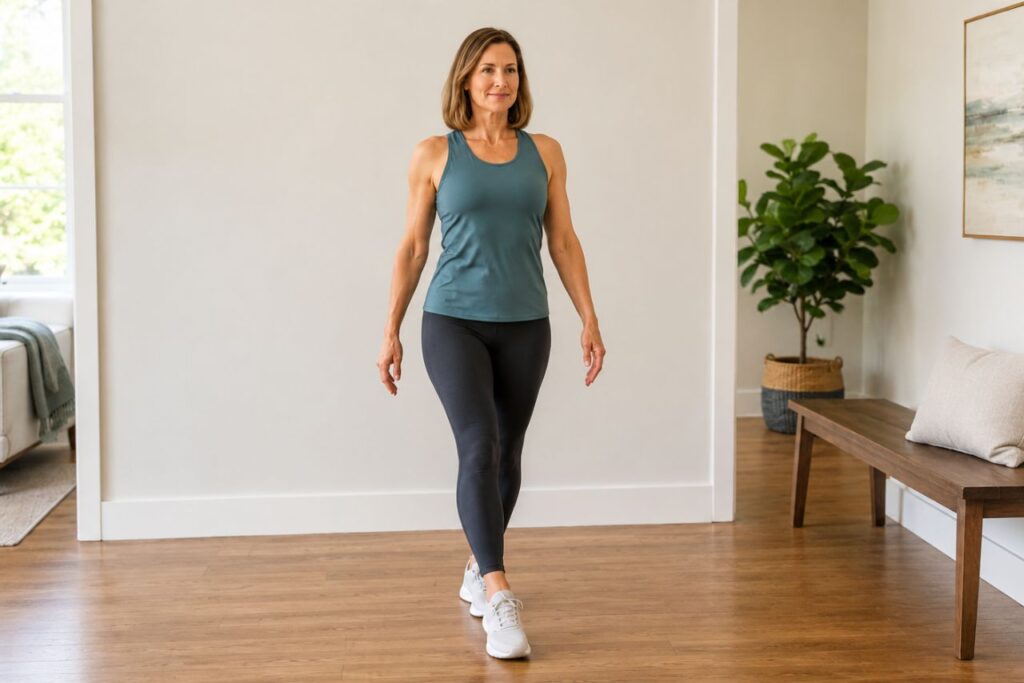
Heel-to-Toe Walk: Walk slowly in a straight line, placing one foot directly in front of the other. Use a wall or bench nearby for support.
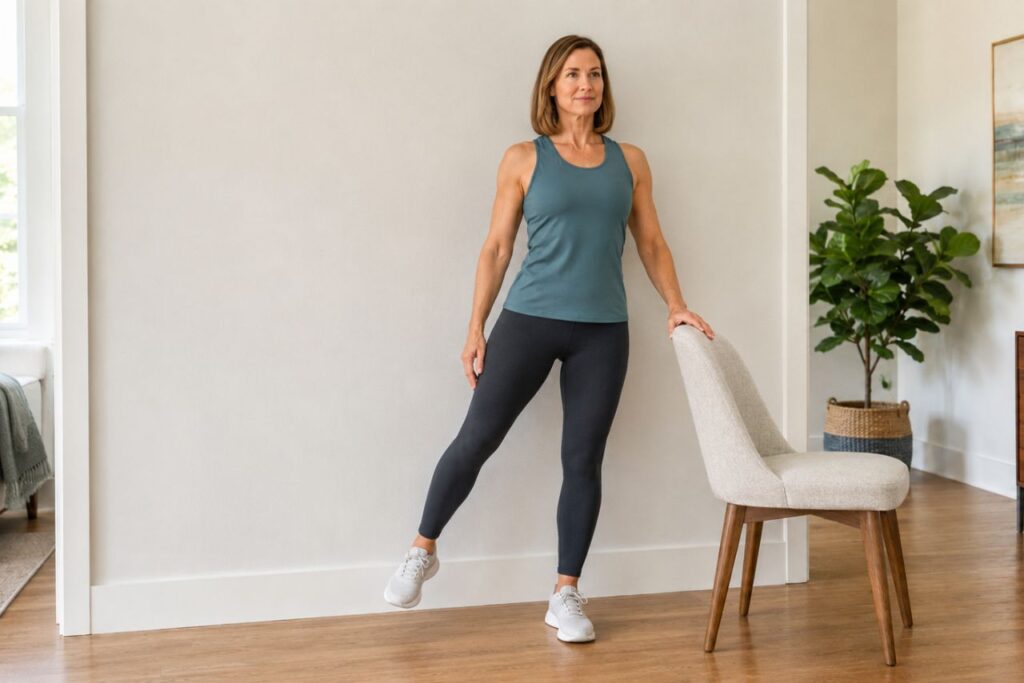
Supported Single-Leg Balance: Stand near a chair, lift one foot slightly, and hold for a few seconds while keeping your posture tall.
These exercises train posture and balance together because they ask the body to stay aligned while controlling movement.
READ ALSO: Standing Core Exercises for Women Over 50
How Often Should You Train Posture and Balance?
Posture work can be practiced most days in small amounts. Balance training can be done 2 to 3 times per week, with short daily balance moments added when safe.
The key is consistency. Five to ten minutes of posture and balance practice can be enough to create awareness and build control. The goal is not to force the body into a stiff position. The goal is to help the body become stronger, more upright, and more responsive.
When Should You Be Careful?
Stop and seek medical advice if you feel dizzy, faint, unsafe, or unusually unsteady. Speak with a healthcare professional if you have osteoporosis, recent fractures, severe back pain, neurological symptoms, unexplained balance changes, or a recent fall.
This is especially important because posture changes can sometimes be linked to osteoporosis, spinal compression fractures, vestibular issues, medication side effects, or neurological conditions.
Final Thoughts
Posture and balance work together every time we stand, walk, turn, reach, and recover from a wobble. Better posture helps the body organize itself more efficiently, while balance training teaches the brain and body how to respond when life moves us off-center.
The goal is not perfect posture. The goal is a body that feels strong, steady, mobile, and confident.
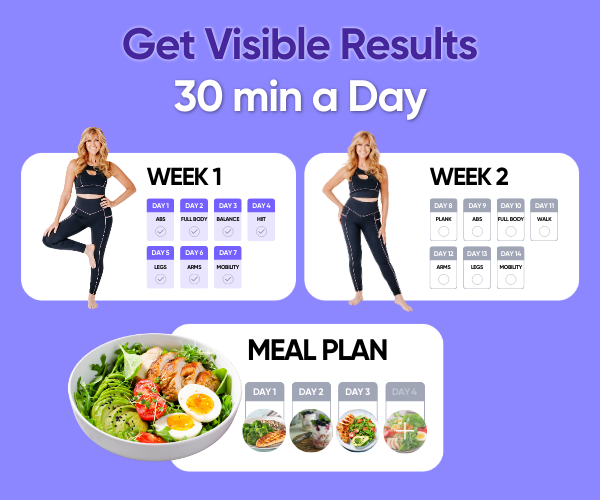
Inside the Fabulous50s Vitality App, you can follow guided workouts that support Balance, Strength, Mobility, Cardio, and Power as part of the Fabulous50s Longevity Protocol™. It gives you a simple way to train posture and balance consistently, with routines designed specifically for women over 50.
Frequently Asked Questions
Yes. Posture affects balance because it changes how your body weight is positioned over your feet. Forward head posture, rounded shoulders, and upper-back rounding can make the body work harder to stay steady.
Rounded shoulders may affect balance by shifting the upper body forward and reducing natural arm swing, posture control, and movement confidence.
The best posture for balance is relaxed alignment. Think tall spine, soft knees, open chest, relaxed shoulders, and weight evenly spread through both feet.
Posture exercises may support fall prevention when combined with balance training, strength work, mobility, and safe functional movement. They should not be the only fall-prevention strategy.
Many women notice better awareness within a few weeks, but strength, posture, and balance changes usually need consistent practice over several months.
Nezhad, Z.G., et al. “The Effects of Hyperkyphosis on Balance and Fall Risk in Older Adults: A Systematic Review.” Gait & Posture, 2025. https://pubmed.ncbi.nlm.nih.gov/39978050/
Koelé, M.C., et al. “The Association Between Hyperkyphosis and Fall Incidence Among Community-Dwelling Older Adults.” Osteoporosis International, 2022. https://pmc.ncbi.nlm.nih.gov/articles/PMC8813677/
Roghani, T., et al. “Age-Related Hyperkyphosis: Update of Its Potential Causes and Clinical Impacts.” Narrative Review, 2017. https://pmc.ncbi.nlm.nih.gov/articles/PMC5316378/
Katzman, W.B., et al. “Targeted Spine Strengthening Exercise and Posture Training Program to Reduce Hyperkyphosis in Older Adults: Results From the SHEAF Randomized Controlled Trial.” Osteoporosis International, 2017. https://pmc.ncbi.nlm.nih.gov/articles/PMC5873977/
Granacher, U., et al. “The Importance of Trunk Muscle Strength for Balance, Functional Performance, and Fall Prevention in Seniors: A Systematic Review.” Sports Medicine, 2013. https://pubmed.ncbi.nlm.nih.gov/23568373/