A strong core is not only about having toned abs. After 50, your core helps you stand taller, move more confidently, protect your lower back, and stay steady when life asks you to turn, reach, step, bend, or recover from a wobble.
That is the reason why standing core exercises are so good for women over 50. They train your center while you are upright, which is how we use our core most often in daily life. We use it when we carry shopping, climb stairs, get out of a chair, walk on uneven ground, and move through the kitchen without thinking about every step.
At Fabulous50s, Balance is one of the Five Pillars of the Fabulous50s Longevity Protocol™ because it supports fall prevention, coordination, steadiness, confidence, and nervous system response. Core strength supports that pillar because the trunk helps the body stay controlled while the arms and legs move.
Key Takeaways: Standing Core Exercises
- Standing core exercises strengthen the muscles that support posture, balance, and daily movement.
- They are helpful for women over 50 who find floor workouts uncomfortable.
- The core includes the abs, back, hips, glutes, and deep stabilizing muscles.
- Fabulous50s standing core workouts include side knee lifts, cross-body knee lifts, squat punches, and standing toe touches.
- Core training works best alongside Balance, Strength, Cardio, Mobility, and Power inside the Fabulous50s Longevity Protocol™.
Why Do Standing Core Exercises Matter After 50?
The core includes more than the abdominal muscles. It includes the deep muscles of the trunk, lower back, pelvis, hips, and glutes. Harvard Health explains that these muscles help support the lower back and help us stand, get out of a chair, bend, lift, and maintain balance.
For this reason, standing core exercises are more useful than endless crunches. Instead of training the body from the floor only, they strengthen the core in the same position we use throughout the day: standing upright.
They can also feel more accessible for women who dislike floor workouts, have neck discomfort, struggle to get down and up from the mat, or want a low-impact way to train the midsection without strain.
How Do Standing Core Exercises Improve Balance?
Balance depends on communication between your brain, eyes, inner ear, feet, ankles, hips, muscles, joints, and core. When the trunk is stronger and more responsive, the body can control weight shifts more efficiently.
Research supports the link between trunk strength and balance in older adults. A systematic review by Granacher and colleagues found that trunk muscle strength is important for balance, functional performance, and fall prevention in seniors. More recent research also suggests that core training can improve balance performance in older adults.
This does not mean core work replaces balance training. It supports it. We still need to practice weight shifts, stepping patterns, single-leg balance, turning, and reaching. Life does not happen in one position, so balance training should include movement in different directions.
READ ALSO: Best Balance Exercises to Improve Your Stability and Coordination
Simple Standing Core Exercises to Try
Here are simple standing core exercises you can include in a short routine.
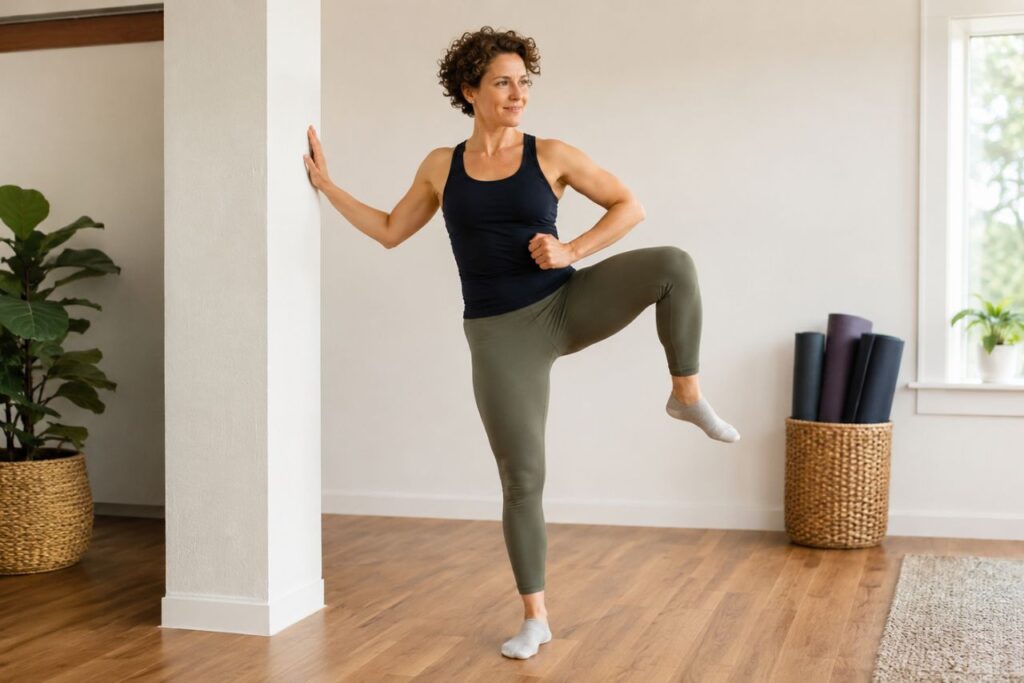
Side Knee Lifts
Stand tall with your feet hip-width apart. Shift your weight into one leg and lift the opposite knee out to the side while gently drawing your elbow toward your waist. Lower slowly and repeat.
This trains the obliques, hips, and standing-leg stability. Keep one hand near a wall or chair if you need support.
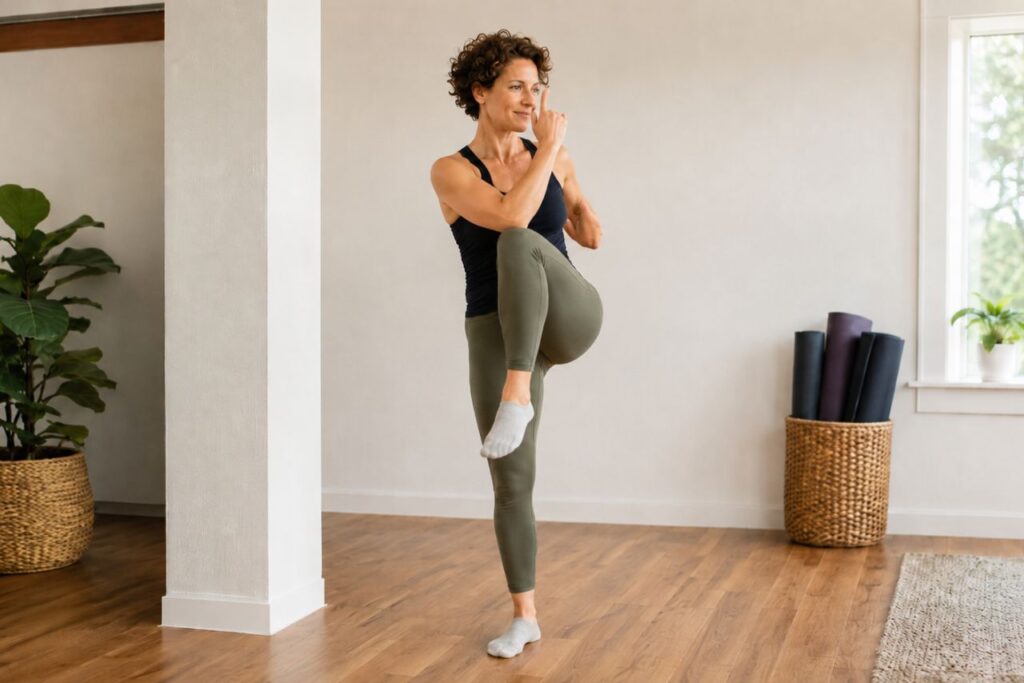
Cross-Body Knee Lifts
Stand tall and lift one knee across the body toward the opposite elbow. Return the foot to the floor with control and repeat on the other side.
This is one of the best standing core exercises because it trains rotation, coordination, and balance at the same time. Move slowly rather than swinging the leg.
Standing Toe Touches
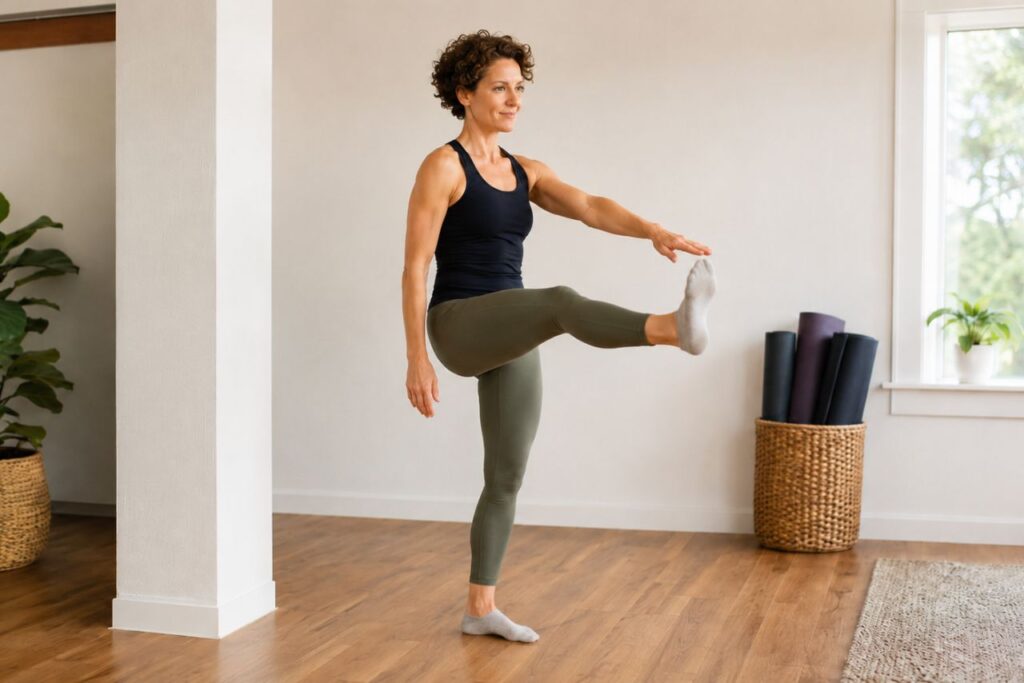
Lift one leg forward and reach toward the foot, shin, or knee. Keep the movement controlled and avoid rounding the back aggressively.
This exercise challenges the lower abs, hip flexors, hamstrings, and balance. It also teaches the core to support the body while one leg is moving.
Squat Punches
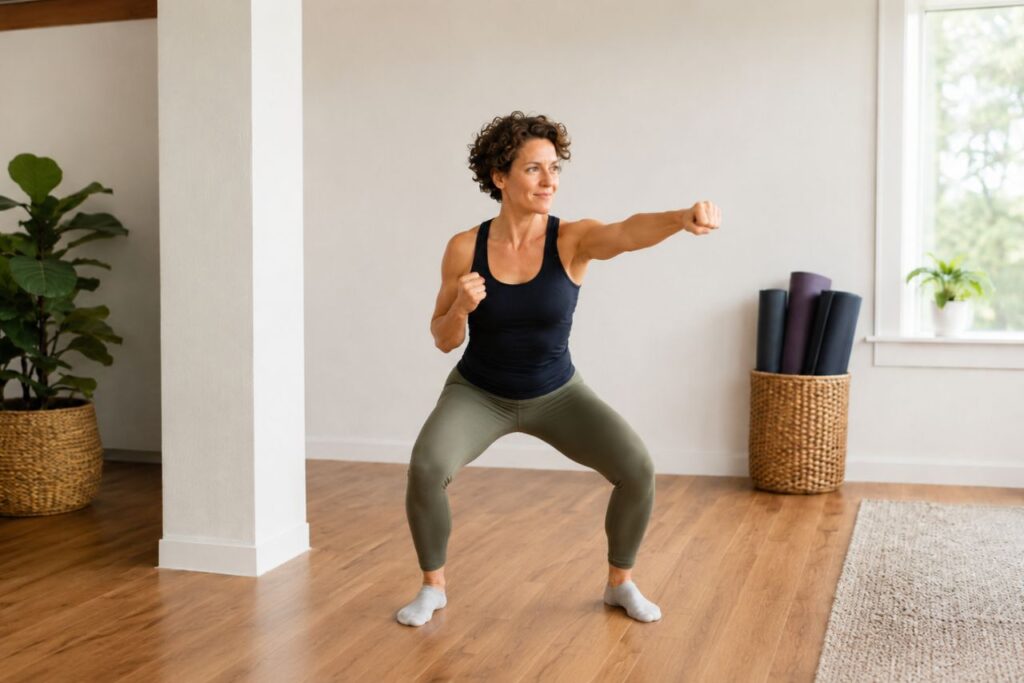
Stand with feet slightly wider than hip-width. Lower into a shallow squat, keep your spine long, and punch one arm forward at a time. Let the core control the movement so your hips do not sway side to side.
This combines legs, arms, and core. It can raise the heart rate gently while training stability through the trunk.
Standing Side Reaches
Reach one arm overhead and gently lean to the side. Return to center and repeat on the other side.
This trains the side body and helps with lateral control. Side control matters because many balance challenges happen when we step sideways, reach awkwardly, or change direction.
READ ALSO: Best Exercises to Improve Balance and Prevent Falls After 50
How Often Should Women Over 50 Do Standing Core Exercises?
Most women can start with standing core exercises 2 to 3 times per week. A short 8 to 12-minute routine is enough when the movements are controlled and consistent.
Try doing a standing ab workout for women over 50 around three times per week and pairing it with walking or light strength sessions for a well-rounded plan.
For best results, core training should sit inside a complete weekly rhythm. The Fabulous50s Longevity Protocol™ brings together Strength, Cardio, Mobility, Balance, and Power because no single type of exercise can meet every need of the midlife female body.
What Safety Tips Matter Most?
Move slowly, breathe normally, and use support when needed. A wall, bench, or sturdy chair can make standing work safer and more effective.
Avoid holding your breath, twisting too fast, locking the knees, or forcing the range of motion. If you feel dizzy, faint, unsafe, or unusually unsteady, stop. Speak with a qualified healthcare professional if you have osteoporosis, recent surgery, severe back pain, neurological symptoms, unexplained dizziness, or a recent fall.
The goal is to train the body to feel more stable, more responsive, and more confident.
READ ALSO: Safe Balance Training for Women With Low Bone Density
Final Thoughts
Standing core exercises are a simple way to strengthen your center without getting down on the floor. They support posture, balance, coordination, and everyday movement, which makes them especially useful for women over 50.
Start with a few gentle moves, use support when needed, and focus on control rather than speed. Over time, these small sessions can help your body feel steadier when you walk, turn, reach, climb stairs, and move through daily life.
Inside the Fabulous50s Vitality App, you can follow guided workouts that support Balance, Strength, Cardio, Mobility, and Power as part of the Fabulous50s Longevity Protocol™. The app gives you a simple structure so you can keep building core strength, steadiness, and confidence with workouts designed for women over 50.
Frequently Asked Questions
Yes. Standing core exercises are useful because they train the core in an upright position, which is how we use it in daily life.
They can support balance by strengthening the trunk, hips, and stabilizing muscles. They work best when combined with balance-specific exercises.
Most women can start with 2 to 3 short sessions per week. Consistency matters more than long workouts.
They are often more practical after 50 because they train multiple muscle groups, support posture, and avoid neck strain from repeated floor crunches.
No. Most standing core exercises can be done with no equipment, although a wall or chair is useful for support.
Zhong, Y., et al. “Effects of Core Training on Balance Performance in Older Adults: A Systematic Review and Meta-analysis.” Frontiers in Public Health, 2025. https://pmc.ncbi.nlm.nih.gov/articles/PMC12548199/
Granacher, U., et al. “The Importance of Trunk Muscle Strength for Balance, Functional Performance, and Fall Prevention in Seniors: A Systematic Review.” Sports Medicine, 2013. https://pubmed.ncbi.nlm.nih.gov/23568373/
Harvard Health Publishing. “The Best Core Exercises for Older Adults.” Harvard Health, 2021. https://www.health.harvard.edu/healthy-aging-and-longevity/the-best-core-exercises-for-older-adults