
There are certain everyday moments that remind us how much we rely on our bodies without thinking about it. Walking upstairs with a basket of laundry. Stepping off a curb while talking to someone. Catching the edge of a rug with your toe. Turning quickly in the kitchen when the kettle starts to whistle. These moments are small, but they ask a lot from the body.
They ask for strength, yes. But they also ask for speed, balance, coordination, and the ability to react before fear takes over.
That is why power exercises for balance matter so much after 50. Power is the ability to create force quickly enough to respond to life. For women over 50, that can mean standing up from a chair with more confidence, stepping up onto a stair, recovering from a stumble, or moving sideways when their bodies need to adjust.
Power is the ability to react quickly and move confidently. In the Fabulous50s approach, power equals independence, and it should be built progressively, with confidence first and intensity later.
Inside the Fabulous50s Longevity Protocol™, Power works alongside Strength, Cardio, Mobility, and Balance. Each pillar has its own job, and together they help women stay capable, steady, and free in daily life.
Key Takeaways: Power Exercises For Balance
- Power helps your body respond quickly during everyday movements.
- Power exercises for balance can support stair climbing, trip recovery, stepping, turning, and confidence on your feet.
- Beginner-friendly options include step-ups, quick sit-to-stands, heel drops, supported side steps, marching, and step-and-reach movements.
- Balance helps you find your center; power helps you recover quickly when you lose it.
- Women with osteoporosis, pelvic floor symptoms, dizziness, severe joint pain, recent surgery, or a history of falls should get professional guidance before higher-impact exercise.
- The Fabulous50s Vitality App is the best place to follow guided workouts across Power, Strength, Cardio, Mobility, and Balance.
Why Do Stairs Feel Harder After 50?
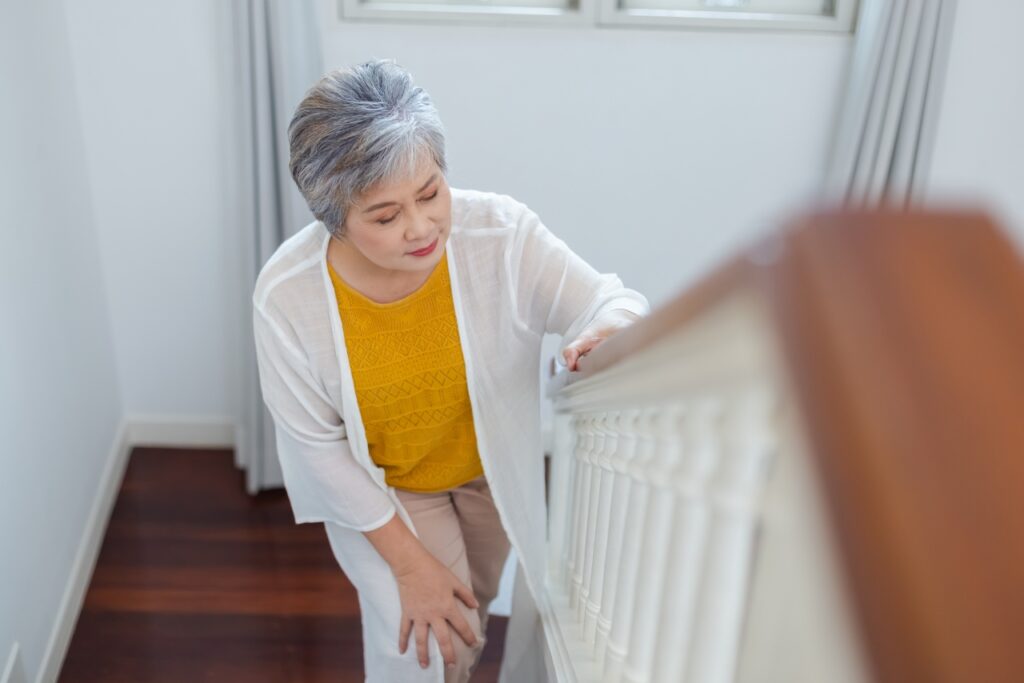
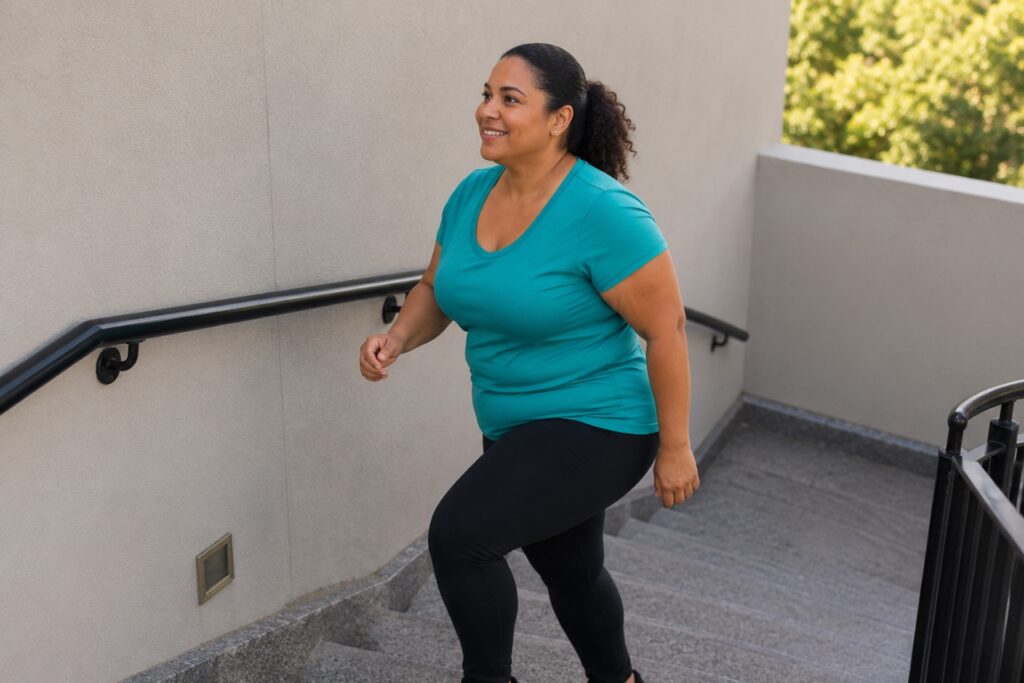
Stairs can reveal changes in the body before we notice them anywhere else. One flight of stairs asks the calves, thighs, glutes, hips, core, ankles, heart, lungs, and balance system to work together. It is not just a leg exercise. It is a full-body task.
When stairs begin to feel harder, many women assume it is only a fitness issue. Sometimes it is. Cardio fitness helps us avoid feeling breathless. Strength helps the legs push the body upward. But power is also part of the picture because each step requires a quick push through the foot and leg.
This is where power exercises for balance become useful. A step-up is not only a strengthening exercise. When performed with control and a little more intention on the upward movement, it begins to train the quick push needed for stairs, curbs, and changes in level.
Research on power training for older adults explains that power supports the ability to react, recover, and move with intent and that the decline in power can affect balance recovery, reaction time, daily movement efficiency, fall risk, and independence.
How Does Power Help When You Trip?
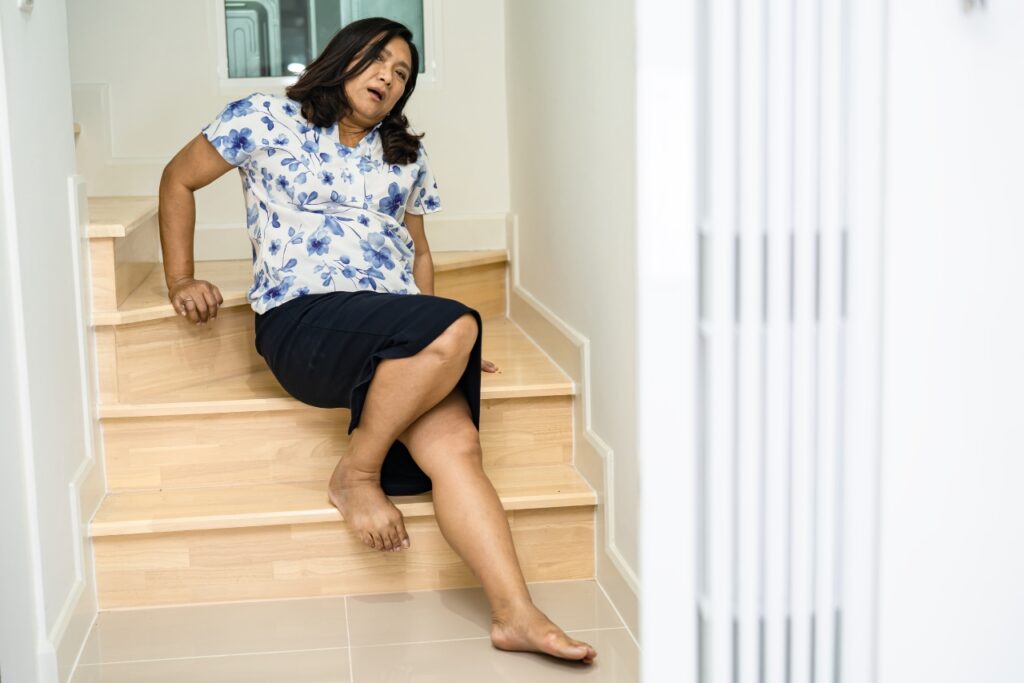
A trip happens faster than we can plan for. One foot catches, the body shifts, and suddenly the nervous system has to decide what happens next. Do you recover? Do you grab something? Do you freeze? Do your feet move quickly enough to help?
This is one of the biggest reasons power matters. Strength may help you stand tall and support your joints, but power helps your body produce that strength quickly enough when timing matters. A physically strong person can still feel vulnerable if the body cannot respond quickly to a sudden change.
For women over 50, trip recovery is not about training for dramatic athletic movement. It is about practicing simple reactions in a safe way. A supported side step, a forward-and-back step, or a quick weight shift can teach the feet and brain to communicate faster.
Power can include stepping in different directions, moving sideways, moving backwards, changing speed, changing direction, and learning to control the body when movement becomes unpredictable. That is exactly what life asks from us when we trip.
READ ALSO: Power Training: The New Science Behind Longevity and Fall Prevention for Women Over 50
What Is The Link Between Power And Balance?
Balance is often treated as standing still on one leg, but real-life balance is rarely still. It happens when you are walking, turning, reaching, bending, stepping over something, climbing stairs, or recovering from a wobble.
Balance training teaches the brain and body to communicate, react, recover, and find center again when we become unstable. Power supports that process because recovery often needs speed. If you wobble, you may need to step quickly. If you turn and feel unsteady, your feet may need to adjust. If you miss the edge of a step, your body needs to respond before you have time to overthink it.
This is why power exercises for balance should not be limited to jumping. For many women, the most useful power work begins with controlled, everyday movements that train the body to respond in different directions.
READ ALSO: Power Training vs. Strength Training: What’s the Difference?
What Are The Best Power Exercises For Stairs?
Step-Ups With Support
Step-ups are one of the most practical exercises for stair confidence. Use the bottom stair or a low step. Hold a railing, wall, or sturdy surface if needed. Place one foot on the step, press through the whole foot, and step up with control. Step down slowly.
At first, focus only on good form. Once you feel steady, add a little more energy to the upward push. This turns the step-up into a gentle power exercise without making it high impact.
Start with 5 repetitions on each side.
READ ALSO: 10 Reasons Why Women Over 50 Are Prone to Falls
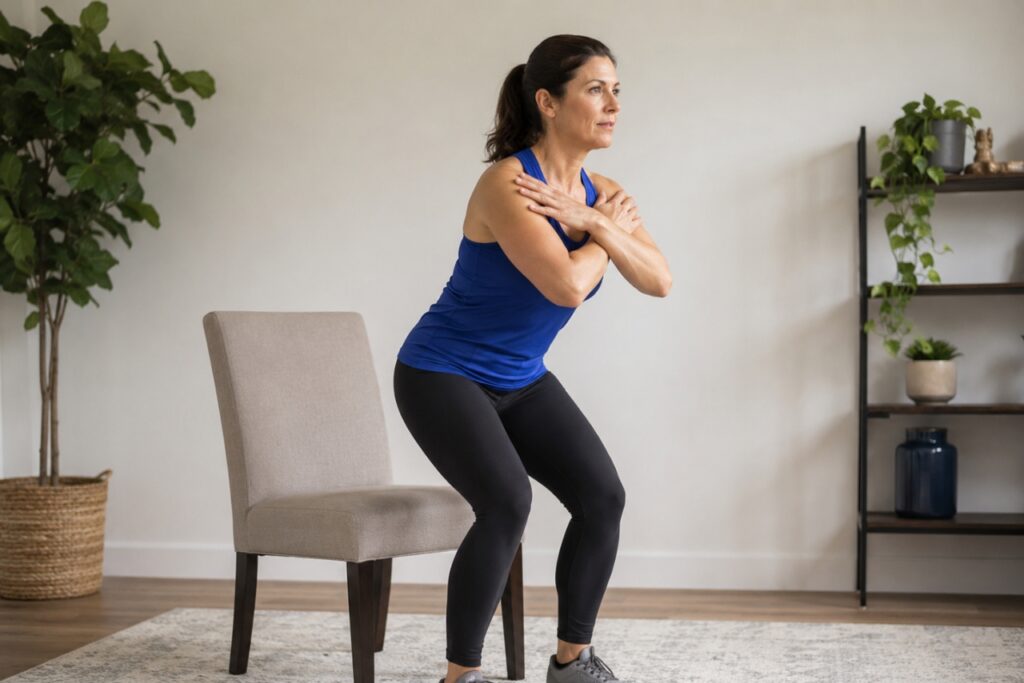
Quick Sit-To-Stands
Sit-to-stands are one of the most useful movements for independence because we rise from chairs every day. Sit toward the front of a sturdy chair with your feet flat on the floor. Stand up with a little more intention, then sit back down slowly.
SB Physio describes sit-to-stand ability as important for daily movement, independence, and fall prevention, especially as people age. For Fabulous50s women, this exercise is valuable because it trains the legs to push, the core to stabilize, and the brain to coordinate the movement.
Start with 5 to 8 repetitions.
READ ALSO: Fast Sit-to-Stands: A Simple Power Exercise After 50
Heel Raises And Heel Drops
The ankles and calves play an important role in stairs and balance. Stand near a wall or chair. Rise onto the balls of your feet, pause briefly, then lower your heels with control. If that feels comfortable, make the lowering slightly more intentional, but never jarring.
This is a gentle way to wake up the lower legs and feet, which are often overlooked in balance and stair confidence.
READ ALSO: Beginner Power Exercises for Women Over 50
What Are The Best Power Exercises For Trips?
Supported Side Steps
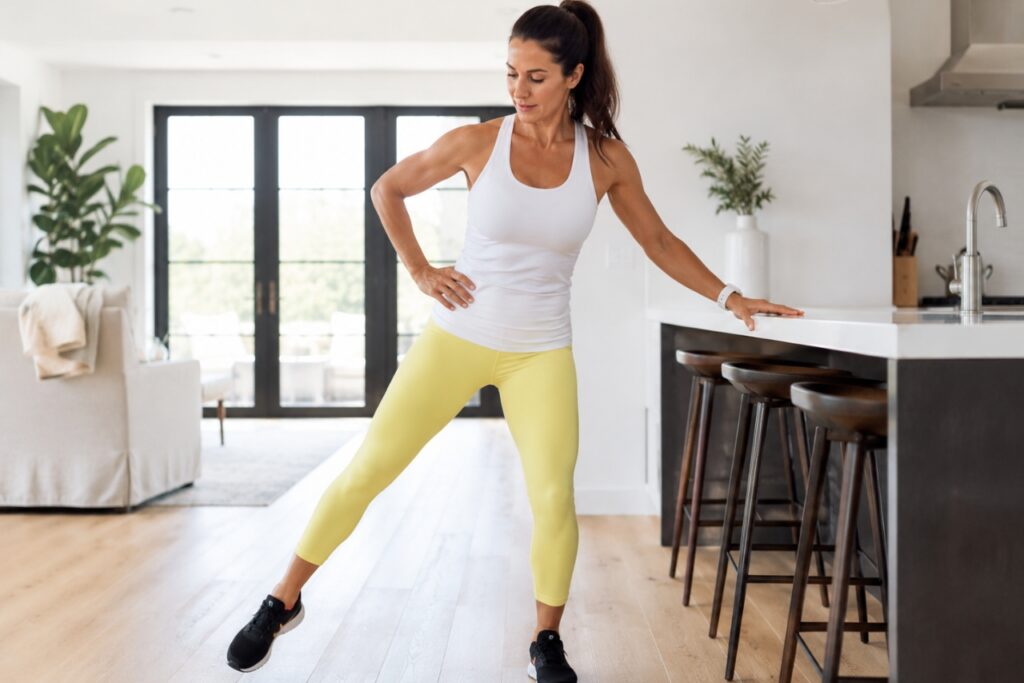
Stand near a chair, wall, or countertop. Step to the right, bring your other foot in, then step to the left. Keep the knees soft and the movement small. Once you feel steady, make the step a little quicker.
This trains your body to move sideways, which is important because trips do not always send us straight forward. Sometimes recovery means stepping out to the side.
This is one of the simplest power exercises for balance because it combines reaction, direction change, and confidence without requiring impact.
Forward-And-Back Steps
Stand tall with support nearby. Step one foot forward, return to center, then step the same foot back and return again. Keep the movement small at first. Once it feels comfortable, add a little more speed.
This helps train the body to leave its base of support and return safely. That is exactly what happens when you catch yourself after a stumble.
Start with 5 rounds on each side.
Toe-Lift Marching
Many trips happen because the foot does not clear the floor as well as it used to. Marching can help train foot clearance, rhythm, coordination, and confidence.
Stand tall, lift one knee gently, then the other. Think about lifting the toes as you march. Let your arms swing naturally. Keep it low impact and controlled.
Start with 20 seconds.
READ ALSO: Strength Isn’t Enough: Why Women Over 50 Need Power Training Too
What Are The Best Power Exercises For Balance?
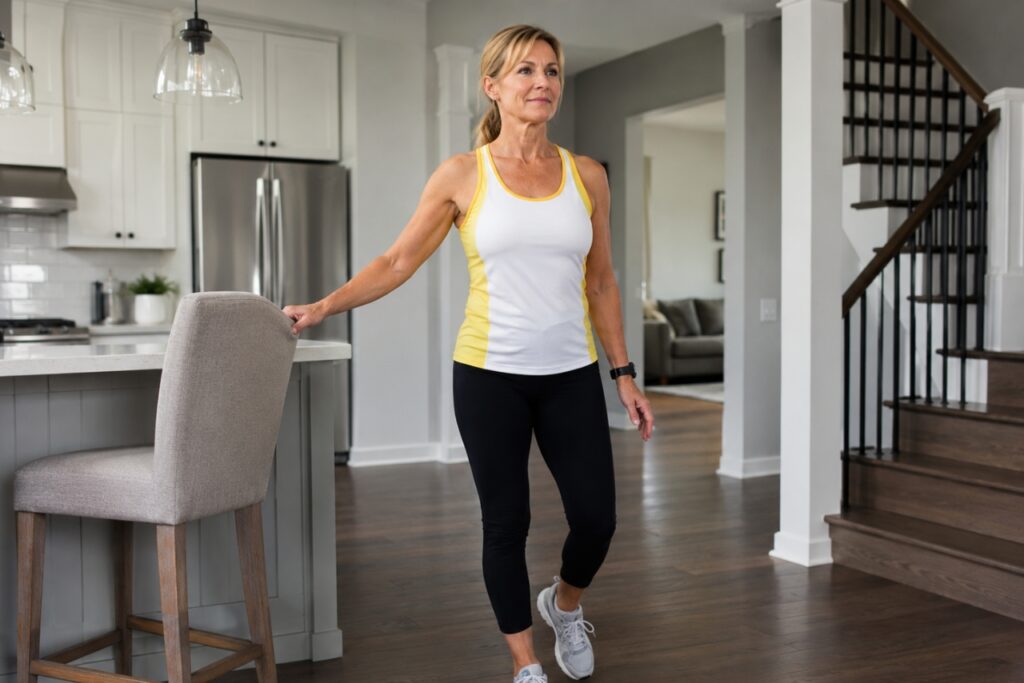
Quick Weight Shifts
Stand with your feet hip-width apart and support yourself nearby. Shift your weight from one foot to the other. Once that feels easy, make the shift slightly quicker while keeping your posture tall.
This trains your body to move its center of gravity without panic. It is small, but it is very useful for balance recovery.
Step And Reach
Stand tall. Step one foot slightly to the side while reaching one arm forward or across the body. Return to center and repeat on the other side. Keep the movement smooth and controlled.
This exercise brings together balance, coordination, and brain training because your arms, legs, eyes, and core all have to work together.
Fast Hands With Steady Feet
Stand or sit tall with your feet grounded. Move your hands quickly in front of your body as though gently pushing the air away. Keep your shoulders relaxed and your body steady.
This is helpful for women who feel nervous about faster lower-body movement. You can train speed and coordination without loading the knees, hips, or pelvic floor.
READ ALSO: Power Training: The New Science Behind Longevity and Fall Prevention for Women Over 50
How Can You Build A Simple Weekly Routine?
You do not need a long workout to begin. A few minutes of Power Exercises For Balance once or twice a week can help your body practice the skill of responding more quickly.
A simple routine might look like this: 5 quick sit-to-stands, 5 step-ups on each side, 10 seconds of supported side steps, 5 forward-and-back steps on each side, 10 quick weight shifts, and 20 seconds of toe-lift marching.
Rest whenever needed. Repeat the routine once more only if you still feel steady. The goal is to finish feeling successful, not exhausted.
Power work is best done when the body feels fresh. Research explains that power training should keep volume low and quality high because fatigue can reduce movement speed and technique. That is especially important for women over 50 because confidence and control are part of the training.
How Do You Know If You Need To Modify?
Modify if a movement causes pain, dizziness, leaking, pressure, fear, or loss of control. Power training should feel alert and focused, not chaotic.
If step-ups feel too hard, use a lower step. If quick sit-to-stands feel unstable, use your hands or a higher chair. If side steps feel unsteady, slow them down and stay close to support. If marching feels too much, reduce the height of the knees.
Johns Hopkins Medicine recommends exercises that support strength and balance for fall prevention and advises people to keep safety in mind when doing movements such as sit-to-stands, balance work, and heel raises.
Women with osteoporosis, osteopenia, joint replacements, pelvic floor symptoms, dizziness, uncontrolled blood pressure, severe joint pain, recent surgery, neurological symptoms, or a history of falls or fractures should seek guidance before adding faster or higher-impact movements.
READ ALSO: Beginner Power Exercises for Women Over 50
How Does This Fit Into The Fabulous50s Longevity Protocol?
Power is one part of the bigger picture. Stairs, trips, and balance do not depend on one system alone. They need strength to lift and support the body, cardio to provide energy and stamina, mobility to allow joints to move freely, balance to stay steady, and power to respond quickly.
That is why the Fabulous50s Longevity Protocol™ is built around all five pillars. It does not ask women over 50 to rely only on walking, only on strength, or only on stretching. It brings the right types of movement together so the body can feel capable in real life.
The Fabulous50s Vitality App helps women follow this protocol with guided workouts, structure, modifications, and support. Instead of guessing which pillar to train, women can build a consistent routine that supports strength, steadiness, mobility, energy, and confidence.
More Power Training Resources
- Power Training: The New Science Behind Longevity and Fall Prevention for Women Over 50
- A Guide to Power Training for Women Over 50
- Why You Need Strength and Power Training in Your Routine Over 50
- Strength Isn’t Enough: Why Women Over 50 Need Power Training Too
- How to Start Power Training Without Jumping
- How Power Training Helps You Stay Independent
- Is Power Exercise Safe After 50?
- Fast Sit-to-Stands: A Simple Power Exercise After 50
- Beginner Power Exercises for Women Over 50
- Power Training vs. Strength Training: What’s the Difference?
- Strength Isn’t Enough: Why Women Over 50 Need Power Training Too
- Why You Need Strength and Power Training in Your Routine Over 50
- Power vs Strength: What Women Over 50 Need to Know
Final Thoughts
The real value of power exercises for balance is not how impressive they look. It is how useful they become in everyday life.
They help when you climb stairs. They help when you step off a curb. They help when your foot catches and your body needs to recover. They help when you turn, reach, shift, or move through a busy day. These are the moments that protect independence.
Power training after 50 can start small. You can do a chair rise, a low step, a side step, a weight shift, and a march. These movements may look simple, but practiced consistently, they teach the body that it can still react, recover, and move with confidence.
Inside the Fabulous50s Longevity Protocol™, Power is one of the Five Pillars because it helps strength become useful when life suddenly asks us to move. The Fabulous50s Vitality App is where you can follow guided workouts across Power, Strength, Cardio, Mobility, and Balance, with modifications designed for women over 50.
Start your 14-day free trial today and begin building the strength, power, and confidence your body needs for the years ahead.
Frequently Asked Questions
The best beginner-friendly power exercises for balance include supported side steps, quick weight shifts, step-and-reach movements, toe-lift marching, quick sit-to-stands, and low step-ups. These exercises help train reaction, coordination, and confidence.
Yes. Step-ups, quick sit-to-stands, heel raises, and heel drops can help train the leg strength and quick push needed for stairs. Start with a low step and use support if needed.
Power exercises may help support the quick reactions needed to recover from a trip, especially when combined with balance and strength training. Forward-and-back steps, side steps, and toe-lift marching are useful starting points.
No. You can train power without jumping. Many women over 50 should begin with low-impact power movements such as step-ups, quick sit-to-stands, supported side steps, and marching.
Beginners can start with a few minutes once or twice a week. The movements should feel controlled and confident. Stop before fatigue affects your balance or technique.
Power exercises can be safe after 50 when they are progressive, controlled, and adapted to your body. Women with medical concerns, osteoporosis, dizziness, severe joint pain, or a history of falls should seek professional guidance.
You can find guided workouts for women over 50 inside the Fabulous50s Vitality App. The app includes workouts across the Fabulous50s Longevity Protocol™, including Power, Strength, Cardio, Mobility, and Balance.
2110 Fitness. “Power Training For Older Adults.” 2110 Fitness, May 2, 2025. https://www.2110fitness.com/post/power-training-for-older-adults
Reid, K.F., and Fielding, R.A. “Skeletal Muscle Power: A Critical Determinant Of Physical Functioning In Older Adults.” Exercise And Sport Sciences Reviews, 2012. https://pmc.ncbi.nlm.nih.gov/articles/PMC3245773/
Johns Hopkins Medicine. “Fall Prevention: Balance And Strength Exercises For Older Adults.” Johns Hopkins Medicine. https://www.hopkinsmedicine.org/health/wellness-and-prevention/fall-prevention-exercises
SB Physio. “Sit-To-Stand Training For Older Adults: Improve Strength, Mobility, And Fall Prevention.” SB Physio. https://www.sbphysio.com/blog/how-to-improve-your-sit-to-stand-strength
Bean, J.F., Kiely, D.K., LaRose, S., Alian, J., Frontera, W.R., and Leveille, S.G. “Increased Velocity Exercise Specific to Task Training Versus the National Institute on Aging’s Strength Training Program: Changes in Limb Power and Mobility.” The Journals of Gerontology: Series A, 2010. https://pubmed.ncbi.nlm.nih.gov/19414509/
Fielding, R.A., LeBrasseur, N.K., Cuoco, A., Bean, J., Mizer, K., and Singh, M.A.F. “High-Velocity Resistance Training Increases Skeletal Muscle Peak Power in Older Women.” Journal of the American Geriatrics Society, 2002. https://pubmed.ncbi.nlm.nih.gov/11982665/
Izquierdo, M., Ibáñez, J., Gorostiaga, E.M., Garrues, M., Zúñiga, A., Antón, A., Larrion, J.L., and Häkkinen, K. “Maximal Strength and Power Characteristics in Isometric and Dynamic Actions of the Upper and Lower Extremities in Middle-Aged and Older Men.” Acta Physiologica Scandinavica, 1999. https://pubmed.ncbi.nlm.nih.gov/10519978/