

Everyone tells women over 50 to lift weights and walk more. Almost no one tells them to train fast. Yet the newest research on ageing keeps pointing to the same overlooked quality, which is power.
When you step off a curb wrong, your body doesn’t react the way it used to, especially in that first half second. You catch yourself, but the unease lingers in your mind for the rest of the day. That half-second delay has a name, and it is not weakness.
It is power, and it is quietly one of the first things women lose after 50, often years before anyone notices a change in strength.
Power is the speed behind your strength, and it may matter more for how long and how well you live than anything else in your routine.
So let’s explore what power training for women over 50 looks like, why the research increasingly points to it as essential, and how to start safely from wherever you are right now.
Key Takeaways: Power Training for Women Over 50
- Power training for women over 50 combines strength and speed, training how fast your muscles can produce force, not just how much.
- A 2025 study in Mayo Clinic Proceedings found muscle power was a far stronger predictor of survival than strength alone in women.
- Falls affect more than one in four adults over 65 every year, according to the CDC.
- A complete power training routine includes warm-up, controlled-speed movements, optional impact work, and recovery.
- You do not need equipment, jumping experience, or advanced fitness to begin.
- Two to three sessions a week, starting gently, is enough to see real change.
What the Research Actually Says About Power Training
Strength training builds the ability to produce force. Power training adds a second ingredient, which is speed, and it’s the ability to produce that force quickly. A large 2025 study published in Mayo Clinic Proceedings followed thousands of middle-aged and older adults and compared relative muscle power against relative muscle strength as predictors of survival.
In women specifically, low muscle power was associated with nearly seven times the mortality risk of high muscle power, a far stronger association than strength showed on its own. Power training for women over 50 is supported by exactly this kind of evidence.
A separate systematic review and meta-analysis published in JAMA Network Open in 2022 examined 20 randomized controlled trials and found that power training produced modestly better improvements in physical function among older adults than traditional, slower strength training alone. This does not mean strength training is unimportant. It means that adding a speed component to your training, the defining feature of power training for women over 50, appears to deliver benefits that strength training by itself does not fully replicate.
The practical stakes are real. According to the CDC, more than one in four adults aged 65 and older falls each year, and falls remain the leading cause of injury-related death in this age group. Power, specifically the ability to react quickly, is closely tied to this risk.
READ MORE: Power Training: The New Science Behind Longevity and Fall Prevention for Women Over 50
How a Power Training Session Is Structured
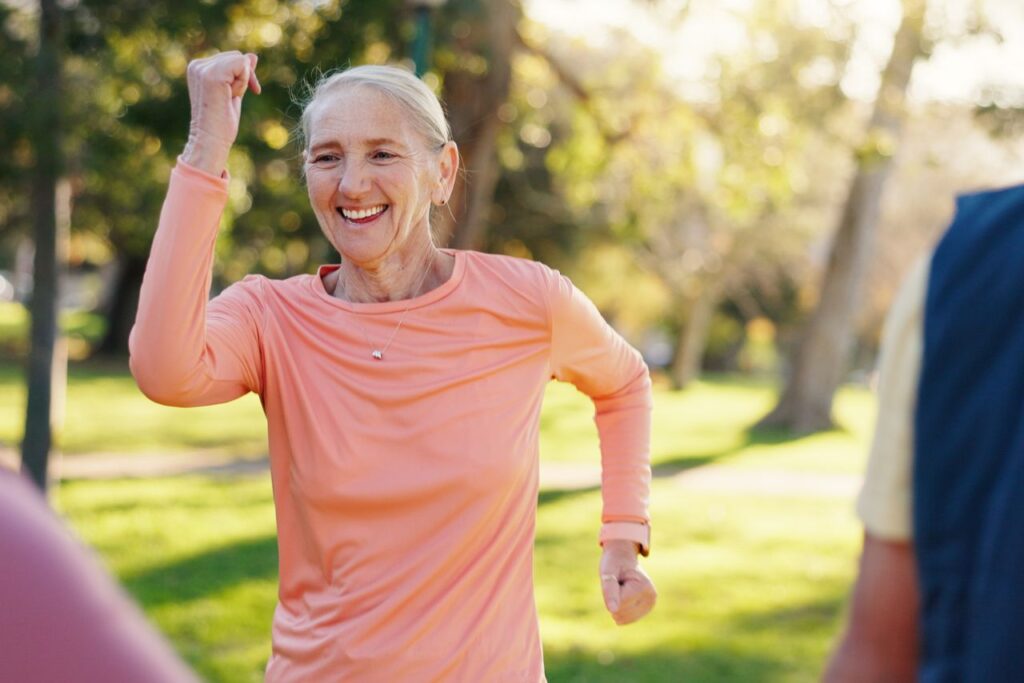
A complete power training for women over 50 session has four parts.
1. Gentle warm-up
Spend five to seven minutes on marching, light leg swings, and ankle circles. Your joints are prepared and your heart rate is raised gradually. Power work asks more of your nervous system than slow, steady strength training does. A proper warm-up matters.
2. Controlled-speed phase
This is the heart of the session. Try fast but controlled sit-to-stands, quick marching steps, and rhythmic step-ups. Each one should be performed with intentional speed while keeping your form clean.
3. Optional impact work
Add this step only once the controlled-speed phase feels confident. Try gentle heel drops or very small hops. This tool is used to build power, particularly for bone density. It is not required to benefit from power training. If you have osteoporosis or a joint concern, check with your doctor first. You can also skip this step entirely.
4. Cool-down
Finish with a few minutes of gentle stretching.
WATCH THIS: Master Your Balance at 50+ With This Quick Standing Workout
A Sample Beginner Session
A first power training for women over 50 session might look like this, such as five minutes of marching and ankle circles to warm up, followed by three rounds of ten controlled sit-to-stands, twenty seconds of quick marching on the spot, and ten slow, controlled step-ups on a low step or stair.
Finish with a few minutes of gentle stretching. The entire session takes around twenty minutes and requires no equipment beyond a sturdy chair and, if available, a single step.
As this becomes comfortable, gradually add speed to the sit-to-stands and step-ups. You can also introduce light impact options if appropriate for your body.
How power training fits with the rest of your routine
Power training for women over 50 is not meant to replace strength training, cardio, balance work, or mobility. It is one part of a complete picture.
Many women find it works best layered into an existing routine two to three times a week, on the same days as a shorter strength session, rather than as a separate standalone workout every day.
If you are also working through a structured strength program, you can find a full example in the Strength Training Blueprint for Women Over 50, which pairs naturally with the power work outlined here.
Common Concerns About Getting Started
Many women hesitate to begin power training for women over 50 because the word “power” sounds intense or athletic. In practice, the entry point is almost always gentler than expected.
If you are newly returning to exercise after time away, starting with strength training fundamentals for a few weeks before adding the speed component is a sensible, low-risk approach.
If you have a bone health diagnosis, you can modify or remove the impact portion of training. You still gain the reaction-time and capability benefits from the controlled-speed phase alone.
WATCH THIS: If You Don’t Train Your Legs After 50, This Happens (10-Min Lower Body Strength Workout)
Why Power Is One of the Fabulous50s Five Pillars of Longevity™
This research is exactly why we built Power into the Fabulous50s Longevity Protocol™ as one of the Fabulous50s Five Pillars of Longevity™, alongside Strength, Cardio, Mobility, and Balance.
The evidence shows it is one of the first physical qualities women lose as they age. This often happens years before strength or stamina shows any visible decline. Power is also one of the strongest predictors of staying capable and independent in the decades ahead.
Within the protocol, Power plays a specific role that the other four pillars do not fully cover. Strength builds the muscle and bone that carry you through daily life. Balance and Mobility keep you steady and free in your movement.
Power is what determines how quickly your body can respond when it matters most, the speed to catch yourself before a fall, the force to rise quickly from a chair, and the reaction time to step around an obstacle without thinking. Training it deliberately, alongside the other four pillars, is one of the most effective things a woman over 50 can do for her long-term independence.
This also means power training for women over 50 is never meant to be done in isolation. It works best as part of the full Fabulous50s Longevity Protocol™, layered alongside Strength, Cardio, Mobility, and Balance training throughout the week.
More Power Training Resources
- Power Training: The New Science Behind Longevity and Fall Prevention for Women Over 50
- A Guide to Power Training for Women Over 50
- Why You Need Strength and Power Training in Your Routine Over 50
- Strength Isn’t Enough: Why Women Over 50 Need Power Training Too
- How to Start Power Training Without Jumping
- How Power Training Helps You Stay Independent
- Is Power Exercise Safe After 50?
- Power Exercises That Help With Stairs, Trips, And Balance
- Fast Sit-to-Stands: A Simple Power Exercise After 50
- Beginner Power Exercises for Women Over 50
- Power Training vs. Strength Training: What’s the Difference?
- Strength Isn’t Enough: Why Women Over 50 Need Power Training Too
- Why You Need Strength and Power Training in Your Routine Over 50
- Power vs Strength: What Women Over 50 Need to Know
Final Thoughts
Power training for women over 50 fills a gap that strength training and cardio do not fully address on their own.
It is about training your body to respond quickly when it matters, whether that is catching yourself on a curb, rising fast from a low chair, or simply feeling capable and ready for whatever your day asks of you.
A gentle, consistent approach makes power training one of the most protective habits for women over 50.
Frequently Asked Questions
A form of exercise combining strength with speed, training how quickly your muscles can produce force rather than just how much force they can produce.
Yes. A 2025 Mayo Clinic Proceedings study and a 2022 JAMA Network Open meta-analysis are among the strongest pieces of evidence specifically comparing power to strength in older adults.
No. A sturdy chair is enough for a complete beginner routine.
Yes, with modification. The controlled-speed phase requires no impact, and any impact work should be guided by your doctor.
Two to three sessions a week of power training for women over 50 is enough to see meaningful improvement.
Strength training typically moves slowly and with control throughout. Power training deliberately adds speed once the movement pattern is mastered.
Many women notice improved confidence on stairs and quicker reactions within four to six weeks.