
For many women over 50, the word “power” can sound intimidating. It may bring to mind jumping, sprinting, box jumps, burpees, or movements that feel far too hard on the knees, hips, back, or pelvic floor. But power training does not have to begin there. In fact, for most women, it should not begin there.
Power is simply the ability to produce force quickly. It is what helps us stand up from a chair with ease, step onto a curb, catch ourselves if we trip, move quickly when we need to, and feel confident when life asks us to react.
Power is one of the missing pieces I didn’t fully understand until later in life. I realized that when I was younger, I was training power naturally by skipping, jumping, running for buses, moving quickly, and bounding up stairs, but as life changed and menopause made my joints more sensitive, I learned that power needed to be rebuilt in a safer, more progressive way.
That is the heart of Power as one of the Five Pillars of the Fabulous50s Longevity Protocol™. Power is not about athletic performance. It is about independence. It is about keeping the body responsive enough to move through life with confidence, especially when something unexpected happens. Power is one of the core pillars of longevity, alongside Strength, Cardio, Mobility, and Balance, because no single type of exercise can support every need of the midlife female body.
The safest way to begin is not by forcing the body to jump before it is ready. The safest way is to start small, build confidence first, and progress gradually.
Key Takeaways: Beginner Power Exercises
- Power is producing force quickly, and it fades faster than strength after 50.
- You do not need to jump. Beginners build power with small, controlled movements.
- The quick sit-to-stand is the safest and most useful starting exercise.
- Heel raises, side steps, and weight shifts train power gently and effectively.
- The rule is simple. Rise or move quickly, then lower slowly with control.
- Confidence comes first. Build it before you add speed, height, or repetitions.
- The Fabulous50s Vitality App guides these movements at a safe, progressive pace.
What You Should Know Before You Begin
A few gentle rules keep these exercises safe. First, do not jump an untrained body. Power is built progressively, the same way strength is. Confidence comes first, then capability follows.
Second, remember the golden tempo. In power training, you move quickly on the effort and slowly on the return. Rise fast, lower slow. That quick intention is what trains your fast-twitch fibers without any impact.
Third, set up for safety. Use a sturdy chair against a wall. Keep a countertop nearby to steady yourself. Wear supportive shoes and clear any rugs or clutter from your space.
A note on leaking: If you leak a little when you move quickly, that is very common. Reduce the intensity, make the movement smaller, and stay controlled. Over time you also train the muscles that support continence.
READ ALSO: A Guide to Power Training for Women Over 50
The Best Beginner Power Exercises After 50
Work through these at your own pace. You do not need to do all seven at once. Even two or three, practiced a few times a week, will start to rebuild your power.
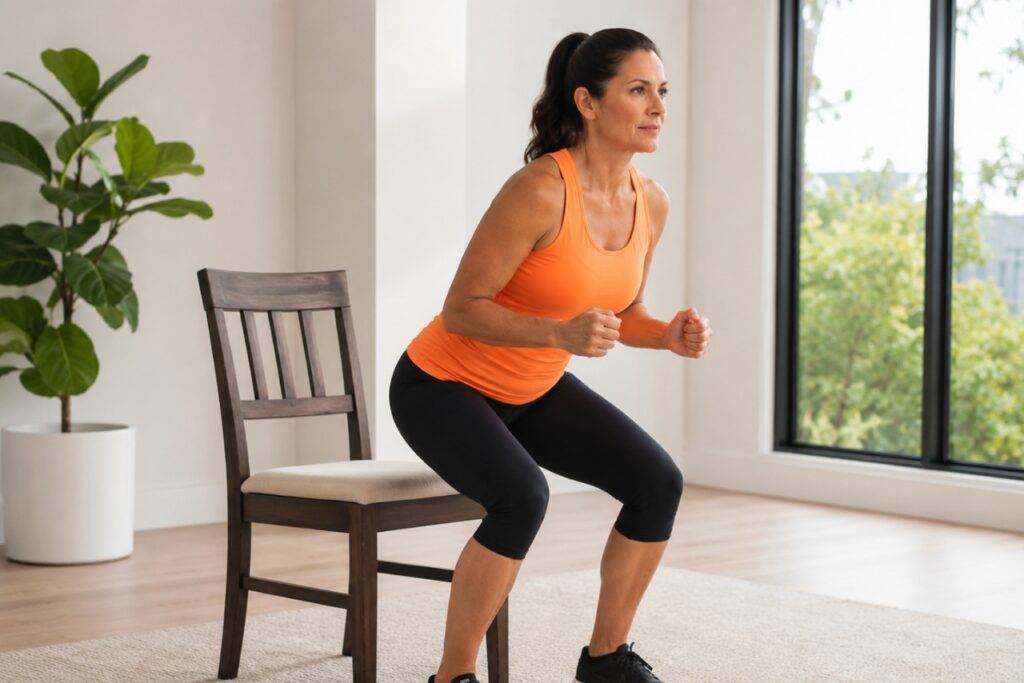
1. The quick sit-to-stand
This is your foundation move. It trains the exact pattern you use dozens of times a day. Research uses it in clinics to measure and improve lower-body power.
- Sit tall at the front of a sturdy chair, feet flat and hip-width apart.
- Cross your arms over your chest, or rest them lightly at your sides.
- Lean your chest slightly forward over your toes.
- Press through your heels and stand up quickly with energy.
- Lower yourself back down slowly, with full control. Repeat 6 to 8 times.
Make it easier: Add a cushion to raise the seat, or use your hands to help you rise.
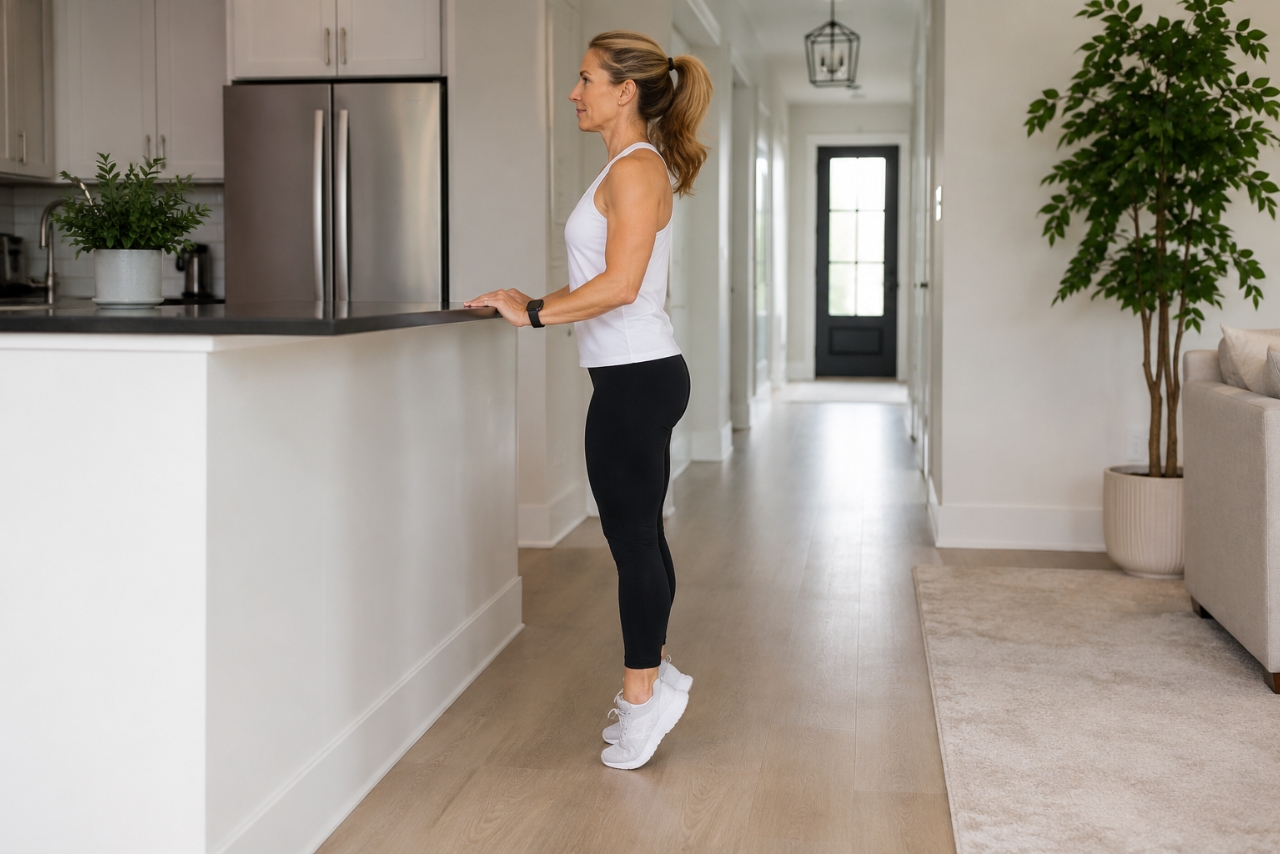
2. Quick heel raises
This gentle move builds calf power and trains your balance reflexes. It is one of the safest ways to add speed.
- Stand tall behind your chair, hands resting lightly on the back for support.
- Lift both heels off the floor as quickly as you can.
- Lower them slowly back down with control. Repeat 8 to 10 times.
Remember: The lift is quick, the lower is slow. That contrast is the whole point.
3. Heel drops
This is my favorite starting point. This teaches your body to absorb force gently, with no jumping at all.
- Stand tall, holding your chair for support if you like.
- Rise onto the balls of your feet, then let your heels drop softly to the floor.
- Feel your legs absorb that small, controlled force. Repeat 8 to 10 times.
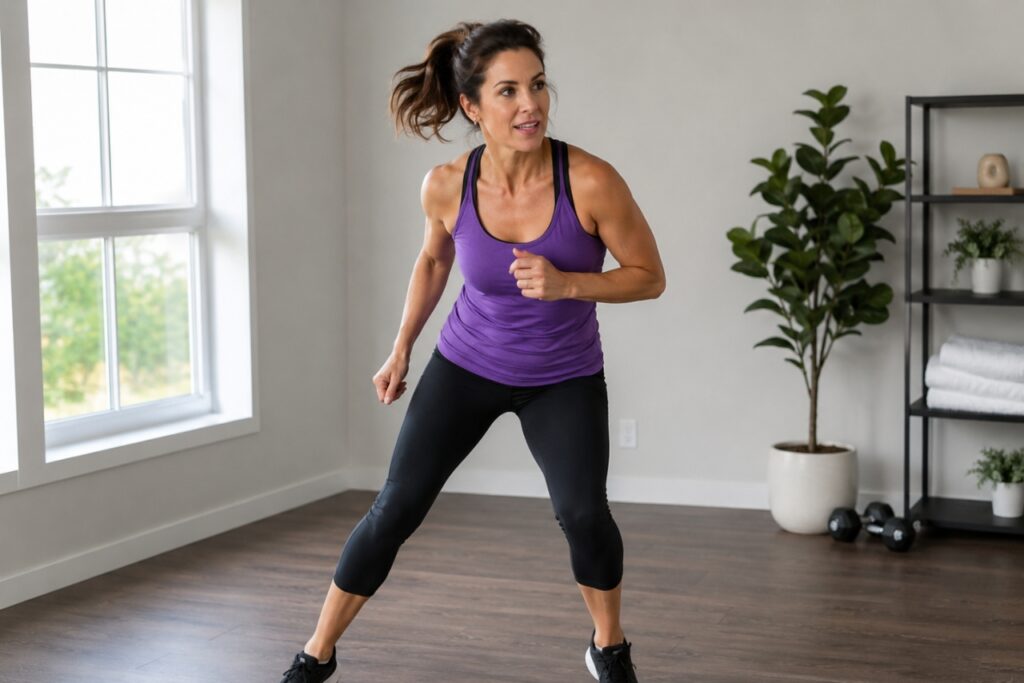
4. Quick side steps
Power is not only up and down. This move trains you to move sideways quickly, the way real life often demands.
- Stand tall with feet together, near a wall or counter for safety.
- Step quickly to the right, then bring your left foot to meet it.
- Step quickly back to the left. Keep the movement light and controlled. Repeat for 30 seconds.
5. Tiny floor bounces
This is the closest we come to jumping, and your toes never leave the floor. It gently reintroduces spring to your legs.
- Stand tall with soft knees, holding support if needed.
- Bounce gently through your knees and ankles, keeping your feet on the ground.
- Stay light and controlled. Repeat for 15 to 20 seconds.
Stay confident: If this feels like too much, return to heel drops. There is no rush.
6. Weight shifts with a quick return
This trains the reactive balance that catches you when you stumble. It is quietly one of the most useful drills here.
- Stand tall, feet hip-width apart, with support nearby.
- Shift your weight onto your right foot, then quickly return to center.
- Shift onto your left foot, then quickly return. Repeat 8 times each side.
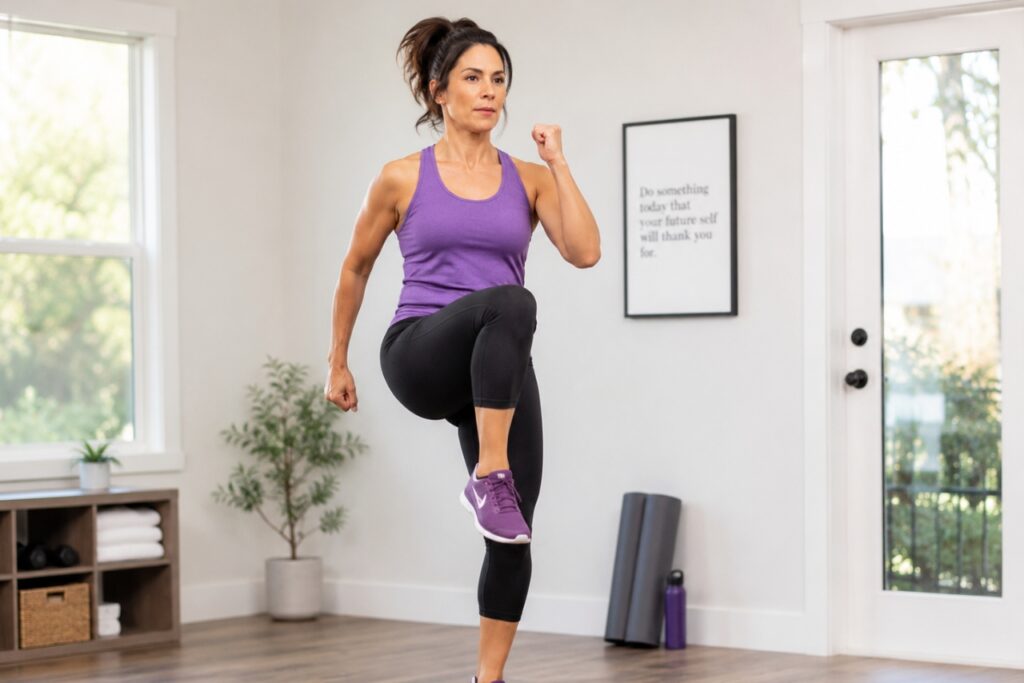
7. Fast marching in place
A joyful way to finish. This combines quick movement, coordination, and a gentle lift in your heart rate.
- Stand tall, support nearby if you want it.
- March in place, lifting each knee with a quick, light tempo.
- Swing your arms naturally as you go. March for 20 to 30 seconds.
READ ALSO: Best Exercises to Improve Balance and Prevent Falls After 50
How Often Should You Practice These?
Start small. Two short sessions a week is a wonderful place to begin. Consistency matters far more than intensity or length.
Pick two or three exercises and practice them for five to ten minutes. As they start to feel easy, add another movement or a few more repetitions. Progress happens gradually, and every small session counts.
If you prefer a seated start, chair-based movements are a gentle and effective way in. They build the same patterns with extra support underneath you. See Chair Exercises for Seniors for a full seated routine.
READ ALSO: Strength Isn’t Enough: Why Women Over 50 Need Power Training Too
Why Do These Gentle Movements Build Power?
It seems almost too simple. How can a quick heel raise matter as much as a box jump? The answer is in the intention behind the movement, not the height or the impact.
When you move quickly on purpose, you wake up your fast-twitch fibers. Those are the fibers we lose first after 50. You also teach your nervous system to react faster, which is what keeps you upright when you trip.
These movements teach your brain something powerful. I can still stay upright, I can still react and I can still move with confidence. That is what beginner power training is really about.
To go deeper on the science, read Power Training: The New Science Behind Longevity and Fall Prevention.
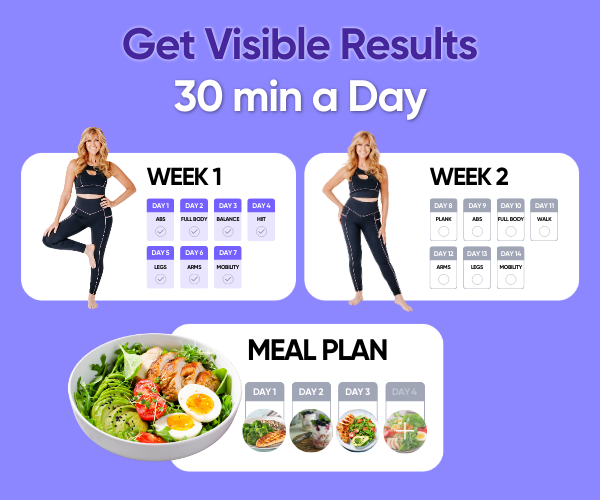
| Follow along, at your own pace, with the Fabulous50s Vitality App The Fabulous50s Vitality App is where you can follow guided workouts across Strength, Cardio, Mobility, Balance, and Power with modifications designed for women over 50. Start your 14-day free trial today and begin building the confidence, strength, and power your body needs for the years ahead. |
More Power Training Resources
- Power Training: The New Science Behind Longevity and Fall Prevention for Women Over 50
- A Guide to Power Training for Women Over 50
- Why You Need Strength and Power Training in Your Routine Over 50
- Strength Isn’t Enough: Why Women Over 50 Need Power Training Too
- How to Start Power Training Without Jumping
- How Power Training Helps You Stay Independent
- Is Power Exercise Safe After 50?
- Power Exercises That Help With Stairs, Trips, And Balance
- Fast Sit-to-Stands: A Simple Power Exercise After 50
- Power Training vs. Strength Training: What’s the Difference?
- Strength Isn’t Enough: Why Women Over 50 Need Power Training Too
- Why You Need Strength and Power Training in Your Routine Over 50
- Power vs Strength: What Women Over 50 Need to Know
Closing Thoughts
You do not need to jump, sprint, or do anything that frightens you. You simply need to move a little more quickly, a little more often, in ways that feel safe. That is how power returns.
Start with one exercise today. Maybe the quick sit-to-stand. Notice how it feels to rise with a little energy. Build confidence first, and capability will follow.
Frequently Asked Questions
That is correct. Jumping is only one way to train power, and it is never where a beginner should start. Quick, small movements like heel raises and fast sit-to-stands build power safely and effectively.
Begin with the quick sit-to-stand. It trains the most useful daily pattern and needs only a chair. Once it feels comfortable, add heel raises and side steps to your routine.
You do not need to rush or strain. Simply move with a little more speed and intention than usual on the effort. Then lower slowly with control. That contrast is what trains power.
Always keep a sturdy chair or countertop nearby for support. If a movement feels shaky, make it smaller or slower. Never train through dizziness or sharp pain, and rest when you need to.
It is never too late. Research shows older adults can rebuild power and mobility at any age. Your body adapts when you train it gently and consistently, one small session at a time.
Many women feel steadier and more confident within a few weeks. Rising from chairs and climbing stairs often start to feel easier. Small, regular practice creates real, lasting change.
Balachandran, A.T., et al. “Comparison of Power Training vs Traditional Strength Training on Physical Function in Older Adults: A Systematic Review and Meta-analysis.” JAMA Network Open, 2022. https://jamanetwork.com/journals/jamanetworkopen/fullarticle/2792175
El Hadouchi, M., et al. “Effectiveness of Power Training Compared to Strength Training in Older Adults: A Systematic Review and Meta-analysis.” European Review of Aging and Physical Activity, 2022. https://pmc.ncbi.nlm.nih.gov/articles/PMC9367108/
Reid, K.F., and Fielding, R.A. “Skeletal Muscle Power: A Critical Determinant of Physical Functioning in Older Adults.” Exercise and Sport Sciences Reviews, 2012. https://pmc.ncbi.nlm.nih.gov/articles/PMC3245773/
Fragala, M.S., et al. “Resistance Training for Older Adults: Position Statement From the National Strength and Conditioning Association.” Journal of Strength and Conditioning Research, 2019. https://pubmed.ncbi.nlm.nih.gov/31343601/
Khowailed, I.A., et al. “Stress Incontinence During Different High-Impact Exercises in Women: A Pilot Survey.” International Journal of Environmental Research and Public Health, 2020. https://www.mdpi.com/1660-4601/17/22/8372
Pires, T., et al. “Prevalence of Urinary Incontinence in High-Impact Sport Athletes: A Systematic Review and Meta-analysis.” Journal of Human Kinetics, 2020. https://pmc.ncbi.nlm.nih.gov/articles/PMC7386138/