


There is a little posture check I love doing now. I simply stand tall, soften my shoulders, and notice where my head naturally wants to sit. Is it floating gently over my spine, or has it crept forward without me realizing? Are my shoulders open, or have they rounded in as if I have been protecting myself from the day?
Most of us do not suddenly wake up with a stiff neck and rounded upper back. It happens slowly. We look down at our phones, and sometimes we sit at computers. We drive, and we also lean forward to read, cook, text, scroll, and work. Then one day, we catch our reflection and realize our posture has changed.
This is why neck and upper back mobility matters so much after 50. It is not about standing perfectly or holding ourselves rigidly. It is about giving the body enough movement, strength, and awareness to come back to a more open, comfortable position.
Mobility is freedom. When the neck, shoulders, and upper back move well, we can turn, reach, breathe, walk, exercise, and carry ourselves through life with more ease.
Key Takeaways: Neck and Upper Back Mobility
- Neck and upper back mobility can help ease stiffness and support better posture after 50.
- Forward head posture and rounded shoulders often develop gradually through sitting, screen time, and reduced movement.
- The neck, upper back, shoulders, ribs, and shoulder blades all work together.
- Gentle mobility is more useful than forcing the body into a “perfect” posture.
- Simple exercises like chin tucks, shoulder rolls, chest openers, wall angels, and thoracic rotations can help.
- A few minutes a day can make posture feel more natural and less strained.
- Never force the neck. Move gently, breathe, and stay within a comfortable range.
Why Does Posture Change After 50?
Posture changes for many reasons. Some are related to age, but many are related to habits repeated over years.
When we sit for long periods, look down at screens, or round forward through the shoulders, the body adapts. The chest can feel tight, the upper back can become stiff, and the head may begin to sit slightly forward of the body. Harvard Health recommends screen-time posture habits such as keeping the monitor just below eye level, sitting with the head level rather than bent forward, and keeping the shoulders relaxed.
Forward head posture is often discussed because it can be linked with neck discomfort. A systematic review found that adults with neck pain showed more forward head posture than adults without symptoms and that the relationship was especially relevant in adults and older adults.
This does not mean posture is something to fear. It simply means the body needs variety. We are not designed to hold one position all day. We are designed to move, reach, rotate, lengthen, breathe, and reset.
READ ALSO: Better Posture Workout For Women Over 50
Why Do The Neck And Upper Back Matter So Much?
The neck and upper back are part of the same beautiful system.
If the upper back becomes stiff and rounded, the neck often has to compensate. Similarly, if the chest becomes tight, the shoulders may roll forward. If the shoulder blades do not move well, the neck can begin to carry more tension. This is why neck and upper back mobility works best when we do not treat the neck as the only problem.
Research on age-related hyperkyphosis, which is an increased rounding of the upper back, suggests that exercise can be an acceptable intervention, with several studies showing improvements in at least one measure of posture. A more recent review also found that therapeutic exercises can improve forward head posture, rounded shoulders, and thoracic kyphosis angles.
And what that means for us is encouraging. We are not stuck in the posture we have today. With gentle, consistent movement, the body can learn to open again.
The Best Neck and Upper Back Mobility Exercises
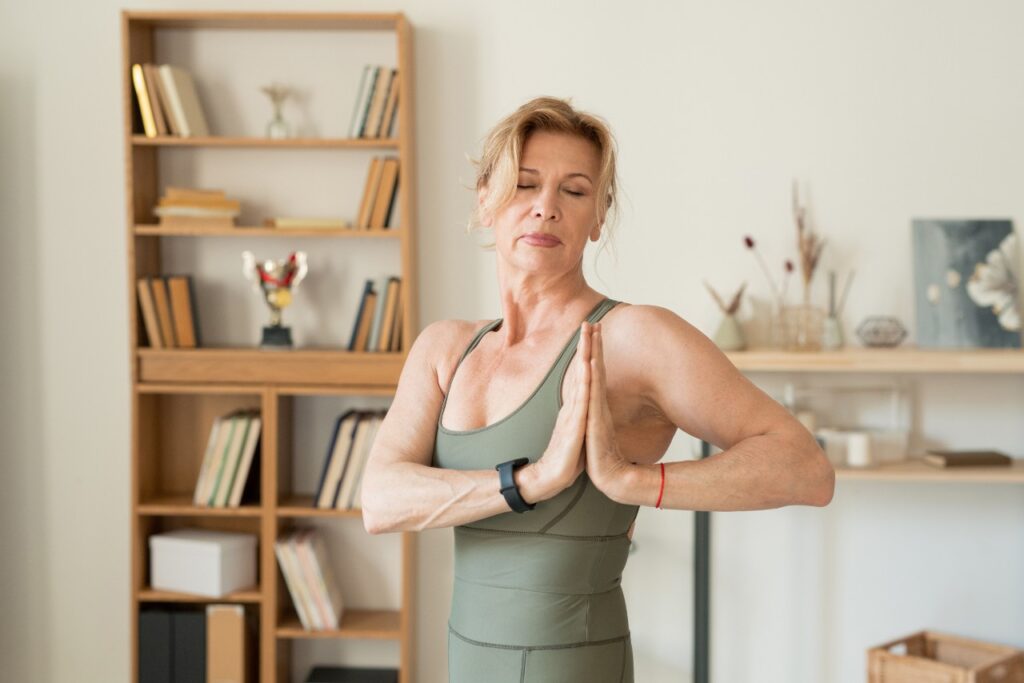
The best exercises are simple, controlled, and kind. We are not yanking the neck or forcing the shoulders back. We are inviting the body into more space.
1. Chin tucks
Sit or stand tall. Imagine gently sliding your head straight back, as though you were making a soft double chin. Keep your eyes level and your jaw relaxed. Hold for a breath, then release.
This helps remind the head where the center is. It should feel gentle, not forced. If it feels uncomfortable, make the movement smaller.
2. Shoulder rolls
Roll your shoulders up, back, and down slowly. Then reverse the direction.
This is one of the simplest ways to begin because it wakes up the shoulders, neck, and upper back without needing any equipment. It is especially helpful after sitting or screen time.
3. Shoulder blade squeezes
Sit or stand with your arms relaxed. Gently draw your shoulder blades toward each other, then release. Keep your shoulders down and your neck soft.
This helps activate the upper back. The goal is not to pinch hard. The goal is to gently remind the back body to participate in your posture.
4. Chest opener
Stand tall and clasp your hands behind your back, or hold a towel if clasping feels uncomfortable. Gently open your chest and breathe.
Modern life pulls us forward, so chest opening can feel wonderful. Keep it easy. We are looking for space, not strain.
5. Wall angels
Stand with your back against a wall if that feels comfortable. Bring your arms out to the sides and slowly slide them upward and downward, staying within a pain-free range. The Cleveland Clinic includes wall angels among posture exercises that support sitting and standing taller.
This exercise helps the shoulders, upper back, and posture work together. If your arms do not touch the wall, that is completely fine. Start where your body is.
6. Seated upper back rotation
Sit tall in a chair. Cross your arms over your chest or place your hands lightly on your shoulders. Slowly rotate your upper body to one side, return to center, then rotate to the other side.
The upper back is meant to rotate. When it gets stiff, turning can become harder and the neck may try to do too much. Move slowly and breathe.
7. Cat-cow
Come onto hands and knees, or do this seated with your hands on your thighs. Gently round the back, then gently lift the chest and lengthen the spine.
This helps bring movement into the whole spine. Keep the range small and smooth, especially first thing in the morning.
8. Thread-the-needle
On hands and knees, slide one arm under the other and gently rotate through the upper back. Rest only as far as feels comfortable, then return to the center and repeat on the other side.
If the floor is not right for you, use a table or chair version. The point is gentle rotation, not forcing the body into a shape.
READ ALSO: Best Mobility Exercises for Stiff Joints After 50
How Can This Help With Better Posture After 50?
Better posture is not about pulling the shoulders back all day. That becomes tiring very quickly.
Better posture comes from giving the body the mobility and support to find a more natural position. When the upper back can move, the chest can open, the shoulder blades can glide, and the neck can sit more comfortably over the spine.
The Fabulous50s Longevity Protocol includes Mobility as one of the key movement pillars because mobility supports freedom of movement, flexibility, joint comfort, posture, and daily function. That is exactly what we are doing here. We are not chasing perfect posture. We are supporting daily function.
When posture improves, we may notice that walking feels more confident, breathing feels easier, and the body feels less collapsed. We may also feel more open emotionally, because the way we hold the body often affects how we feel in the world.
READ ALSO: The Difference Between Flexibility and Mobility After 50
How Often Should We Practise Neck And Upper Back Mobility?
A little and often is the most realistic approach.
The CDC recommends that adults 65 and older include aerobic activity, muscle-strengthening activity, and activities to improve balance each week. For mobility, we can think of this as part of the wider rhythm of staying capable. The NHS also recommends that older adults do some form of physical activity every day and include activities that improve strength, balance, and flexibility at least twice weekly.
For the neck and upper back, five minutes a day can be a beautiful place to begin. You might do chin tucks and shoulder rolls after brushing your teeth, a chest opener after screen time, or upper back rotations before a walk.
The body responds to regular reminders. We do not need to overwhelm it. We simply need to keep inviting it back into movement.
What Should We Avoid?
The neck is sensitive, so we want to be gentle.
Avoid forcing the head into extreme positions. Don’t make neck circles if they make you dizzy or uncomfortable. Avoid pushing into pain, numbness, tingling, or any symptoms that travel down the arm.
A stretch should feel like gentle tension, not sharp pain. If a movement feels wrong, make it smaller or stop.
This is especially important if you have osteoporosis, severe arthritis, dizziness, a history of neck injury, nerve symptoms, headaches that are new or worsening, pain after a fall, or pain that travels into the arm or hand. In those cases, please speak with a qualified healthcare professional.
Mobility is not about pushing through. It is about listening well.
How Can We Begin This Week?
Choose three exercises: chin tucks, shoulder rolls, and seated upper back rotations. Practise them for five minutes a day for one week.
Before you begin, notice how your posture feels. Is your head forward? Are your shoulders rounded? Does your upper back feel stiff? Can you turn your head comfortably?
After your practice, take note of the changes again. Check if your neck feels lighter. You may also feel your chest is more open. You’ll notice the small change, and you should feel proud that you showed up.
That counts.
This is also why the Fabulous50s Vitality App is such a beautiful next step. Inside the app, mobility becomes part of a complete longevity rhythm alongside strength, cardio, balance, power, recovery, and community support. You do not have to guess what to do next. You can choose a gentle mobility or stretching session and let me guide you step by step.
Every stretch is a deposit in your independence. Start your 14-day free trial of the Fabulous50s Vitality App today and take your first gentle step toward moving with more freedom.
Keep Moving With These
Low-Impact Osteoporosis Exercises for Women Over 50
Why You Feel Stiff After 50 and What to Do About It
Best Stretching Exercises for Arthritis to Reduce Pain and Stiffness
The 5 Ultimate Workouts Every Woman Over 50 Should Do
Relieve Hip Pain Fast! 8 Powerful Hip Exercises to Improve Flexibility & Mobility
Effective Stretching Workouts to Improve Your Flexibility & Mobility
Top 5 Mobility Exercises For Women Over 50
An Easy 8-Minute Mobility and Flexibility Workout for Women Over 50
5 Minute Hip Mobility Workout For Women Over 50
8 Powerful Hip Exercises to Improve Flexibility & Mobility
Chair Exercises for Seniors: Gentle Seated Workouts for Women Over 50
Final Thoughts
Your posture is not something to criticize. It is something to support.
After 50, the neck and upper back may need more regular care because modern life asks us to look down, sit still, and round forward far too often. But with a few gentle movements, we can remind the body that it still knows how to open, lengthen, rotate, and move with ease.
Start small. Roll your shoulders. Soften your jaw. Lift through the crown of your head. Breathe.
Neck and upper back mobility is not about perfection. It is about feeling more comfortable, capable, and free in the body you live in every day.
Frequently Asked Questions
Chin tucks, shoulder rolls, shoulder blade squeezes, chest openers, wall angels, seated upper back rotations, cat-cow, and thread-the-needle are gentle exercises that can help.
Yes. Mobility can help the upper back, shoulders, chest, and neck move more freely, which may support a more comfortable and upright posture.
Looking down or leaning forward for long periods can increase tension through the neck, shoulders, and upper back. Regular movement breaks and gentle mobility can help.
Five minutes most days is a helpful place to begin. Keep the movements gentle and consistent.
Slow, small movements may feel fine for some women, but full neck circles can feel uncomfortable or dizzying for others. Gentle chin tucks, side turns, and shoulder rolls are often safer starting points.
Yes. The shoulders and upper back work together. When the upper back moves better, shoulder movement often feels easier too.
Seek professional advice if you have severe pain, pain after a fall, numbness, tingling, weakness, pain traveling down the arm, dizziness, worsening headaches, or symptoms that do not improve.
Sources
- Harvard Health Publishing. Stretch to ease screen-time-related neck and shoulder pain. https://www.health.harvard.edu/healthbeat/stretch-to-ease-screen-time-related-neck-and-shoulder-pain
- Mahmoud NF, et al. The relationship between forward head posture and neck pain: a systematic review and meta-analysis. https://pubmed.ncbi.nlm.nih.gov/31773477/
- Sepehri S, et al. The effect of various therapeutic exercises on forward head posture, rounded shoulder, and thoracic hyperkyphosis. https://pubmed.ncbi.nlm.nih.gov/38302926/
- Bansal S, et al. Exercise for improving age-related hyperkyphotic posture. https://pubmed.ncbi.nlm.nih.gov/23850611/
- CDC. Older Adult Activity: An Overview. https://www.cdc.gov/physical-activity-basics/guidelines/older-adults.html
- NHS. Physical activity guidelines for older adults. https://www.nhs.uk/live-well/exercise/physical-activity-guidelines-older-adults/
- Cleveland Clinic. 8 Posture Exercises To Sit and Stand Straighter. https://health.clevelandclinic.org/posture-exercises